Legal CBD website: 7 disclosures to check before ordering
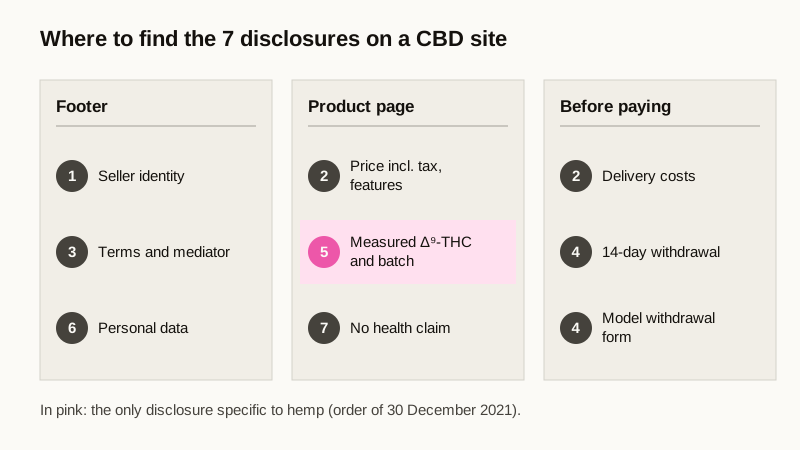
Selling CBD online in France is governed by ordinary distance-selling law, plus one text specific to hemp. A serious website shows seven pieces of information you can verify: the seller's identity, price and features, terms of sale, the 14-day withdrawal right, Δ⁹-THC content with its batch, personal data, and no health claims. You can check each one in a few clicks, with the legal text to hand.

Key takeaways
- Six of the seven points rest on general consumer and digital law; none of them is specific to CBD.
- The seventh rests on the French order of 30 December 2021, which caps the product at 0.30% Δ⁹-THC.
- You have 14 days to withdraw, and any exception has to be announced before you order.
- A shop selling CBD oils or sweets "to swallow" disregards the French agriculture ministry's position of 20 May 2026.
- Claiming a health effect counts as a misleading commercial practice.
Where these obligations come from
Three sets of texts apply to a French online shop. Under the 2004 law on confidence in the digital economy, known as LCEN, the seller's identity and contact details must be accessible. The consumer code covers pre-contract information, price, terms and conditions and the right of withdrawal. The General Data Protection Regulation (GDPR) fixes what the website has to say about the data it collects.
Hemp itself is the subject of a single text, the order of 30 December 2021. It authorises varieties listed in the official catalogues whose Δ⁹-THC content does not exceed 0.30%, and extends the same cap to extracts and to the products that contain them. On 29 December 2022, the Conseil d'État, France's highest administrative court, struck down the ban on selling raw flowers and leaves and kept this limit in place.
The 7 disclosures and their legal basis
| # | What the website must show | Legal basis | Where to find it |
|---|---|---|---|
| 1 | Seller identity: company name, address, email, phone, registration number, share capital, VAT number | LCEN, art. 19 and 1-1 | Footer, "Legal notice" |
| 2 | Essential features and price including tax, delivery costs stated | Consumer code, art. L111-1; LCEN, art. 19 | Product page, basket |
| 3 | Terms and conditions, pre-contract information, consumer mediator | Consumer code, art. L221-5 | Terms of sale |
| 4 | 14-day withdrawal right, model form, any exceptions | Consumer code, art. L221-18, L221-24, L221-28 | Terms of sale, order confirmation |
| 5 | Measured Δ⁹-THC content and batch number | Order of 30 December 2021, art. 1 | Product page |
| 6 | Information on personal data | GDPR, art. 13 | Privacy policy |
| 7 | No claim of a health effect | Consumer code, art. L121-2 | Product pages, blog, featured reviews |
Point 5 calls for a clarification. The order sets the limit a product must respect, and by itself it does not require any percentage to be published. Yet without the measured value and the matching batch, a buyer has no way to check compliance. This point is what sets a CBD website apart from an ordinary shop.
The points most often left incomplete
The seller's identity
Article 19 of the LCEN requires "easy, direct and permanent access" to the following: name or company name, address, email address and phone number, plus, for a registered company, the registration number, share capital and registered office. A seller liable for VAT must also give the intra-EU VAT number. Since May 2024, article 1-1 of the same law has added the name of the publication director and the host's name, address and phone number.
The page usually exists; it is just incomplete. A contact form is no substitute for an email address or a phone number, and a company name with no registration number cannot be checked against any register.
Terms of sale and the mediator
Article L221-5 lists what the seller has to tell you before you order: features, price, delivery time, identity, guarantees, how to withdraw using the model form, and the possibility of turning to a consumer mediator. If a website names no mediator, the buyer has no identified way to settle a dispute out of court.
Withdrawal and its exceptions
Article L221-18 allows 14 days, counted from receipt of the goods, to withdraw from a distance purchase without giving a reason. Within the next 14 days, the seller refunds everything, delivery costs included (article L221-24).
Article L221-28 contains two exceptions that may concern hemp: goods liable to deteriorate or expire quickly (4°), and unsealed goods that cannot be returned for reasons of hygiene or health protection (5°). A seller who relies on them has to say so before the order. If you only learn of the exception afterwards, in an email refusing the return, take it as a red flag.
THC content and the batch
"Compliant with the law" is a claim with no measurement behind it. What you can verify is a pair, a Δ⁹-THC value and a batch number, tied to a certificate of analysis. Our guide to reading a certificate of analysis shows how to link the two, and the article on the 0.30% limit explains what that figure covers.
What hemp adds: three red flags
Certain products rule a website out on their own, however complete its legal notice.
The first red flag is a cannabinoid classified as a controlled drug. HHC has been one since 13 June 2023. According to the French medicines agency, ANSM, H4CBD, THCP and other derivatives have been since 3 June 2024. A website that still sells them, sometimes under a new acronym, operates outside the legal framework.
The second is CBD to swallow. On 20 May 2026, the French agriculture ministry restated that foods containing CBD are not authorised under the novel food regulation, food supplements included. The rule covers gummies, chocolates and oils presented as food. Our overview of CBD regulation in 2026 describes where things stand.
The third is a health claim. Article L121-2 of the consumer code classes as misleading any practice resting on false or misleading claims about a product's properties and the results to expect from using it. Epidyolex, dispensed on prescription, is the only authorised CBD-based medicine. Our article on advertising CBD products sets out the penalties.
Checking a website in five minutes
- From the footer, open the legal notice. Write down the company name and SIREN number and look them up in a public business register.
- Make sure the site gives an email address and a phone number, beyond a contact form.
- Search the terms of sale for "withdrawal" (« rétractation »). You should find at least 14 days, a model form and any exceptions spelled out.
- Find the name of a consumer mediator.
- On a product page, locate the price including tax, the Δ⁹-THC content and a batch number.
- Read through the product pages for any claimed effect on the body and any product meant to be swallowed.
Take the Phytogrammes catalogue as an example. The Skunk page shows a reference profile tied to batch PG-26-7188 and a per-gram price scale (checked on 23 September 2026), and no laboratory certificate is published for it. The legal notice page lists the company name, legal form, share capital, registered office, SIREN, VAT number, publication director and hosts. Practical questions are gathered in the FAQ.
What no text requires
Three disclosures are often presented as mandatory, yet the texts cited here either do not provide for them or do not use the usual wording.
- No text sets a general minimum age for CBD as such; the rule depends on the format. A CBD e-liquid is a vaping product and may not be sold to under-18s. For flowers and resins, "adults only" is a shop practice as the texts currently stand. Each case is covered in our article on CBD and the legal age.
- France has no public quality label for CBD. A certificate of analysis from an accredited laboratory, tied to a batch, is what counts.
- The phrase "not for ingestion" reflects the status of extracts under food law, yet none of the texts cited here requires it on the website.
Frequently asked questions
Look at the seller's identity and registration, the terms of sale with the 14-day withdrawal right, the Δ⁹-THC content and batch on each product page, and make sure no health claim appears. Avoid any website that sells HHC, H4CBD or CBD to swallow.
Yes, if the seller is registered. Under article 19 of the LCEN, the registration number, share capital and registered office address must be accessible.
In principle, yes: you have 14 days and need give no reason. Article L221-28 allows exceptions, among them unsealed goods that cannot be returned for hygiene reasons, and the seller must announce them before you order.
No. Crediting a product with health properties or results it has not been shown to have falls under article L121-2 of the consumer code. A therapeutic effect may be claimed only for an authorised medicine.
A Δ⁹-THC value of no more than 0.30%, the limit that the order of 30 December 2021 sets for varieties and extracts alike. The Conseil d'État upheld it in December 2022.
Written by the Phytogrammes team
Each journal article draws on cited primary sources: ANSM, EFSA, EUR-Lex and peer-reviewed publications. Product profiles are distinguished from documented laboratory results. Our approach.
Article published on . CBD is not a medicine.