Legal THC limit in France: 0.3%, measured on what?
In France, the THC limit for hemp and for products made from it is 0.30% Δ⁹-tetrahydrocannabinol at most, under the order of 30 December 2021. The percentage describes the plant and the product, as measured in a laboratory: it says nothing about what a saliva test finds in a driver. The figure itself comes from a botanical criterion published in 1976, not from an effect threshold.
Contents
- 01The threshold: 0.30% Δ⁹-THC, plant and products
- 02Where the figure comes from: a botanists' criterion turned farm rule
- 032020 to 2022: four decisions that set today's framework
- 04How the threshold is measured, and the THCA trap
- 05What the threshold does not cover: driving
- 06What the threshold does not cover: controlled molecules and food
- 07Frequently asked questions
> Key takeaways > > - The threshold is 0.30% Δ⁹-THC, for the cultivated variety as well as for extracts and finished products. > - The order's official method measures THC by gas chromatography, with a tolerance of 0.03 points. > - Heated inside the instrument, THCA turns almost entirely into THC: a flower rich in THCA can exceed the limit under the official method. > - Behind the wheel the threshold protects nobody: the mere presence of THC in saliva or blood is enough for the offence. > - HHC, H4CBD and THCP are controlled drugs, whatever the THC content of the product.
The threshold: 0.30% Δ⁹-THC, plant and products
The reference text is the order of 30 December 2021, in its current version. Its article 1 authorises "the cultivation, import, export and industrial and commercial use only of varieties of Cannabis sativa L. whose delta-9-tetrahydrocannabinol content is not higher than 0.30%". The variety must also appear in the EU common catalogue or the French catalogue. The order applies the same 0.30% limit to hemp extracts and to the products that contain them.
Two conditions therefore apply together. The first concerns genetics: a listed variety, grown from certified seed by an active farmer. The second concerns the result: a product under 0.30% Δ⁹-THC. A flower within the limit but from an unlisted variety does not meet the text. Our article on the varieties in the EU catalogue explains how a variety gets listed.
Δ⁹-THC is the form of THC that produces the psychoactive effect. The difference with CBD, which has none, is covered in THC and CBD: the differences.
Where the figure comes from: a botanists' criterion turned farm rule
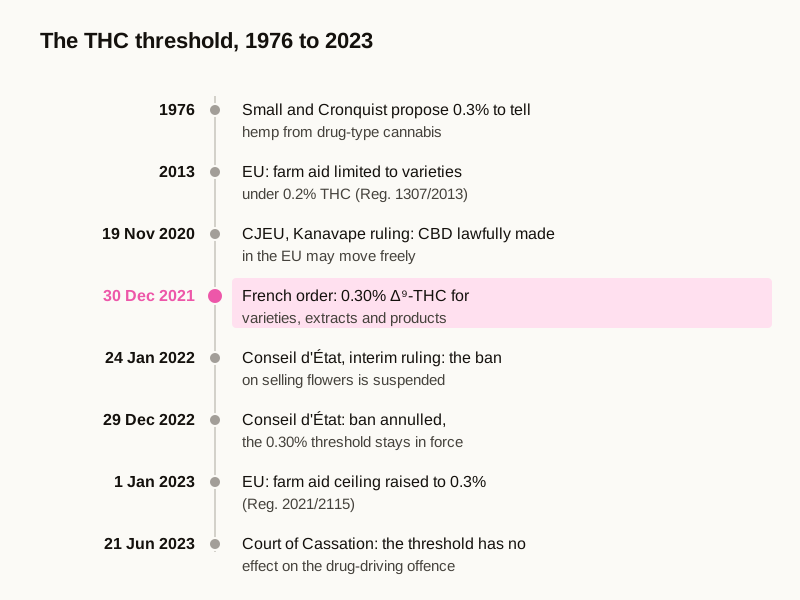
The 0.3% figure was not calculated from any effect on humans. In 1976, the Canadian botanists Ernest Small and Arthur Cronquist proposed it to classify Cannabis sativa plants: above it, the "drug" type; below it, hemp. The Canadian Food Inspection Agency notes that this dividing line is still the reference in North America.
For a long time the European Union used a lower figure for its farm aid. Article 32 of Regulation (EU) No 1307/2013 only accepted hemp areas if the varieties had a THC content "not exceeding 0.2%". Regulation (EU) 2021/2115, which has governed the common agricultural policy since 1 January 2023, raised that ceiling to 0.3% in its article 4. The French order of December 2021 set 0.30% from the day it was published.
Pages that still mention 0.2% are therefore describing the rule from before 2022.
2020 to 2022: four decisions that set today's framework
On 19 November 2020, the Court of Justice of the European Union delivered the Kanavape ruling (C-663/18). It held that a member state cannot ban the sale of CBD lawfully produced in another member state, except on a proportionate public health ground. At paragraph 76, it found that including CBD in the definition of narcotic drugs under the 1961 Convention would run against the spirit of that text, since CBD has no known psychoactive effect. Our article on the Kanavape ruling sets out its reach.
The order of 30 December 2021 drew the consequences of that ruling while banning the sale of raw flowers and leaves to consumers. The Conseil d'État's interim relief judge suspended that ban on 24 January 2022. On 29 December 2022, the Conseil d'État annulled it: it found no evidence that flowers under 0.30% Δ⁹-THC carry a risk that would justify a general and absolute ban. The rest of article 1, including the threshold, stayed in force. The episode is told in our article on the order that tried to ban flowers.
How the threshold is measured, and the THCA trap
The annex to the order describes the method for checking crops. The sample is dried to constant weight, then analysed by gas chromatography with a flame ionisation detector. The result is expressed in grams of Δ⁹-THC per 100 grams of sample, to two decimal places, and it "carries a tolerance of 0.03% in absolute value". When a result is high, the stricter procedure samples the top third of 200 plants.
The living plant mostly contains THCA, the acid form of THC, which has no psychoactive effect until it is heated. Gas chromatography heats the sample. A 2022 study in Frontiers in Chemistry reproduced the conditions of the official method, with an injector at 300 °C: almost all the THCA turns into THC. The figure obtained is therefore close to "total THC".
Most CBD certificates of analysis are produced by liquid chromatography (HPLC), which does not heat the sample and separates the two forms. They show one Δ⁹-THC line and one THCA line. To estimate total THC, the standard formula is Δ⁹-THC + 0.877 × THCA. The 0.877 factor corrects for the mass lost when THCA releases its carboxyl group.
| HPLC certificate line | Example flower | What to take from it |
|---|---|---|
| Δ⁹-THC | 0.12% | Under the limit on its own |
| THCA | 0.40% | Turns into THC with heat |
| Estimated total THC | 0.12 + 0.877 × 0.40 = 0.47% | Above 0.30%, even with the tolerance |
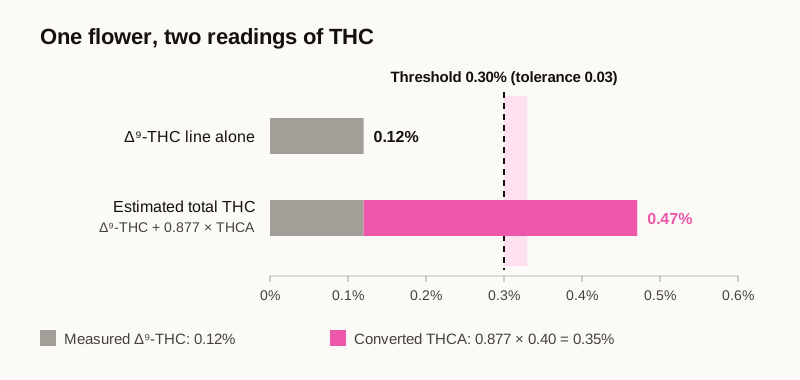
For any product, read both lines, not just the first. Our guide to reading a certificate of analysis goes through each line, and the page on THCA explains its chemistry. The laboratory page describes the measurement methods.
What the threshold does not cover: driving
The 0.30% threshold describes a product. It creates no tolerance for the person who uses it. Article L235-1 of the Highway Code punishes driving when a blood or saliva test shows use of a controlled drug with three years in prison and a €9,000 fine. On 21 June 2023, the Court of Cassation ruled that permission to sell products under 0.30% THC has no bearing on this offence, which is made out whatever the dose taken.
A compliant hemp product can contain traces of THC, and a saliva test detects the molecule, not the percentage in the original product. Our guide to CBD and saliva testing gives the known detection windows.
What the threshold does not cover: controlled molecules and food
A product under 0.30% Δ⁹-THC is not legal if it contains a controlled molecule. The ANSM added HHC, HHCO and HHCP to the list of controlled drugs from 13 June 2023, then H4CBD, THCP and other derivatives from 3 June 2024. Our pages on HHC and H4CBD describe these molecules.
Nor does the threshold say anything about food law. A CBD product meant to be swallowed falls under the EU regulation on novel foods, and foods containing CBD are not authorised in France. The full picture is in our article on CBD regulation in 2026.
Frequently asked questions
What is the legal THC limit in France?
0.30% Δ⁹-THC, for the hemp variety grown as well as for extracts and finished products, under the order of 30 December 2021. The variety must also appear in the EU or French catalogue.
Does the 0.3% apply to my body after use?
No. The threshold describes the product, as measured in a laboratory. A saliva or blood test looks for the presence of THC, and detecting it is enough for the offence of driving after drug use.
Why do some sites say 0.2%?
That was the ceiling for EU farm aid until 2022, set by Regulation No 1307/2013. Since 1 January 2023, Regulation 2021/2115 uses 0.3%, and the French order has set 0.30% since December 2021.
Does THCA count towards the limit?
The text targets Δ⁹-THC, but the official method heats the sample, which turns almost all the THCA into THC. On an HPLC certificate, calculate Δ⁹-THC + 0.877 × THCA to see where the product stands.
Will the 0.3% threshold change?
As of 22 September 2026, the version of the order in force still states 0.30%. European debates about raising it do not change French law until a new text is published.
Written by the Phytogrammes team
Every article in this journal draws on primary sources (ANSM, EFSA, EUR-Lex, peer-reviewed publications) and on the lab's own practice: batch-by-batch HPLC analyses, measured cannabinoid profiles. Our approach.
Article published on . CBD is not a medicine.