THCA (THC acid): the raw form of THC, heat and French law
THCA, or tetrahydrocannabinolic acid, is the form in which the plant makes THC: in a raw flower, it accounts for up to 90% of total THC. On its own it produces no psychoactive effect, but heat turns it into THC. In France, it is not banned in compliant hemp: the ANSM decision of 3 June 2024 excludes it from the list of controlled drugs as long as the THC content respects the 0.3% threshold. It does, however, count towards that threshold, because the official method heats the sample.
Contents
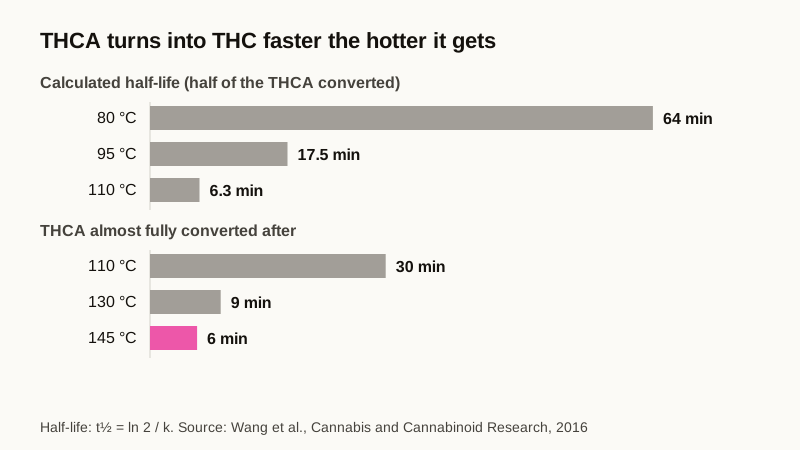
> Key takeaways > > - The plant makes THC in the form of THCA, which turns into THC when heated. > - At 110 °C, half of the THCA is gone in about 6 minutes; at 145 °C, almost none is left after 6 minutes. > - The ANSM classified THC derivatives in 2024, then excluded THCA present in hemp whose THC content respects 0.3%. > - The official measurement method heats the sample to 300 °C: THCA is almost entirely counted as THC. > - On a certificate of analysis, total THC is calculated as: Δ⁹-THC + 0.877 × THCA.
What is THCA?
THCA is an acidic cannabinoid. The plant first builds cannabigerolic acid, CBGA, then an enzyme, THCA synthase, turns it into THCA. It is the same pattern as for CBD, whose plant form is CBDA. THCA carries a carboxyl group, a small chemical group (COOH) that THC no longer has.
According to a review published in 2016 in Cannabis and Cannabinoid Research, THCA accumulates in the glandular trichomes of flowers and leaves, where it represents up to 90% of total THC. The same review notes that, unlike THC, it produces no psychoactive effects in humans. Results on its binding to the CB1 receptor, THC's main target in the brain, differ from one study to the next. It also slowly turns into THC during storage, and can then degrade into CBN.
Research on its own effects is still, for the most part, cell and animal studies.
Decarboxylation: from THCA to THC
Heat strips THCA of its carboxyl group, which leaves as carbon dioxide: this is decarboxylation. Burning, vaporising or cooking triggers it. The molecule loses about 12% of its mass in the process, hence the 0.877 factor used in calculations.
A 2016 study followed the reaction in a vacuum oven, between 80 and 145 °C. At 80, 95 and 110 °C, the authors measured a reaction rate, from which we derived the half-life, the time needed to convert half of the THCA. At higher temperatures, they noted when the THCA had almost disappeared.
| Temperature | Measured rate constant | Calculated half-life | THCA almost gone after |
|---|---|---|---|
| 80 °C | 0.18 × 10⁻³ per second | 64 minutes | Reaction incomplete within 60 minutes |
| 95 °C | 0.66 × 10⁻³ per second | 17.5 minutes | Reaction incomplete within 60 minutes |
| 110 °C | 1.83 × 10⁻³ per second | 6.3 minutes | 30 minutes |
| 130 °C | Not calculated | 9 minutes | |
| 145 °C | Not calculated | 6 minutes |
This is why a raw flower does not produce the effect of a smoked or heated one. Our guide to decarboxylation covers the methods and their limits.
Is THCA banned in France?
Not in compliant hemp. On 22 May 2024, the French medicines agency (ANSM) decided to classify several cannabinoids as controlled drugs from 3 June 2024: H4CBD and H2CBD, plus a whole family of derivatives including HHC, THCP and, because of its chemical structure, THCA. The classification targeted products sold online and in shops that mimic the effects of THC.
The agency amended this classification as early as 3 June. Its decision of 3 June 2024 excludes substances present at very low concentrations in industrial hemp: CBNA, THCV and THCVA up to 0.3%, and THCA "subject to compliance with the content set in article 1 of the order of 30 December 2021". Put simply, THCA naturally present in hemp whose THC content respects 0.3% is not a controlled drug.
H4CBD and THCP remain banned: our article on the H4CBD ban traces that classification. And a THCA-rich product that does not respect the THC threshold does not benefit from the exception.
Why THCA counts towards the 0.30% threshold
The threshold targets Δ⁹-THC. The French order of 30 December 2021 authorises varieties, extracts and products with no more than 0.30% Δ⁹-THC, with a tolerance of 0.03 point. But its annex prescribes a method: gas chromatography, with an injector heated to 300 °C.
At that temperature, THCA decarboxylates inside the instrument. A study published in 2022 in Frontiers in Chemistry reproduced these conditions: nearly all THCA turns into its neutral form. The official figure is therefore close to a total THC.
Most certificates of analysis are produced by liquid chromatography (HPLC), which does not heat the sample and separates the two forms. To see where a product stands, the usual calculation applies: total THC = Δ⁹-THC + 0.877 × THCA. Two fictional flowers show what is at stake.
| Flower A | Flower B | |
|---|---|---|
| Δ⁹-THC measured by HPLC | 0.05% | 0.10% |
| THCA measured by HPLC | 0.25% | 0.60% |
| Estimated total THC | 0.05 + 0.877 × 0.25 = 0.27% | 0.10 + 0.877 × 0.60 = 0.63% |
| Against the 0.30% threshold | Below | Above, even with the tolerance |
Flower B shows a low Δ⁹-THC, but the official measurement would put it over the threshold. A flower sold as "THCA-rich" is, once heated, a THC-rich flower. Food law reasons the same way: Regulation (EU) 2022/1393 adds THC and THCA together to set maximum levels for hemp seeds.
Our article on the legal THC level explains where the threshold comes from, and our guide to reading a certificate of analysis shows where to find both lines. The laboratory page describes the measurement methods.
Frequently asked questions
Does THCA get you high?
Not as it is: it produces no psychoactive effect in humans. But once heated, by burning, vaporising or cooking, it turns into THC, which does.
Is THCA banned in France?
No, when it is present in hemp whose THC content respects the 0.3% threshold. The ANSM decision of 3 June 2024 then excludes it from the list of controlled drugs. A product above that threshold does not benefit.
How do you calculate a product's total THC?
Add the Δ⁹-THC and 0.877 times the THCA shown on the certificate of analysis. A flower with 0.10% Δ⁹-THC and 0.60% THCA thus contains about 0.63% total THC.
Does THCA turn into THC during storage?
Yes, slowly. Heat speeds the reaction up a lot: the calculated half-life drops from 64 minutes at 80 °C to about 6 minutes at 110 °C. Over time, THC can then degrade into CBN.
What is the difference between THCA and CBDA?
Both are acid forms, made by the plant from the same precursor, CBGA. When heated, THCA gives THC, which is psychoactive, and CBDA gives CBD, which is not.
Written by the Phytogrammes team
Every article in this journal draws on primary sources (ANSM, EFSA, EUR-Lex, peer-reviewed publications) and on the lab's own practice: batch-by-batch HPLC analyses, measured cannabinoid profiles. Our approach.
Article published on . CBD is not a medicine.