CBD and focus: what the trials actually measured
No study shows that CBD improves focus in healthy adults, and French law forbids promising it. The available trials say something else: 600 mg of CBD did not change the memory scores of 15 volunteers, and CBD-rich cannabis did not impair the driving of 26 others, unlike THC. For attention, the measured levers remain sleep and, in moderation, caffeine.
Contents
> Key takeaways > > - No health claim is authorised for CBD, and a product presented as acting on a disorder falls under the legal definition of a medicine. > - In 2020, 600 mg of CBD increased blood flow in the hippocampus of 15 adults, without improving their memory tests. > - The same year, CBD-dominant cannabis did not change the driving of 26 drivers; THC impaired it as much as a blood alcohol level of 0.5 g/l (0.05%). > - Sleeping 6 hours a night for 14 days produced deficits of up to the equivalent of two sleepless nights, which participants barely noticed. > - A CBD product can contain traces of THC: when driving, French law sets no threshold.
What the law allows you to say, and what it forbids
EU Regulation No 1924/2006 sets the rule for foods: a health claim is prohibited unless it has been authorised and entered on the official lists. None has been for CBD. In France the question is settled earlier anyway: CBD foods and supplements are not authorised, as our piece on the EFSA reference dose explains.
For other products, flowers, resins or oils sold for non-food use, the limit comes from the Public Health Code. Its article L5111-1 defines as a medicine any product "presented as having curative or preventive properties with regard to human diseases". MILDECA, the government body that coordinates drug policy, puts it plainly: CBD products may not, "on pain of criminal penalties, claim therapeutic properties". Promising an effect on an attention disorder falls within that scope.
What trials have measured on CBD
Studies of CBD and cognitive functions, meaning attention, memory or reasoning, are rare and small. Two of them, double-blind and placebo-controlled, give precise measurements.
At University College London, Michael Bloomfield and colleagues gave 600 mg of CBD or a placebo to 15 healthy adults, in two separate sessions. Three hours after intake, MRI showed higher blood flow in the hippocampus, a brain region linked to memory. Working memory and prose recall tests, however, did not differ between CBD and placebo. Higher blood flow is therefore not a better result.
At Maastricht University, Thomas Arkell and colleagues had 26 adults, occasional cannabis users, drive 100 km on public roads. In separate sessions, each had vaporised THC-dominant cannabis, CBD-dominant cannabis, an equal mix or a placebo, at 13.75 mg per cannabinoid. The main measure was how much the car weaved in its lane, measured as the standard deviation of its lateral position.
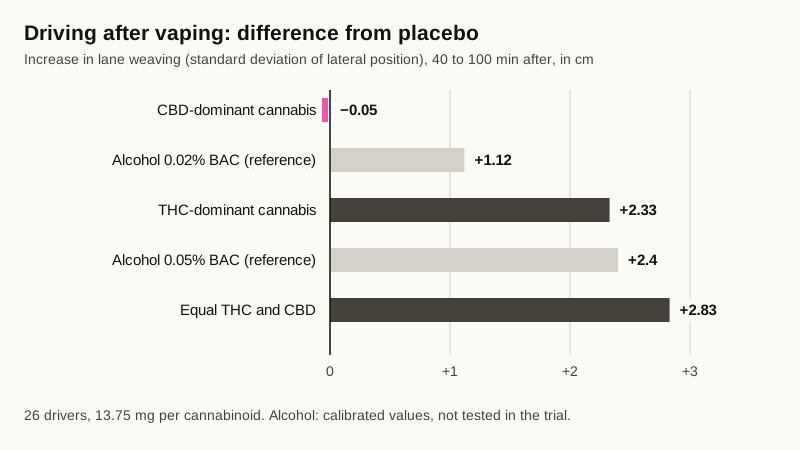
Between 40 and 100 minutes after intake, CBD-dominant cannabis gave the same result as placebo: 18.21 cm against 18.28 cm. THC added 2.33 cm, and the THC and CBD mix 2.83 cm. For comparison, the team had calibrated that a blood alcohol level of 0.5 g/l adds 2.4 cm. CBD therefore did not dampen the effect of THC. Four hours later, no condition differed from placebo any more. The authors point out that the doses tested may not reflect common use.
Neither trial shows an attention gain with CBD. They show, at these doses and for these tasks, no measurable effect. The 600 mg dose is also 300 times the EFSA's provisional reference of 2 mg per day for 70 kg. For attention deficit disorder, our article on CBD and ADHD reviews the few trials.
THC, the other side of the question
The Maastricht trial also answers a common search: does THC help you focus? On the road, it impaired lane keeping as much as a blood alcohol level of 0.5 g/l during the hour and a half after intake. THC is a narcotic in France, and our article on the differences between THC and CBD compares the two molecules.
A compliant CBD product can contain up to 0.30% Δ⁹-THC. MILDECA reminds readers that driving after using narcotics is banned "regardless of the dose absorbed". France's Court of Cassation ruled on 21 June 2023 that the legality of the product consumed makes no difference to this offence. Our guide to saliva drug testing details the detection windows, and our article on saliva tests at work covers what an employer may check.
What is documented for attention: sleep and caffeine
Sleep has a measured effect, and a large one. In 2003, Hans Van Dongen and colleagues followed 48 adults in a laboratory: some slept 8, 6 or 4 hours a night for 14 days, others were kept awake for three nights in a row. At 6 hours or less, cognitive deficits reached up to the equivalent of two sleepless nights. Their feeling of sleepiness, however, barely increased after the first days: participants misjudged their own loss of performance. Our article on CBD and sleep looks at what research does and does not say about CBD in this area.
Caffeine is the best-studied substance in this field. The EFSA states that in moderate doses it increases alertness and reduces sleepiness. For a healthy adult, the agency sees no safety concern up to 200 mg in a single dose and 400 mg a day. It also notes that 100 mg can affect sleep duration in some adults, especially close to bedtime.
| Lever | What was measured | Source |
|---|---|---|
| CBD, 600 mg | No difference in memory tests | Bloomfield et al., 2020 |
| CBD-dominant cannabis | Driving identical to placebo | Arkell et al., 2020 |
| Sleep limited to 6 h | Deficits of up to the equivalent of 2 sleepless nights | Van Dongen et al., 2003 |
| Caffeine, moderate doses | Greater alertness, less sleepiness | EFSA |
Precautions if you use CBD during the day
Three points deserve attention. The first is what the product really contains. In June 2025, ANSES, the French food and health safety agency, reported several hundred poisonings since 2024 linked to products sold as CBD that contained THC above 0.3% or synthetic cannabinoids. The agency cites a 2023 study in which eight products out of ten did not have the stated CBD content. Our laboratory page explains how to read an analysis.
The second concerns traces of THC. A full-spectrum product contains them, an isolate does not: our comparison of full spectrum and isolate helps you choose if you drive or if your job involves testing. The third is interaction with medicines, through liver enzymes: our article on the grapefruit effect explains it. Drowsiness is also among the reported side effects, see CBD side effects.
Frequently asked questions
Does CBD improve focus?
No study shows it in healthy adults. In the 2020 trial, 600 mg of CBD did not change the memory scores of 15 volunteers. No claim of this kind is authorised in France.
Does CBD stop you from concentrating?
The available data do not show that either. In the Maastricht trial, CBD-dominant cannabis did not change driving performance. The risk comes mainly from the THC a product may contain, and from the drowsiness some people report.
Does THC help you focus?
Not behind the wheel: in the 2020 trial, it impaired lane keeping as much as a blood alcohol level of 0.5 g/l for the hour and a half after intake. THC is a narcotic in France.
Is CBD an alternative to ADHD medication?
No. No trial has established an effect of CBD on this disorder, and prescribed medication should only be stopped with the advice of the doctor who prescribed it.
Can you combine CBD and coffee?
No study measures the effect of this combination on attention. For caffeine alone, the EFSA sees no safety concern up to 400 mg a day in healthy adults, and notes that a late dose can shorten sleep.
Written by the Phytogrammes team
Every article in this journal draws on primary sources (ANSM, EFSA, EUR-Lex, peer-reviewed publications) and on the lab's own practice: batch-by-batch HPLC analyses, measured cannabinoid profiles. Our approach.
Article published on . CBD is not a medicine.