CBD and medication: the grapefruit effect in numbers
Yes, CBD can change how some medicines work, a little like grapefruit: it slows down enzymes that clear them, and their level in the blood rises. At medicinal doses, studies measured a clobazam metabolite rising 3 to 4 fold and an immunosuppressant, everolimus, rising 2.5 fold. At the doses found in consumer products, the data are missing: if you take a regular treatment, talk to your pharmacist before using CBD.
Contents
> Key takeaways > > - CBD slows several liver and gut enzymes, mainly CYP2C19, that clear many medicines. > - Interactions were measured at 1,000 mg of CBD a day and above, doses close to those of the medicine Epidyolex. > - Grapefruit acts on the gut enzyme CYP3A4. In the official study, CBD did not change this enzyme. > - EFSA and the UK Food Standards Agency do not cover people on medication in their dose benchmarks. > - Narrow-margin medicines (anticoagulants, immunosuppressants, antiepileptics) are the first to flag.
The mechanism: enzymes that clear medicines
Most medicines are cleared by enzymes, mainly in the liver and the gut wall. The best-known family is the cytochromes P450, written CYP. When a substance slows one of these enzymes, the medicine it should break down builds up. Its effect, and its side effects, can then increase.
The CYP3A4 enzyme matters a great deal: New Zealand's medicines agency, Medsafe, states that it handles more than 50% of medicines. A 2023 review in Frontiers in Psychiatry lists the enzymes CBD slows: CYP2C9, CYP2C19, CYP2D6 and CYP3A, with a possible effect on CYP1A2, CYP2B6 and CYP2C8. CBD may also slow two conjugation enzymes, UGT1A9 and UGT2B7. Many of these results come from laboratory tests on cells or isolated enzymes.
Our article on CBD and the liver explains the role of these enzymes and liver monitoring under Epidyolex.
Grapefruit as a point of comparison
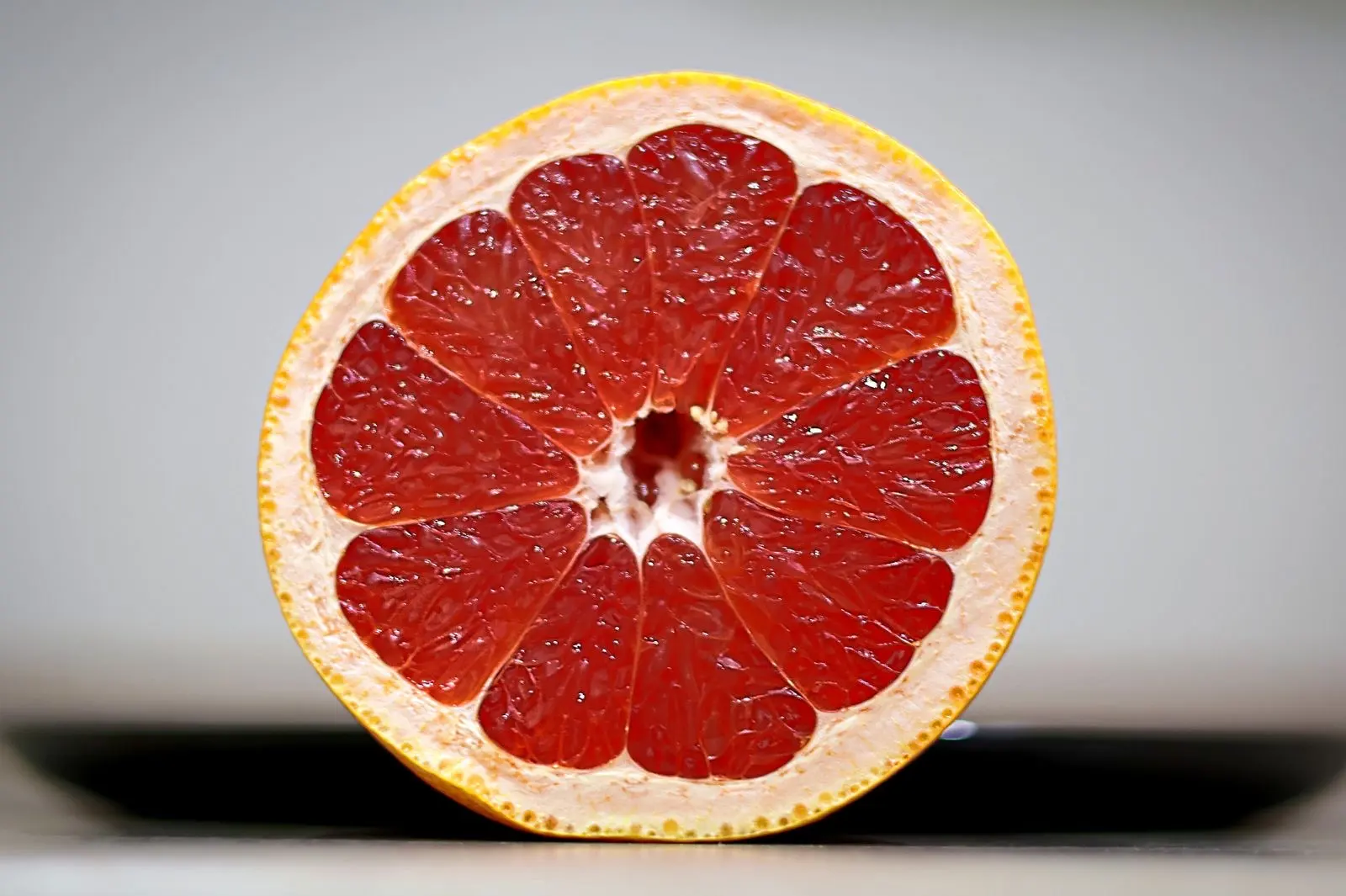
Grapefruit is the usual example because its effect is well documented. A 2013 review in the CMAJ counted more than 85 medicines that interact, or are expected to interact, with the fruit. For 43 of them, the interaction can have serious consequences.
The mechanism is specific. Compounds in the fruit, furanocoumarins, irreversibly inactivate CYP3A4 in the small intestine. One whole grapefruit or 200 ml of juice is enough. The effect is greatest when the fruit is eaten within 4 hours before the medicine; about 25% of it remains after 24 hours. A medicine given intravenously is not affected, because it does not pass through the gut.
| Criterion | Grapefruit | CBD |
|---|---|---|
| Main enzyme | Gut CYP3A4 | Mainly CYP2C19, plus other enzymes |
| CYP3A4 at the dose studied | Irreversibly inactivated | No measured effect on midazolam |
| Amount involved | 1 fruit or 200 ml of juice | 1,000 to 1,750 mg a day in the studies |
| Duration of effect | About 25% left at 24 hours | Not established at consumer doses |
| Source | Bailey et al., CMAJ, 2013 | EMA, Epidyolex summary of product characteristics |
The analogy holds for the principle: a seemingly harmless substance changes the real dose of a medicine. It does not hold for the enzymes involved, or for the amounts.
What has been measured in humans
The best data come from the approval file of Epidyolex, the only CBD-based medicine. Its summary of product characteristics, published by the European Medicines Agency, describes studies in healthy volunteers. CBD was given at 7.5 to 12.5 mg per kilo twice a day, or about 1,000 to 1,750 mg a day for 70 kg.
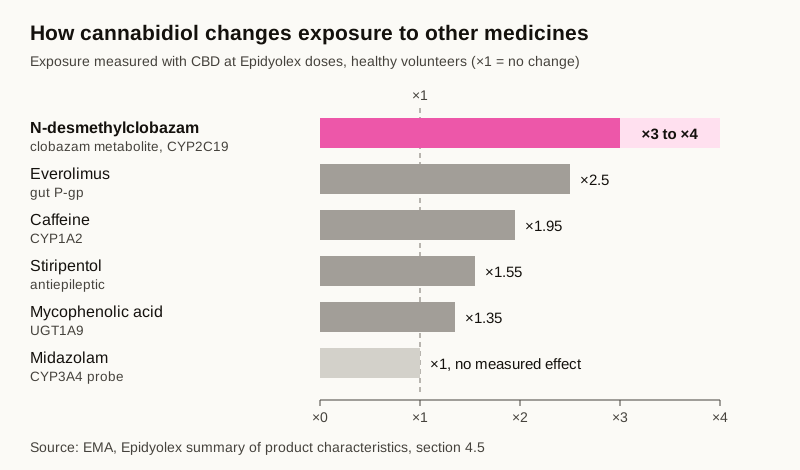
Four results deserve attention:
- Clobazam, an antiepileptic. The level of its active metabolite, N-desmethylclobazam, is 3 to 4 times higher, probably through inhibition of CYP2C19. Drowsiness affected 43% of patients on CBD and clobazam, against 14% on CBD without clobazam.
- Everolimus, an immunosuppressant. Its exposure rises about 2.5 fold. The agency attributes this to a gut transporter, P-gp, and names tacrolimus, sirolimus and digoxin as exposed to the same risk.
- Caffeine. Its total exposure rises by 95%, which makes CBD a weak inhibitor of CYP1A2.
- Midazolam, the medicine used as a marker of CYP3A4. CBD did not change its exposure. At these doses, CBD does not behave like grapefruit towards this enzyme.
The same document notes that combining CBD with valproate increases how often liver enzymes rise. A case published in 2017 describes a 44-year-old patient followed for epilepsy who was also taking warfarin, an anticoagulant. His INR, the clotting marker monitored on this treatment, went from 2.22 to 6.86 when CBD reached 10 mg per kilo per day. His warfarin dose had to be cut by about 30%.
The question of dose
All these measurements concern medicinal doses. Epidyolex is prescribed at 5 to 20 mg per kilo per day, up to 25 mg in one indication, or 350 to 1,400 mg a day for 70 kg. The 2023 review considers strong interactions likely with high-dose oral CBD, around 700 mg. It also cites a rise in citalopram, an antidepressant, with CBD products dosed at 200 to 800 mg a day.
At the doses of products sold to the public, studies are lacking. No data does not mean no risk, and the agencies say so clearly. EFSA set on 9 February 2026 a provisional level of 2 mg a day for a 70 kg adult, but could not establish safety for people taking medicines. The UK Food Standards Agency advises people on medication against CBD. Our article on how much CBD per day compares these benchmarks.
In France, swallowing CBD also raises a legal question: CBD foods and supplements must be withdrawn from sale, as our overview of CBD regulation in 2026 explains.
What to do if you take a treatment
The right person to ask is the pharmacist or doctor who knows your treatment. They can check each molecule, which no general list can do. To prepare that conversation:
- List all your medicines, including over-the-counter ones, supplements and St John's wort, which also acts on these enzymes.
- Spot the narrow-margin ones, where a small change in concentration matters: anticoagulants such as warfarin, immunosuppressants such as tacrolimus or everolimus, antiepileptics, digoxin.
- Never change on your own the dose of a prescribed medicine, whether to "make room" for CBD or the other way round.
- Mention CBD before surgery, like any product you use. Our article on CBD before anaesthesia reviews the question.
- Allow for drowsiness. The Epidyolex summary states that alcohol and other nervous system depressants can strengthen it.
The side effects of CBD itself are covered in our article on its side effects, and the situation of older people, who often take several medicines, in our article on CBD for seniors.
Frequently asked questions
Does CBD really act like grapefruit?
In principle, yes: both slow enzymes that clear medicines. But grapefruit inactivates gut CYP3A4, while the measured effect of CBD runs mainly through CYP2C19 and a gut transporter. In the Epidyolex study, CBD did not change CYP3A4.
Which medicines are most affected?
Those whose interactions have been measured: clobazam, everolimus, stiripentol, valproate, mycophenolic acid. The European agency also names tacrolimus, sirolimus, digoxin and omeprazole. Warfarin is the subject of a published case.
Is a small dose of CBD a problem?
Nobody knows. Interactions were measured at doses of 1,000 mg a day and above. No agency has set a safe dose for a person on medication.
Does CBD cream carry the same risk?
Passage into the blood through the skin is presumed to be low, but it was not measured in these studies. If you take a narrow-margin medicine, mention it to your pharmacist as well.
How long should I leave between CBD and a medicine?
No study gives a safe gap for CBD. For grapefruit, about a quarter of the effect remains 24 hours later. Only a health professional can advise based on your treatment.
Written by the Phytogrammes team
Every article in this journal draws on primary sources (ANSM, EFSA, EUR-Lex, peer-reviewed publications) and on the lab's own practice: batch-by-batch HPLC analyses, measured cannabinoid profiles. Our approach.
Article published on . CBD is not a medicine.