Supercritical CO2 extraction of CBD: the process in numbers
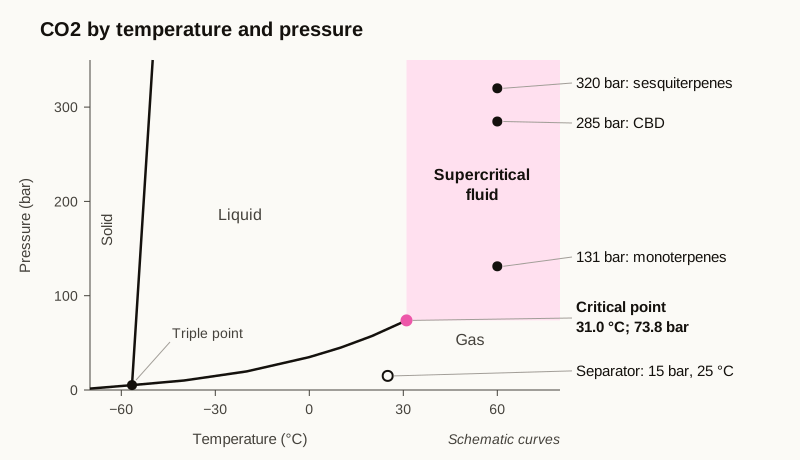
Supercritical CO2 extraction uses carbon dioxide taken above 31.0 °C and 73.8 bar. In that state it dissolves cannabinoids and terpenes like a liquid, then turns back into a gas as soon as the pressure drops, leaving no solvent in the extract. The chosen pressure decides what comes out: light terpenes around 130 bar, CBD around 285 bar in a 2022 study.
Contents
> Key takeaways > > - The critical point of CO2 lies at 31.0 °C and 73.8 bar; above it, CO2 is neither liquid nor gas. > - In a study on industrial hemp, yields ranged from 0.75 to 8.83% depending on pressure and temperature. > - The raw extract mostly contains CBDA, the acid form: it has to be heated to give CBD. > - CO2, ethanol and butane are all authorised as food extraction solvents in the European Union. > - Concentrating a flower also concentrates its THC: an extract can exceed 0.30% even when the plant did not.
What "supercritical" means
A pure substance has a critical point, a temperature and pressure beyond which liquid and gas can no longer be told apart. For carbon dioxide, the NIST tables put it at 304.18 K and 73.80 bar, that is 31.0 °C. The triple point, where solid, liquid and gas coexist, lies at −56.6 °C and 5.18 bar.
Above the critical point, CO2 becomes a supercritical fluid. Its density approaches that of a liquid, which lets it dissolve weakly polar molecules such as cannabinoids. Yet it spreads through plant material almost like a gas. By adjusting the pressure, you set its density, and therefore its dissolving power.
The process, step by step
A CO2 extraction unit runs as a loop:
- Preparation. The plant material (flowers, leaves, threshing residues) is dried and ground to give the fluid more surface.
- Extraction. Compressed, heated CO2 flows through the vessel holding the material. It picks up cannabinoids, terpenes and waxes.
- Separation. In a second vessel, the pressure drops. The CO2 becomes a gas again, loses its dissolving power, and the extract settles out.
- Recycling. The gas is condensed again and sent back to the vessel.
Figures from a study published in 2022 in Pharmaceuticals by a Croatian team give the order of magnitude. The researchers extracted industrial hemp inflorescences for 30 minutes, with a CO2 flow of 1.4 kg per hour. The separator ran at 15 bar and 25 °C: at that pressure CO2 is a gas and the extract drops to the bottom. The same paper notes that adding a little ethanol to the CO2, as a co-solvent, improved yields in other work.
Pressure and temperature decide what comes out
Supercritical CO2 does not extract everything at once. In the 2022 study, the authors varied pressure and temperature, then measured each extract by chromatography.
| Optimal setting measured | Target compounds |
|---|---|
| 131.2 bar | Monoterpenes (myrcene, pinenes, limonene) |
| 284.78 bar | CBD |
| 319.7 bar | Sesquiterpenes (beta-caryophyllene, etc.) |
| 60 °C | Optimal temperature for all responses studied |
Yield ranged from 0.75 to 8.83% of the plant mass, depending on the setting. The extract obtained at 320 bar and 40 °C contained 305.8 µg of CBDA per milligram, about 31% of its mass. CBD is therefore mostly present in its acid form, since the process does not heat enough to convert it. A heating step, decarboxylation, comes next, as described in our guide to decarboxylation methods.
Low pressures favour volatile terpenes, high pressures heavier molecules. Two "CO2" extracts can therefore have very different profiles depending on the setting used. Our article on hemp terpenes describes these families of molecules.
CO2, ethanol, butane: what the rules say
The "solvent-free" claim needs a caveat. Directive 2009/32/EC on food extraction solvents allows, for all uses and under good manufacturing practice, propane, butane, ethyl acetate, ethanol, carbon dioxide, acetone and nitrous oxide. Hexane is only allowed for specific uses, with residue limits such as 1 mg/kg in an oil.
On the medicines side, the ICH Q3C guideline on residual solvents, adopted by the European Medicines Agency, puts ethanol in class 3, the least toxic. It accepts up to 5,000 ppm, or 0.5%, without justification. Hexane sits in class 2, limited to 290 ppm.
| Process | EU food status | Residue to check |
|---|---|---|
| Supercritical CO2 | Authorised for all uses | None: the CO2 leaves as a gas |
| Ethanol | Authorised for all uses | Residual ethanol, ICH class 3 (0.5%) |
| Butane, propane | Authorised for all uses | Residual hydrocarbons, to be measured |
| Hexane | Restricted uses | ICH class 2, 290 ppm |
| Sieving, heat press | No solvent | No solvent; see rosin |
The real advantage of CO2 is therefore less about the law than about physics: it leaves nothing in the extract to measure. For other processes, a serious certificate of analysis shows a residual solvent test. Our article on solvents in CBD hash explains how to read it.
What extraction does not change: the THC threshold
The French order of 30 December 2021 limits Δ⁹-THC to 0.30% in authorised hemp varieties and in the extracts and products made from them. The extraction method changes nothing here.
A simple calculation shows why testing the extract matters. Take a flower at 0.2% total THC and an extraction yield of 8%. If all the THC goes into the extract, the extract holds 0.2 ÷ 0.08, or 2.5%. The raw extract is then more than eight times over the threshold. It has to be purified or diluted, in an oil for instance, until the finished product is back under 0.30%.
This is what the laboratory measures on the finished product: THC, CBD, other cannabinoids and, depending on the process, residual solvents. The laboratory page describes the testing methods. For the next steps (dilution, carrier oil, spectrum), see how a CBD oil is made and the range of CBD oils.
Frequently asked questions
Does supercritical CO2 leave traces in the extract?
No. When the pressure drops, the CO2 returns to a gas and leaves the extract. In the 2022 study, the separator ran at 15 bar and 25 °C, conditions in which CO2 is a gas.
Why does a CO2 extract contain CBDA rather than CBD?
Because extraction runs at a moderate temperature, between 40 and 60 °C in the 2022 study, too low to decarboxylate the acid forms. The study's most CBDA-rich extract contained about 31%.
Is CO2 extraction better than ethanol?
It leaves no residue and lets you sort compounds by pressure. Ethanol remains an authorised, low-toxicity solvent; quality depends mostly on purification and on testing the finished product.
Can a CO2 extract contain too much THC?
Yes. Extraction concentrates every cannabinoid. With an 8% yield, a flower at 0.2% THC gives a raw extract at 2.5%. The finished product has to come back under 0.30%.
Written by the Phytogrammes team
Every article in this journal draws on primary sources (ANSM, EFSA, EUR-Lex, peer-reviewed publications) and on the lab's own practice: batch-by-batch HPLC analyses, measured cannabinoid profiles. Our approach.
Article published on . CBD is not a medicine.