How CBD oil is made: 8 steps from field to bottle
A CBD oil is a hemp extract diluted in a vegetable oil. The flowers are dried and ground, then their cannabinoids are extracted with supercritical CO₂ or ethanol. The extract is purified, heated to turn CBDA into CBD, then diluted to the percentage on the label. A batch test then checks the CBD content and the Δ⁹-THC, which must not exceed 0.30%.
Contents
- 01The 8 steps in one diagram
- 02The raw material: authorised varieties, dried slowly
- 03Extraction: supercritical CO₂, ethanol or hydrocarbons
- 04Purifying: winterisation, filtration, evaporation
- 05Decarboxylating: from CBDA to CBD
- 06Diluting: the maths behind the label percentage
- 07Testing the batch: what the analysis should show
- 08Oil for swallowing: the rules in 2026
- 09Frequently asked questions
> Key takeaways > > - CO₂ becomes supercritical above 31.06 °C and 73.83 bar: it then dissolves cannabinoids without leaving any solvent behind. > - Ethanol extracts efficiently but also pulls out chlorophyll; in medicines, its residues are tolerated up to 5,000 ppm. > - The plant makes CBDA; heat is what turns it into CBD. A commercial oil often keeps traces of it. > - The percentage on the label comes from a dilution calculation, then a measurement on the finished batch.
The 8 steps in one diagram
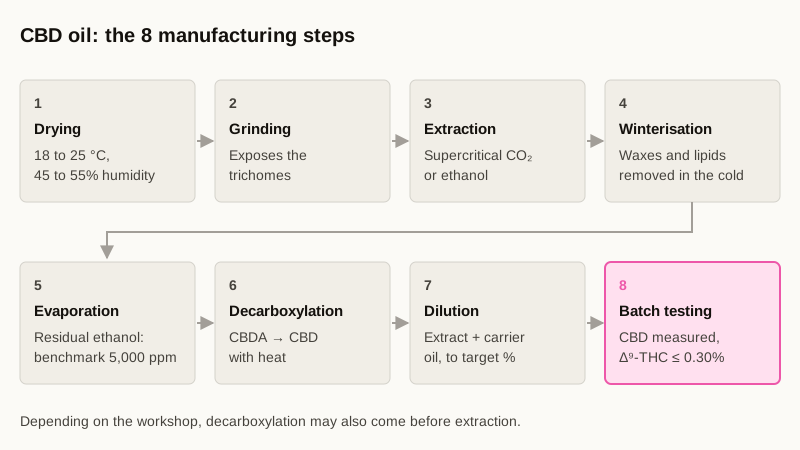
Not every oil follows exactly the same path, but the outline is shared: prepare the plant, extract the cannabinoids, purify the extract, decarboxylate it, dilute it and test it. The diagram below follows that order. Depending on the workshop, decarboxylation can happen before extraction, on the ground flower, or after, on the extract.
The raw material: authorised varieties, dried slowly
It all starts with the plant. In France, the decree of 30 December 2021 only allows Cannabis sativa L. varieties listed in the EU common catalogue or the French catalogue whose Δ⁹-THC content does not exceed 0.30%. The same threshold applies to extracts and to products containing them, so to the finished oil.
The harvested flowers are dried, then ground to expose their trichomes, the tiny glands where the plant stores its cannabinoids. A review published in 2021 in the Journal of Cannabis Research describes traditional hang-drying at 18 to 25 °C with 45 to 55% humidity. Freeze-drying, which dries the plant with cold under vacuum, preserves volatile compounds better, but it uses a lot of energy.
Extraction: supercritical CO₂, ethanol or hydrocarbons
Extraction separates the cannabinoids and terpenes from the plant material. Three families of solvents dominate, and each has its trade-off.
| Method | Principle | Strength | Watch point |
|---|---|---|---|
| Supercritical CO₂ | CO₂ taken above 31.06 °C and 73.83 bar | No residual solvent, moderate heat | Expensive equipment |
| Ethanol | Soaking in alcohol, then evaporation | High yield | Also extracts chlorophyll; solvent to evaporate |
| Butane, propane | Gases liquefied under pressure | Evaporate at low temperature | Flammable; possible residues |
Beyond its critical point, CO₂ is neither quite a gas nor quite a liquid: it penetrates the material like a gas and dissolves like a liquid. Back at ambient pressure, it turns into gas again and escapes. The 2021 review cites working conditions of around 55 °C and 34 MPa, or 340 bar, with a little ethanol added as a co-solvent. Our article on supercritical CO₂ extraction details the settings.
Ethanol gives some of the best cannabinoid yields. But it also carries chlorophyll along, which is then removed by filtering through activated charcoal, at the cost of losing part of the cannabinoids. Hydrocarbons, butane and propane, raise two problems the review points out: they are flammable, and industrial-grade solvents can leave impurities in the extract. The guide can a CBD hash contain solvents shows how to spot them on a certificate.
Purifying: winterisation, filtration, evaporation
The raw extract contains plant waxes and lipids that cloud the oil. Winterisation removes them: the extract is dissolved in ethanol, then placed in the cold, well below zero. The waxes set and settle out, the cannabinoids stay dissolved, and cold filtration separates the two. The ethanol is then evaporated, often under vacuum so the work can be done at a lower temperature.
Traces always remain. The ICH Q3C guideline, which the European Medicines Agency applies to medicines, ranks ethanol among the least toxic solvents, known as class 3. It considers up to 5,000 ppm of this kind of solvent, or 0.5%, acceptable without specific justification. A CBD oil is not a medicine, but this threshold gives a sense of scale when you read the "residual solvents" line on a certificate.
Decarboxylating: from CBDA to CBD
The plant makes very little CBD. It produces CBDA, its acidic form, which loses a carboxyl group under heat and becomes CBD. A 2016 study followed this reaction between 80 and 145 °C, over 60 minutes at most: the higher the temperature, the faster the conversion. The authors also note that the sum of CBDA and CBD decreases as time and temperature go up. Heating too hard or too long therefore loses cannabinoids.
When CBDA loses its carboxyl group, it loses about 12% of its mass. To estimate the total CBD of an oil, the formula is: total CBD = CBD + 0.877 × CBDA. Example with the catalogue's 10% CBD Oil, checked on 23 September 2026: 10.2% CBD and 0.4% CBDA on batch PG-26-8C8F, or about 10.55% total CBD. The three oils in the catalogue show 0.2 to 0.4% CBDA: on these batches, decarboxylation is not complete. Our guide to decarboxylation compares the methods.
Diluting: the maths behind the label percentage
The decarboxylated extract is too concentrated to be dosed as it is. It is diluted in a carrier oil, often a medium-chain triglyceride (MCT) oil made from coconut, sometimes hemp seed oil or olive oil. Check which one on the label.
The calculation is a simple rule of three. For 100 g of oil at 10% CBD, you need 10 g of CBD. If the purified extract contains 60% CBD, a figure chosen for the example, you need 10 ÷ 0.60 = 16.7 g of it, topped up with 83.3 g of carrier oil. With a 99% isolate, 10.1 g would be enough. The purity of the extract also tells you what else the oil contains: a 60% extract brings other cannabinoids and terpenes, an isolate brings only CBD.
The terms are defined in our articles on full spectrum and on 99% isolate. In the catalogue, the three oils in the CBD oils category are full spectrum: 5.1% CBD for the Full Spectrum, 10.2% for the 10% CBD Oil and 19.6% for the product called "10", with 0.1 to 0.2% Δ⁹-THC depending on the batch. The price displayed on 23 September 2026 starts at €29.90.
Testing the batch: what the analysis should show
The percentage targeted by the calculation has to be checked on the finished batch, because dilution and mixing are never perfect. A useful certificate of analysis has at least five lines:
- the measured CBD, as a percentage or in mg/ml, and the CBDA if any remains;
- the Δ⁹-THC, which must not exceed 0.30%;
- residual solvents, when a solvent was used for extraction;
- pesticides and heavy metals;
- the batch number, which must match the one on the bottle.
A good certificate also screens for the semi-synthetic molecules classified as narcotics in France, such as HHC, H4CBD or THCP. Our guide to the certificate of analysis goes through each line, and the laboratory page describes the measurement methods.
Oil for swallowing: the rules in 2026
How an oil is made says nothing about how it may be used. A CBD oil meant to be swallowed is a food, and the Regulation (EU) 2015/2283 on novel foods requires an authorisation that no CBD ingredient has obtained. The French Ministry of Agriculture restated this on 20 May 2026: in its view, foods containing CBD are illegal and must be withdrawn from the market, food supplements included. It also reports a rise in poisoning reports linked to these products since 2024. Our update on CBD regulation in 2026 describes what remains on sale.
Frequently asked questions
What is the best extraction method for a CBD oil?
None is best on every count. Supercritical CO₂ leaves no solvent and uses little heat, but needs expensive equipment. Ethanol gives a good yield if its evaporation is checked by testing. The batch certificate shows the result whatever the method.
Why does a CBD oil still contain CBDA?
Because decarboxylation is not always complete. Heating harder or longer would convert more CBDA, but would also lose cannabinoids. The oils in the catalogue keep 0.2 to 0.4%.
What does "MCT oil" on the label mean?
It is the carrier oil: medium-chain triglycerides, most often made from coconut. It is neutral in taste and stable. Other makers use hemp seed oil or olive oil.
Can you make CBD oil at home?
Technically, steeping flowers in oil is possible, but nobody can then know its CBD or THC content without a lab test. And an oil meant to be swallowed falls under the novel food rules, which do not allow it.
Written by the Phytogrammes team
Every article in this journal draws on primary sources (ANSM, EFSA, EUR-Lex, peer-reviewed publications) and on the lab's own practice: batch-by-batch HPLC analyses, measured cannabinoid profiles. Our approach.
Article published on . CBD is not a medicine.