Where does CBD come from? From hemp trichome to bottle
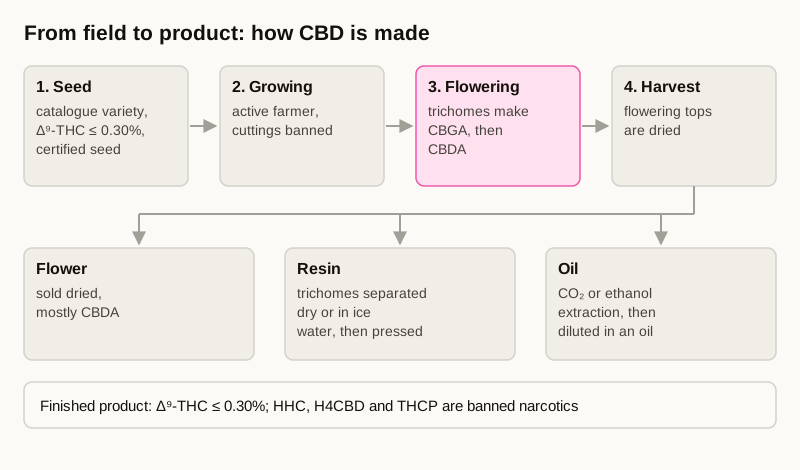
*CBD comes from hemp, Cannabis sativa L. The plant makes it in the trichomes of its flowers, tiny glands, in an acidic form, CBDA, which heat turns into CBD. In France, this hemp comes from varieties listed in the official catalogues, with no more than 0.30% Δ⁹-THC. After harvest, three routes lead to a product: dried flower, resin made by separating the trichomes, and oil, which goes through extraction and then dilution.*
Contents
- 01A plant regulated by variety, not by species
- 02Where the plant makes CBD: the trichomes
- 03Flower, resin, oil: three routes after harvest
- 04Full spectrum, broad spectrum, isolate: what extraction keeps
- 05CBD made outside hemp, and the "derivatives" to avoid
- 06What to check before you buy
- 07Frequently asked questions
> Key takeaways > > - CBD is made and stored in the glandular trichomes, mostly on female flowers. > - The plant first makes CBGA, which the enzyme CBDA synthase turns into CBDA. > - In France, only catalogue varieties grown from certified seed can produce flowers for sale. > - A CBD oil is an extract, obtained with CO₂ or ethanol, diluted in a vegetable oil. > - "Derivatives" made from CBD, such as HHC or H4CBD, are classified as narcotics.
A plant regulated by variety, not by species
Hemp and so-called recreational cannabis belong to the same species, Cannabis sativa L. What separates them in law is the content of Δ⁹-THC, the psychoactive molecule. Our article on the differences between hemp and cannabis covers this in detail.
The reference text is the order of 30 December 2021. It authorises the growing, import and industrial use of varieties listed in the EU Common Catalogue or the French official catalogue whose Δ⁹-THC content does not exceed 0.30%. For flowers and leaves it adds three conditions: plants must come from certified seed, selling plants and taking cuttings are banned, and only active farmers may grow them. Extracts and the products containing them are capped at the same 0.30% threshold.
The order also banned the sale of raw flowers and leaves to consumers. The Conseil d'État annulled that ban on 29 December 2022. The authorised varieties are explained in our guide to the EU catalogue of hemp varieties.
Where the plant makes CBD: the trichomes
CBD does not circulate through the whole plant. A 2020 study in Scientific Reports notes that cannabinoids and terpenes are produced and stored in the secretory cells of glandular trichomes, which are especially dense on seedless female flowers. Stems and roots contain very little. That is why CBD is harvested from the flowering tops. Our article on the role of trichomes describes them under the microscope.
Synthesis runs in three steps. The plant joins olivetolic acid and geranyl pyrophosphate to form CBGA, the "mother molecule". An enzyme, CBDA synthase, then turns it into CBDA, as a 2021 review in Frontiers in Pharmacology describes. CBD hemp carries mostly this enzyme; THC cannabis carries mostly THCA synthase. Finally, CBDA loses a carboxyl group when heated and becomes CBD: this is decarboxylation.
The same glands produce other compounds. The 2020 study counts 120 terpenoids in cannabis, including 61 monoterpenes and 52 sesquiterpenoids. Hemp also makes two flavonoids specific to the species, cannflavins A and B, whose biosynthetic pathway was described in 2019.
Flower, resin, oil: three routes after harvest
Every CBD product starts from the same dried flowering tops. What changes is how much of the plant is kept.
| Product | Key step | What remains of the plant | Dominant form |
|---|---|---|---|
| Flower | Drying the tops | Everything: tissue, trichomes, terpenes | CBDA, little CBD |
| Resin (hash) | Mechanical separation of trichomes | The trichomes, concentrated | Mostly CBDA, some CBD if heated |
| Oil | Extraction, then dilution | Compounds dissolved by the solvent | CBD if the extract was heated |
Flower is sold as it is, after drying. Resin is made without solvent: the trichomes are knocked off dry, over sieves, or in ice water, then gathered and pressed. The glossary describes, for example, dry sifting.
Oil requires extraction. A 2022 comparison of industrial techniques describes the two main ones. Supercritical CO₂ usually works at 100 to 300 bar and 35 to 60 °C. It leaves no residue in the extract, but the equipment is expensive. Ethanol also dissolves chlorophyll and waxes. Used cold, at −60 to −40 °C, it pulls in less of them. It then has to be evaporated, preferably below 60 °C. A "winterisation" step, chilling followed by filtration, removes the waxes: the review considers it necessary after CO₂ extraction. Our article on supercritical CO₂ extraction explains the process.
Finally, the extract is diluted in a vegetable oil, often MCT oil made from coconut or palm kernel, hemp seed oil or olive oil. The percentage on the label depends on this ratio. A 10% oil by weight per volume contains 100 mg of CBD per millilitre, or 1,000 mg in a 10 ml bottle. Our article on how a CBD oil is made goes through each step.
Full spectrum, broad spectrum, isolate: what extraction keeps
The same extract can be sold in three forms. A full-spectrum extract keeps the cannabinoids, including traces of THC below the legal limit, and part of the terpenes. A broad-spectrum extract removes the THC. An isolate contains only purified CBD, as a crystalline powder. Our comparison full spectrum or isolate helps you choose between them.
CBD made outside hemp, and the "derivatives" to avoid
Hemp is not the only possible source. In 2019, a Berkeley team published in Nature the complete biosynthesis of cannabinoids, including CBDA, in engineered yeast. CBD can also be made by chemical synthesis. Our article on CBD produced outside hemp reviews these routes.
These sources must be kept apart from another use of CBD: as raw material for synthetic molecules. The ANSM, France's medicines agency, states that HHC is obtained by chemical synthesis from natural cannabinoids. It classified HHC as a narcotic from 13 June 2023. H4CBD, which the ANSM lists among "chemically modified natural substances", followed on 3 June 2024, together with THCP and a whole family of derivatives. A "CBD derivative" is therefore not a CBD product: our article on the H4CBD ban gives the details.
What to check before you buy
A product's origin can be read on its label and its certificate of analysis. Four pieces of information let you trace the chain:
- the batch number, which must match the one on the certificate;
- the variety, which you can look up in the EU catalogue;
- Δ⁹-THC, at no more than 0.30% in the finished product;
- the absence of HHC, H4CBD or THCP when the lab tested for them.
Our guide to reading a certificate of analysis goes through each line, and our laboratory page describes the measurement methods. One regulatory note: since May 2026, oils presented as food supplements have been withdrawn from sale in France, after the Ministry of Agriculture restated that foods containing CBD are not authorised.
Frequently asked questions
Where does CBD come from?
From hemp, Cannabis sativa L. The plant makes it in the trichomes of its flowers, as CBDA, starting from CBGA. Heat then turns CBDA into CBD.
Is CBD natural or synthetic?
The CBD in flowers, resins and oils comes from hemp. Chemical and yeast-based routes exist, but they produce the same molecule. Do not confuse it with semi-synthetic derivatives such as HHC or H4CBD, which are classified as narcotics in France.
Does CBD come from the leaves or the flowers?
Mostly from the female flowers, where glandular trichomes are densest. Leaves carry fewer, stems and roots very few.
What is the difference between CBD oil and hemp oil?
CBD oil is a flower extract diluted in a vegetable oil. Hemp seed oil is pressed from the seeds, which carry no trichomes: it contains practically no CBD. Our article on the difference between CBD oil and hemp seed oil covers both.
Is a "CBD derivative" product legal?
Not when it is a molecule transformed by synthesis, such as HHC or H4CBD. The ANSM classified them as narcotics in 2023 and 2024, even when they are made from hemp-derived CBD.
Written by the Phytogrammes team
Every article in this journal draws on primary sources (ANSM, EFSA, EUR-Lex, peer-reviewed publications) and on the lab's own practice: batch-by-batch HPLC analyses, measured cannabinoid profiles. Our approach.
Article published on . CBD is not a medicine.