Hemp trichomes: 3 types, and the gland where CBD is made
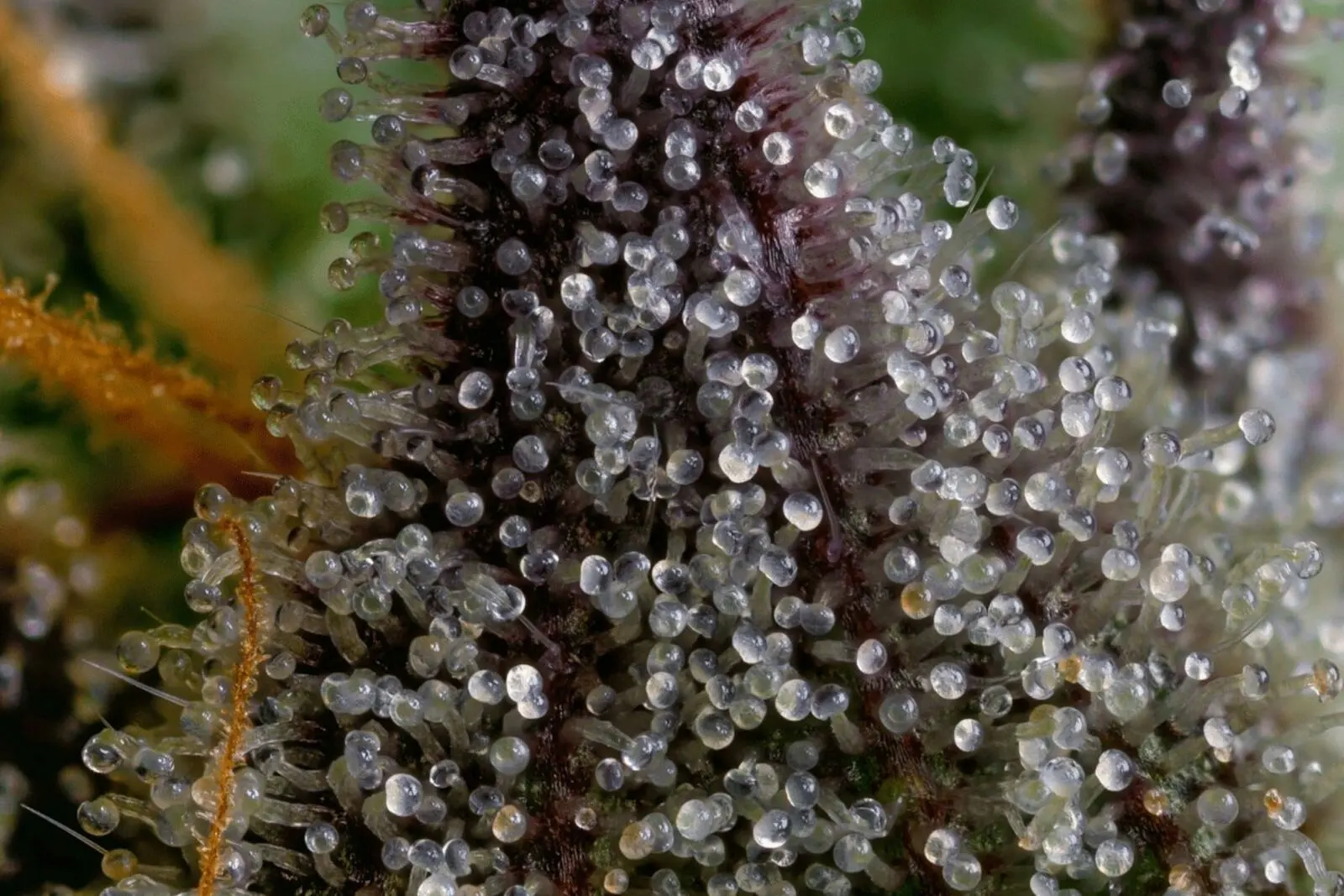
Trichomes are the tiny glands that cover the female flowers of hemp. Their secretory cells are where the plant makes its cannabinoids, including the acidic precursor of CBD, and its terpenes. A CBD flower carries them like any other cannabis: three glandular types, the largest with a head of 40 to 110 microns. Hence the gap measured in 2020 across three varieties: 15.8 to 20.4% cannabinoids in the flower, 1.1 to 2.1% in the leaf.
Contents
> Key takeaways > > - A glandular trichome is a stalk topped by a head: secretory cells at the base, a resin storage cavity above them. > - Three types: bulbous, capitate sessile and capitate stalked. The last one produces the most cannabinoids. > - Capitate trichome heads measure 40 to 110 microns, or 0.04 to 0.11 mm. > - The colour shifts from clear to milky to amber late in flowering. It is a growing cue, not a measure of potency. > - Hash, rosin and extracts are all ways of collecting the resin in these heads.
What is a trichome?
A trichome is an outgrowth of the epidermis, the layer of cells covering the plant. Some are plain hairs. Others are glandular: they secrete resin, and those are the ones that matter for CBD.
A glandular trichome looks like a tiny match. A stalk carries a round head. At the base of the head, a disc of secretory cells makes the cannabinoids and terpenes. According to a review published in 2021 in Frontiers in Plant Science, these molecules are then stored in a cavity above the disc, under a thin cuticle. That pocket of resin is what sparkles on a "frosty" flower.
Three types of glandular trichomes
Botanists distinguish three types of glandular trichomes on hemp. A Canadian team measured them under the microscope on two THC-rich varieties, in a paper published in 2023 in the Journal of Cannabis Research.
| Type | Head | Stalk | Secretory cells | Where it is found |
|---|---|---|---|---|
| Bulbous | 15 to 30 µm | 10 to 15 µm | Not specified | Leaves and bracts |
| Capitate sessile | Round | Very short | 8 | Leaves, stems, young flowers |
| Capitate stalked | 40 to 110 µm for capitate heads | 20 to 1,100 µm | 12 to 16 | Bracts of female flowers |
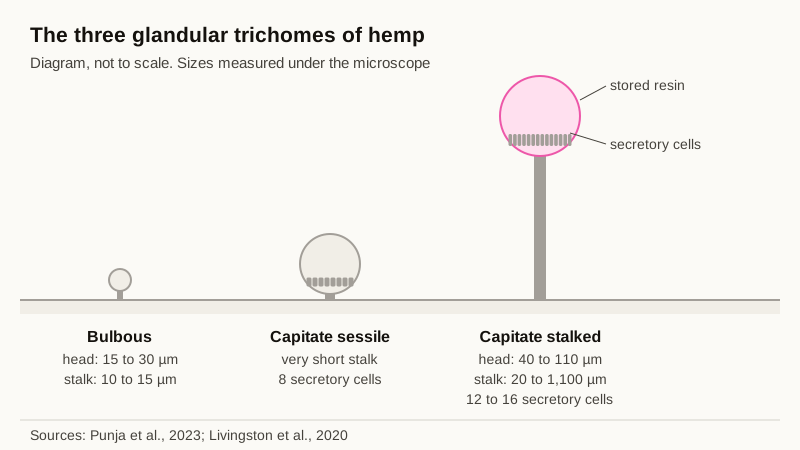
The stalked trichome is the star. Of the three types, it produces the most cannabinoids, according to the 2021 review. It is not a separate kind, though: a study published in 2020 in The Plant Journal shows that stalked trichomes develop from precursors that look sessile. The authors count 12 to 16 secretory cells, against 8 for a true sessile trichome. They also note a terpene profile clearly dominated by monoterpenes, the light molecules behind much of the smell. Our article on terpenes describes these families.
In the 2023 study, the stalks of stalked trichomes averaged 300 to 500 µm after six weeks of flowering, depending on the variety. Their density ranged from 12 to 30 trichomes per square millimetre of bract across genotypes, with more on the lower surface.
Why the flower concentrates the cannabinoids
Stalked trichomes cluster on the bracts, the small leaves that wrap the female flowers. The large leaves carry few of them. The difference in content follows.
A Canadian team tested three varieties, organ by organ, in a study published in 2020 in Scientific Reports. The inflorescences contained 15.77 to 20.37% cannabinoids, against 1.10 to 2.10% for the leaves of the same plants. Terpenes followed the same slope: 1.28 to 2.14% in the flowers, 0.13 to 0.28% in the leaves.
The trichome type matters too. Earlier work cited by the 2023 team reports up to 20 times more THC in stalked heads than in sessile heads. That is why flowers are sold by the gram, while leaves mostly go to extraction or infusions.
Clear, milky, amber: what the colour tells you
A trichome head changes appearance as flowering goes on. The 2023 study describes resin that is first translucent, then milky, then amber. In its trials, heads were still clear around the third week, and browning rose sharply by the seventh or eighth. The authors attribute it to the oxidation of phenolic compounds.
Growers use it to choose when to harvest. Older work, cited in the same study, suggests that over-mature glands hold less THC, because the resin leaks out or evaporates. Colour remains a visual clue, though, not a measurement.
For a buyer the lesson is the same: a very frosty flower does not necessarily have a high level. Only the batch analysis gives the CBD and Δ⁹-THC content. Our guide to reading a certificate of analysis shows which lines to check before choosing among the CBD flowers.
From trichomes to hash and extracts
Every concentrate starts from the same idea: separating the trichome heads from the rest of the plant. There are two broad families of methods.
- Mechanical separation. When cold, the heads turn brittle and break off. They are collected dry, on stacked sieves (dry sift), or in ice water filtered through fine-mesh bags (ice-o-lator).
- Extraction. A solvent or supercritical CO₂ dissolves the resin. The process is described in our article on CO₂ extraction.
Head size explains the vocabulary of hash. With heads of 40 to 110 µm, a 120 µm mesh only holds back the largest ones, along with clumps of resin. The detail, with batch figures, is in our article static, frozen, 120u: what a hash name tells you.
Frequently asked questions
Does CBD flower have trichomes?
Yes. CBD-rich hemp carries the same types of glandular trichomes as THC-rich cannabis. What differs is the enzyme active in their secretory cells: CBDA synthase rather than THCA synthase. The 2020 study found many genes in floral trichomes expressed in step with CBDA synthase.
Can you see trichomes with the naked eye?
The capitate stalked ones, yes: together they give the flower its frosty look. To tell a head from its stalk, or to judge colour, you need a magnifier or a pocket microscope.
Does a very frosty flower contain more CBD?
Not necessarily. Trichome density is a clue, not a measurement. Only a laboratory analysis gives the actual CBD and THC content of a batch.
What do trichomes do for the plant?
The 2021 review puts forward several protective roles: UV protection, since the plant makes more THC under stronger UVB light, action against some microbes, and a deterrent effect on plant-eating animals. These are hypotheses backed by observations, not all of them proven.
Why do leaves contain fewer cannabinoids?
Because they carry few stalked trichomes, the type that produces the most. In the 2020 study, leaves contained 1.10 to 2.10% cannabinoids, against 15.77 to 20.37% for flowers.
Written by the Phytogrammes team
Every article in this journal draws on primary sources (ANSM, EFSA, EUR-Lex, peer-reviewed publications) and on the lab's own practice: batch-by-batch HPLC analyses, measured cannabinoid profiles. Our approach.
Article published on . CBD is not a medicine.