CBD small buds: what small flowers and trim are worth
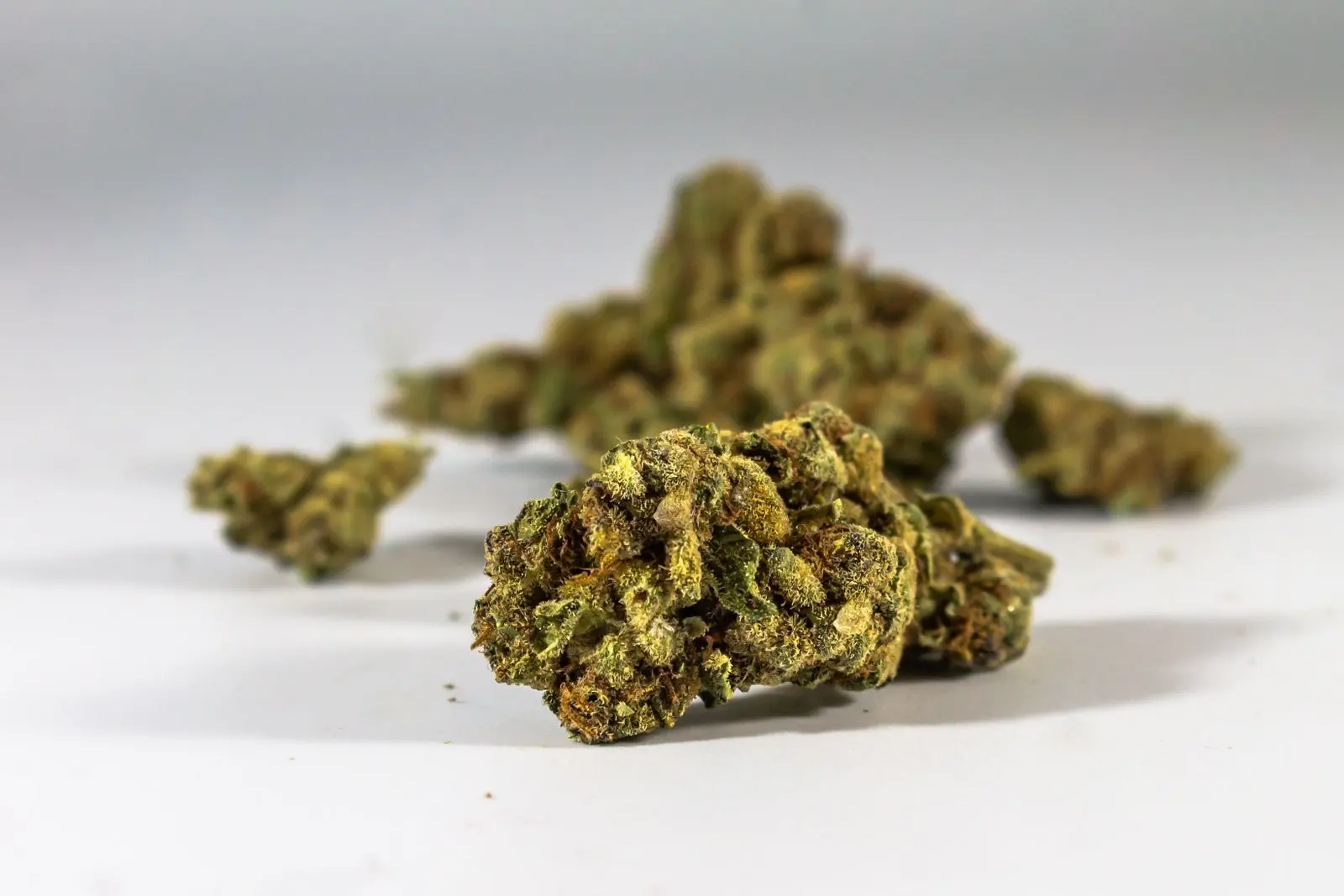
Small buds are small hemp flowers, sold cheaper because they come from the bottom of the plant or from sorting by size. Trim means the small leaves removed during manicuring. A 2022 study measured up to 90% fewer cannabinoids in flowers from the bottom of the plant, but size alone does not tell you about a batch: only the certificate of analysis says what you are buying.
Contents
> Key takeaways > > - "Small buds" is a trade term: it has no definition in botany or in law. > - On a CBD-rich variety, flowers on the lower branches held up to 90% fewer cannabinoids than the main top cola. > - A very frosty flower is not necessarily richer: trichome density alone does not predict content. > - The legal limit is the same for every size: 0.30% Δ⁹-THC. > - The right calculation is the price per 100 mg of CBD, not the price per gram.
Small buds and trim: two trade words
"Small buds" is neither a botanical term nor a legal category. Depending on the grower, it means two different things: flowers harvested from the lower branches, or the small size grade obtained by sorting the whole harvest. The product page rarely says which, and the difference matters, as we will see.
Trim is a clearer anatomical reality. It is the sugar leaves, the small resin-covered leaves that stick out of the flower and are cut off during manicuring. They carry trichomes, but less evenly than bracts, the small structures that wrap the flower. Trim is most often used as raw material for extracts, such as rosin.
No French or European text grades flowers by size or quality. Labels such as "small", "popcorn" or "AAA" therefore have no regulatory meaning.
What research measures about position on the plant
The gap between the top and the bottom of a plant is documented. In 2022, Nadav Danziger and Nirit Bernstein published a study in Frontiers in Plant Science on a CBD-rich medical variety, with 8 to 16% CBD and under 1% THC. They measured cannabinoids at five heights on the plant. Result: axillary flowers at the bottom held up to 90% fewer cannabinoids than the apical flower, the one that crowns the main stem.
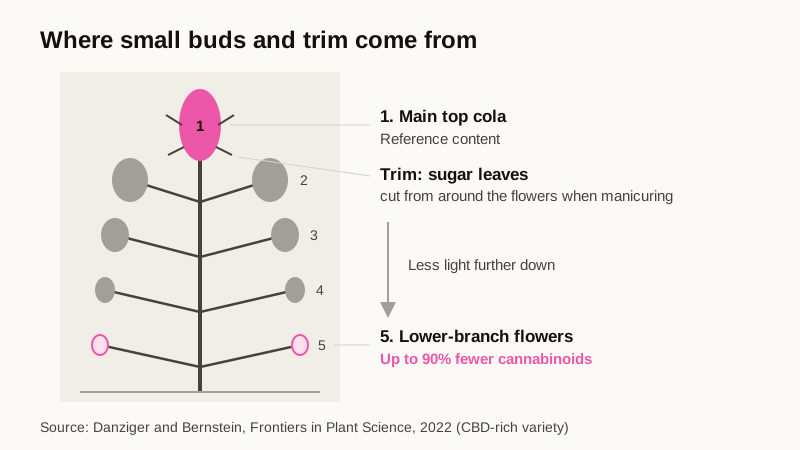
Planting density widens the gap. Going from 1 to 2 plants per square metre, the concentrations of the six detected cannabinoids fell by 71 to 76% in the bottom flowers of the control plants. The authors link this to the lack of light at the bottom of a canopy that is too dense. CBGA, the precursor of the other cannabinoids, was the least sensitive to position: the profile changes shape rather than being diluted evenly.
Two caveats. The study covers a medical variety grown in a greenhouse, not hemp at 0.30% THC: the trend carries over, the exact figures do not. Above all, the gradient concerns the plant, not the bag. Small buds from a size sort of the whole harvest are not bottom flowers.
Why appearance does not reveal content
A review published in 2025 in Plants challenges the idea that a frosty flower is necessarily more potent. Its authors conclude that higher trichome density alone does not guarantee a higher cannabinoid content. Enzyme activity and genetics weigh as much as the number of glands.
The same review offers two observations that matter for trim. Bracts are the most reliable site for counting trichomes, with dense and even resin coverage. Sugar leaves are less regular, with more trichomes along the edges and at the tip.
Trichome type matters too. In 2020, a team at the University of British Columbia showed in The Plant Journal that stalked trichomes on flowers show a signature associated with high cannabinoid levels. Sessile trichomes, found on mature flowers as well as on leaves, have a different profile. Our article on trichomes describes the different types.
The law does not know about sizes
Small or large, flowers fall under the same text. The French order of 30 December 2021 authorises Cannabis sativa L. varieties with no more than 0.30% Δ⁹-THC, and sets the same cap for extracts and products containing them. No threshold depends on flower size. Our article on the legal THC level explains how it is measured.
How to judge a batch of small buds
Three checks, in this order.
- The certificate of analysis for the batch, not for the variety. It is the only data that answers the question of CBD and THC content. Our guide to reading a certificate of analysis goes through each line.
- The state of preservation. For the same weight, small flowers expose more surface to air and light. Our articles on storing flowers and on mould explain what to look for.
- The price relative to CBD, not per gram.
The last point takes one line: price per 100 mg of CBD = price per gram × 10 ÷ CBD content in %. Here is a worked example, with made-up prices.
| Large buds | Small buds A | Small buds B | |
|---|---|---|---|
| Price per gram | €8.00 | €4.00 | €4.00 |
| Measured CBD | 12% | 6% | 9% |
| CBD per gram | 120 mg | 60 mg | 90 mg |
| Price per 100 mg of CBD | €6.67 | €6.67 | €4.44 |
Half the price but half as rich, small buds A cost no less per unit of CBD. Small buds B, for instance from a simple size sort, are the best buy of the three. Without an analysis, there is no way to know which of the two you are buying. Our overview of CBD prices in 2026 gives market ranges, and the CBD flowers category gathers the catalogue references.
Frequently asked questions
Do small buds contain less CBD than large flowers?
It depends on where they come from. Flowers on the lower branches can hold up to 90% fewer cannabinoids than the main top cola, according to the 2022 study. But small buds from a size sort of the whole harvest do not have that gap. The batch certificate of analysis settles it.
Is CBD trim worth anything?
Yes, mainly as raw material for extraction. Sugar leaves carry trichomes, but less evenly than bracts. Trim should not be judged like a flower, and its content should appear on an analysis.
Is a very frosty flower richer in cannabinoids?
Not necessarily. The review published in 2025 in Plants concludes that trichome density alone does not guarantee a higher content. Appearance tells you about the care taken in growing and drying, not about concentration.
Are small buds legal in France?
Yes, on the same terms as other flowers: from an authorised variety, with no more than 0.30% Δ⁹-THC. The law makes no distinction by size.
Written by the Phytogrammes team
Every article in this journal draws on primary sources (ANSM, EFSA, EUR-Lex, peer-reviewed publications) and on the lab's own practice: batch-by-batch HPLC analyses, measured cannabinoid profiles. Our approach.
Article published on . CBD is not a medicine.