Tobacco vs cannabis: two dependencies, one kind of smoke
Tobacco and cannabis are two different plants: the first contains nicotine and no THC, the second THC and no nicotine. Nicotine leads to dependence far more often, 67.5% of smokers against 8.9% of cannabis users in a large US survey. But their smoke contains similar families of toxicants, and in France the two are usually smoked together, in the same joint.
Contents
> Key takeaways > > - Nicotine comes from tobacco, THC from cannabis: neither plant contains the other's molecule. > - In the NESARC survey, the probability of becoming dependent after first use is 67.5% for nicotine and 8.9% for cannabis. > - Cannabis smoke contained up to 20 times more ammonia than tobacco smoke in a 2008 analysis. > - Tobacco caused more than 68,000 premature deaths in France in 2023, according to Santé publique France. > - In France, 87.5% of cannabis users surveyed for the Global Drug Survey 2014 smoked it with tobacco.
Two plants, two molecules
Tobacco comes from the leaves of Nicotiana tabacum. Its active molecule is nicotine, an alkaloid with the formula C₁₀H₁₄N₂. Cannabis comes from the flowers of Cannabis sativa. Its psychoactive molecule is Δ⁹-THC, with the formula C₂₁H₃₀O₂, which has no chemical link with nicotine. So there is no THC in tobacco, and no nicotine in cannabis. When a joint contains both, it is because they were mixed.
The two molecules do not act on the same targets. Nicotine binds to acetylcholine receptors known as nicotinic receptors. THC mainly activates the CB1 receptor of the endocannabinoid system, which is involved in memory and mood among other things. CBD, the other major cannabinoid in hemp, has the same molecular formula as THC but a different structure, and it does not intoxicate.
| Tobacco | Cannabis | CBD hemp | |
|---|---|---|---|
| Plant | Nicotiana tabacum | Cannabis sativa | Cannabis sativa L., authorised varieties |
| Main molecule | Nicotine | Δ⁹-THC | CBD |
| Psychoactive effect | Mild stimulant, no intoxication | Yes | No |
| Status in France | Sale to minors banned | Narcotic | Authorised if Δ⁹-THC ≤ 0.30% |
The 0.30% threshold is explained in our article on the legal THC level, and the difference between the two cannabinoids in THC and CBD: the differences.
Dependence: nicotine hooks people more often
The best comparison available comes from the US NESARC survey, carried out in two waves among adults. A study published in 2011 derived from it the lifetime probability of becoming dependent after first use. The sample included 15,918 people who had smoked tobacco and 7,389 who had used cannabis.
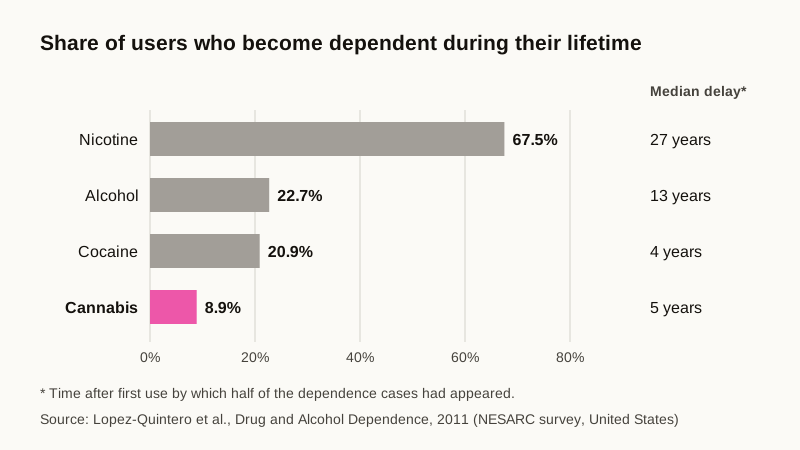
Two figures should be read together. Two thirds of tobacco smokers become dependent at some point in their lives, against fewer than one cannabis user in ten. But cannabis dependence, when it occurs, sets in faster: half of the cases appear about 5 years after first use, against 27 years for nicotine. These figures describe the US population of the early 2000s; today's products, richer in THC, may change the picture.
Cannabis dependence is recognised by medical classifications. In France, about 54,000 people were followed for their cannabis use in 2022 in specialised addiction centres, according to the OFDT summary. Our article on cannabis and mental health covers the other risks.
The smoke: similar toxicants, in different amounts
Burning a leaf or a flower produces carbon monoxide, tar and particles, whatever the plant. In 2008, researchers compared tobacco and cannabis cigarettes prepared and smoked the same way by a machine. Their results, published in Chemical Research in Toxicology, show qualitatively similar smoke. The amounts differ: inhaled cannabis smoke contained up to 20 times more ammonia, and 3 to 5 times more hydrogen cyanide, nitrogen oxides and some aromatic amines. Some polycyclic aromatic hydrocarbons, which cause cancer, were on the other hand less concentrated than in tobacco smoke.
Lung imaging points the same way. A study published in 2023 in Radiology reviewed the chest scans of 56 cannabis smokers, 57 non-smokers and 33 tobacco-only smokers. Emphysema, a destruction of the air sacs, affected 75% of cannabis smokers, 67% of tobacco-only smokers and 5% of non-smokers. Signs of airway inflammation were more frequent among cannabis smokers. The authors point out a limit: the cannabis group also included cigarette smokers, so the effect cannot be put down to a single plant.
No smoke is harmless to the lungs, then, and the idea that cannabis is less harmful than tobacco does not hold for the smoke itself. What differs most is the amount smoked: a daily tobacco smoker often burns much more material than an occasional cannabis user.
The overall toll of tobacco is well established. According to Santé publique France, it remains the leading cause of avoidable death in France, with more than 68,000 premature deaths in 2023, or 11% of all deaths.
In France, the two are smoked together
The French joint almost always mixes the two plants. The OFDT describes herbal cannabis and resin as "generally" smoked as a joint, with tobacco. In the Global Drug Survey 2014, run at the end of 2013 and analysed in 2016 in Frontiers in Psychiatry, 87.5% of French respondents used cannabis with tobacco. In the Americas, the share fell to between 4.4 and 16.0%.
A 2021 national survey of 18,288 adults aged 18 to 64 gives the order of magnitude. 22.3% smoked tobacco daily without using cannabis, 1.4% used cannabis without tobacco, and 4.5% combined daily cigarettes with cannabis at least once a month. Among the latter, cannabis use was more frequent than among those who used cannabis alone.
The mix combines both risks: nicotine, with its strong dependence, and the combustion of both plants. Someone who thinks of themselves as a "cannabis smoker" can thus become dependent on the tobacco in their joints. Our article on smoking without tobacco compares the three alternatives and what each one removes.
Where does CBD fit in?
CBD hemp is cannabis low in THC: no more than 0.30% Δ⁹-THC in the finished product. It does not get you high, and it contains no nicotine. But a smoked CBD flower is still plant matter that burns: its combustion products are those of any plant. Rolled with tobacco, it also brings nicotine and its dependence.
CBD is not a treatment for quitting smoking. A 2013 pilot study of 24 smokers explored the idea, and the data remain preliminary; our article on CBD and quitting tobacco covers them. The only authorised cannabidiol medicine, Epidyolex, is reserved for rare forms of epilepsy.
Reducing the risks, or quitting
For anyone who smokes one or the other, three levers stand out from the studies cited here:
- Taking the tobacco out of the joint removes the nicotine, not the combustion.
- Heating without burning. A vaporiser avoids combustion, but not nicotine if you put tobacco in it; our guide to vaporisation gives the temperatures.
- Getting help to quit tobacco. Tabac Info Service offers free support from tobacco specialists, on 39 89 or online.
Cannabis rich in THC remains a narcotic, smoked or not. The comparison with the other most widely used legal substance is in our article alcohol and cannabis.
Frequently asked questions
Is there THC in nicotine or in tobacco?
No. Nicotine is a tobacco molecule, THC a cannabis molecule, and they have no chemical link. A cigarette contains no THC; a joint only contains it if cannabis was put in.
Is cannabis less harmful to the lungs than tobacco?
Nothing allows that claim for the smoke itself. Both kinds of smoke contain similar toxicants, and cannabis smoke contained more ammonia and hydrogen cyanide in the 2008 analysis. Tobacco weighs more overall because it is smoked more often and in larger amounts.
Which is more addictive, tobacco or cannabis?
Nicotine. In the NESARC survey, 67.5% of tobacco smokers became dependent during their lives, against 8.9% of cannabis users. Cannabis dependence, however, set in faster.
Why do people mix tobacco and cannabis in France?
It is a European habit. In the Global Drug Survey 2014, 87.5% of French users surveyed smoked their cannabis with tobacco, against less than 16% in the Americas.
Is a smoked CBD flower risk-free?
No. It contains neither nicotine nor enough THC to get you high, but its smoke contains the combustion products of any plant. Mixed with tobacco, it also exposes you to nicotine.
Written by the Phytogrammes team
Every article in this journal draws on primary sources (ANSM, EFSA, EUR-Lex, peer-reviewed publications) and on the lab's own practice: batch-by-batch HPLC analyses, measured cannabinoid profiles. Our approach.
Article published on . CBD is not a medicine.