CBD and melatonin: two mechanisms, no joint trial
Melatonin is a hormone that tells the body clock night has come. CBD has no known hormonal action, and its effect on sleep has not been demonstrated. No human trial has assessed the two together, and in France a gummy or oil that combines them is a CBD food, not authorised for sale.
Contents
> Key takeaways > > - In France a food supplement may provide less than 2 mg of melatonin a day; at 2 mg it becomes a prescription medicine. > - In a 2013 meta-analysis, melatonin shortened the time to fall asleep by 7 minutes on average compared with placebo. > - A 2024 trial found no difference between 150 mg of CBD and a placebo on insomnia severity. > - CBD slows an enzyme, CYP1A2, that clears melatonin: the combination has never been tested in humans.
Melatonin: a hormone that tells the time
Melatonin is released at night by the pineal gland, in the brain. It does not knock you out like a sleeping pill. It signals to the body that the rest period is starting and aligns the biological clock with the day-night cycle. The French food safety agency Anses notes that it also acts on body temperature, mood and the immune system.
Its measured effect on sleep is modest. A 2013 meta-analysis in PLoS One pooled 19 trials and 1,683 people with primary sleep disorders. Compared with placebo, melatonin shortened the time to fall asleep by 7 minutes on average and lengthened total sleep by 8 minutes.
In France the dose decides the status. According to Anses, the rules allow food supplements that provide less than 2 mg of melatonin a day. At 2 mg you are in medicine territory: Circadin, a prolonged-release tablet, is prescribed to patients aged 55 or over, for 13 weeks at most.
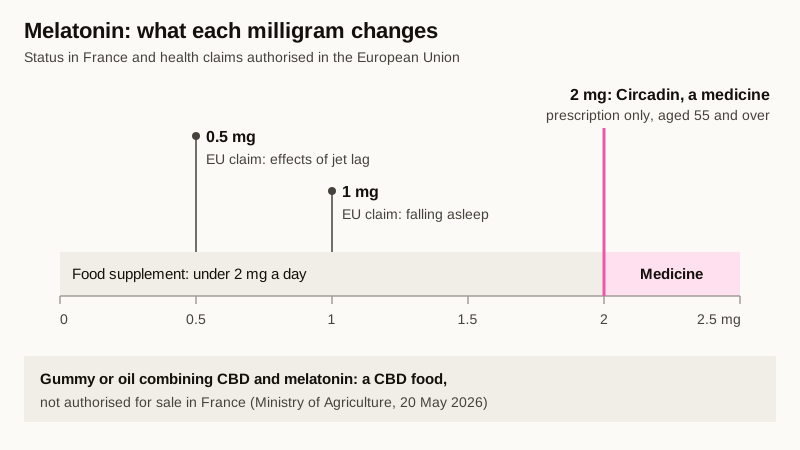
Melatonin also has two health claims authorised in the EU under Regulation (EU) 432/2012: one on reducing the time taken to fall asleep, at 1 mg taken before bedtime, the other on the effects of jet lag, from 0.5 mg.
CBD and sleep: what the trials show
CBD (cannabidiol) is a hemp cannabinoid with no psychoactive high. It acts on several receptors, including those of the endocannabinoid system, but no hormonal mechanism comparable to melatonin's is known.
Controlled trials on sleep remain few and small. In 2024 an Australian team gave 150 mg of CBD or a placebo every evening to 30 adults with insomnia, for two weeks. Insomnia severity, self-reported time to fall asleep and night-time waking did not differ between the groups. Sleep efficiency measured at the wrist was better on CBD after two weeks, and reported well-being was higher. Our feature on CBD and sleep covers the other trials, dose by dose.
Drowsiness, on the other hand, is well documented as a side effect, especially at high doses: 23% of patients on Epidyolex, the only CBD medicine, according to its product information. It is not a sought-after effect, and our article on CBD side effects sets it among the others. No health claim is authorised for CBD: a seller cannot write that it helps you sleep.
What happens when you combine them
No human trial has measured the effect of the combination on sleep. The only documented point concerns the liver, which clears both molecules.
The Circadin product information states that melatonin is broken down mainly by the enzymes CYP1A1 and CYP1A2. A drug that slows them raises melatonin levels: with fluvoxamine, an antidepressant, exposure to melatonin rises 17-fold. CBD slows CYP1A2. In the Epidyolex product information, 1,500 mg of CBD a day almost doubled exposure to caffeine, which uses the same enzyme (+95%). The document calls CBD a weak inhibitor of that enzyme.
Two laboratory studies looked at melatonin itself. In mice, a high dose of CBD multiplied exposure to melatonin by 2.85, according to a 2024 study. In 2025 another team combined measurements in cells, rats and dogs with a computer model. It projects a worst-case 12-fold rise in exposure in humans. That is a projection, not a measurement: it only says the interaction deserves testing.
The same authors present the combination as a lead for insomnia, with no human data behind it. Anses, for its part, has recommended since 2018 favouring simple formulations that do not combine melatonin with other ingredients, and avoiding taking several supplements at once, to limit interactions. Our article on CBD interactions and the grapefruit effect explains this enzyme mechanism.
What French law says about combined products
Gummies, oils or capsules combining CBD and melatonin are foodstuffs. Swallowed CBD falls under Regulation (EU) 2015/2283 on novel foods, and no CBD ingredient has been authorised under it. On 20 May 2026 the French Ministry of Agriculture restated that foodstuffs containing CBD are not authorised for sale and extended checks to every channel, online sales included. A combined product sold in France today is therefore unlawful, whatever its melatonin dose.
Our update on CBD regulation in 2026 details what remains on sale, and the article on the withdrawal of CBD gummies follows the format hit hardest. On 9 February 2026 EFSA published a provisional safe level of about 2 mg of CBD a day for a 70 kg adult, discussed in our article on EFSA's reference dose. That benchmark authorises no product.
Who should avoid one or the other
The two agencies have published similar lists. For melatonin supplements, Anses advises against use by pregnant or breastfeeding women, children and teenagers, people with inflammatory or autoimmune diseases, and anyone whose activity requires sustained alertness. It asks for medical advice in case of epilepsy, asthma, mood disorders or medication, and recommends occasional use only.
For CBD, EFSA considers safety not established under 25, during pregnancy and breastfeeding, and for people on medication. Both substances can cause drowsiness: do not drive after taking them. If your nights are disrupted over time, see a doctor, not a supplement shelf.
Frequently asked questions
Does CBD contain melatonin?
No. CBD is a hemp cannabinoid, melatonin a hormone made by the brain. Only some products combine them on purpose in one formula, and those products are CBD foods not authorised for sale in France.
Can you take CBD and melatonin on the same evening?
No human trial has assessed the combination. CBD slows the enzyme CYP1A2, which clears melatonin, and animal studies show a rise in melatonin exposure. Ask a doctor or pharmacist, especially if you take a treatment.
What dose of melatonin is allowed in France?
A food supplement must provide less than 2 mg of melatonin a day. Circadin, dosed at 2 mg in prolonged release, is a prescription medicine for people aged 55 or over.
Is CBD more effective than melatonin for sleep?
No direct comparison exists. Melatonin has a modest but measured effect on falling asleep, and two authorised claims. CBD did no better than a placebo on insomnia severity in the 2024 trial, and no claim is authorised for it.
Is CBN an alternative for the evening?
CBN is another cannabinoid, often sold for evening use. It is not authorised in food either, and its sleep trials are few. Our article on CBN and sleep reviews them.
Written by the Phytogrammes team
Every article in this journal draws on primary sources (ANSM, EFSA, EUR-Lex, peer-reviewed publications) and on the lab's own practice: batch-by-batch HPLC analyses, measured cannabinoid profiles. Our approach.
Article published on . CBD is not a medicine.