Endocannabinoid system: CB1, CB2 and what CBD does there
The endocannabinoid system is one of the body's signalling systems, made of receptors (CB1 and CB2), molecules the body makes itself (anandamide and 2-AG) and enzymes that produce and then break them down. It was described between 1988 and 1995, while researchers were working out how THC acts. CBD binds to it poorly: it acts indirectly, through mechanisms measured mostly in the laboratory, which are not proof of any health effect.
Contents
- 01Definition: three parts that make a system
- 02A discovery made by tracing THC, from 1964 to 1995
- 03How it works: a signal made on demand that travels backwards
- 04Homeostasis: what the word means, and what it does not
- 05THC and CBD: two very different ways of touching the system
- 06From bottle to receptor: what happens to swallowed CBD
- 07Why "CBD rebalances your system" is not an argument
- 08Frequently asked questions
> Key takeaways > > - A cannabinoid receptor was detected in rat brain in 1988; CB1 was cloned in 1990, CB2 in 1993. > - Anandamide (1992) and 2-AG (1995) are made on demand, then quickly broken down by two enzymes, FAAH and MAGL. > - In the brain, these molecules travel backwards: from the neuron that receives a signal to the one that sends it, to slow its release. > - THC activates CB1, hence its psychoactive effect; CBD binds it weakly and modulates its response, according to cell studies. > - No health claim is authorised for CBD, and the only cannabidiol medicine is Epidyolex.
Definition: three parts that make a system
A 2016 review in Biological Psychiatry describes the endocannabinoid system as a widespread neuromodulatory system. It adjusts the strength of other signals more than it sends its own. It has three parts.
| Part | Main elements | Role |
|---|---|---|
| Receptors | CB1, CB2 | Receive the signal at the cell surface |
| Endogenous ligands | Anandamide (AEA), 2-AG | Carry the signal, made by the body |
| Enzymes | FAAH, MAGL | Break down the ligands, switching the signal off |
CB1 is the most abundant cannabinoid receptor in the central nervous system. It is dense in the cortex, hippocampus, basal ganglia and cerebellum, regions involved in memory, movement and coordination. CB2 was first described in 1993 as a "peripheral" receptor found in immune cells; in the brain it sits mainly in microglia, the immune cells of nerve tissue. Other targets respond to some cannabinoids: TRP channels, such as heat-sensitive TRPV1, and nuclear receptors of the PPAR family.
The two best-studied ligands are anandamide and 2-arachidonoylglycerol, known as 2-AG. Both derive from arachidonic acid, a fatty acid of cell membranes. For the cannabinoids that come from the plant, see our article on hemp cannabinoids.
A discovery made by tracing THC, from 1964 to 1995
The system is named after the plant because it was found by looking for THC's target. In 1964, Yehiel Gaoni and Raphael Mechoulam described the structure of that molecule. It took until 1988 for an American team to detect, in rat brain, a binding site specific to cannabinoids. The CB1 gene was cloned in 1990, a result published in Nature.
A receptor implies a molecule from the body that binds to it. Mechoulam's team isolated the first one in 1992 from pig brain and named it anandamide, from the Sanskrit ananda, bliss. 2-AG was identified in 1995 by two teams, one in dog gut, the other in Japan, in brain tissue.
How it works: a signal made on demand that travels backwards
Most neurotransmitters are stored in vesicles, ready to go. Endocannabinoids are not: their precursors sit in cell membranes, and an activated neuron releases them in one or two enzymatic steps. They act close to where they are made, then disappear quickly. FAAH mainly breaks down anandamide, MAGL mainly 2-AG.
Their route is unusual. In a synapse, the signal normally runs from the sending neuron, called presynaptic, to the receiving neuron. Endocannabinoids leave the receiving neuron and travel back to the sender, where they activate CB1. The effect is a brake: the sender releases less neurotransmitter. This is called retrograde signalling.
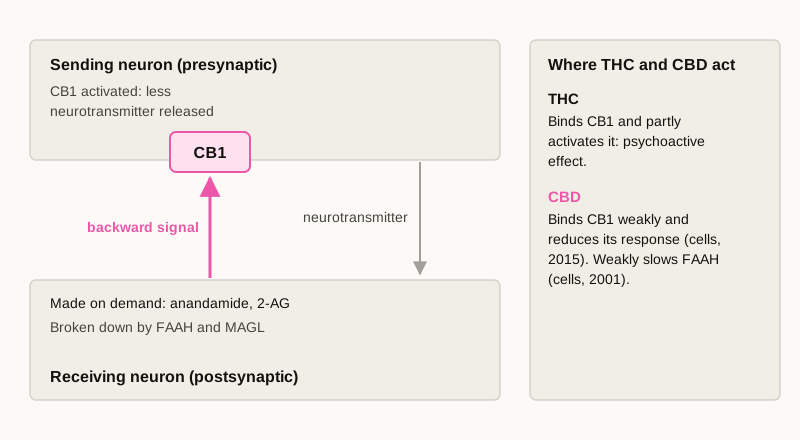
The 2016 review adds a useful nuance. 2-AG fully activates CB1, whereas anandamide and THC are "partial" agonists: even when bound to the receptor, they only partly activate it.
Homeostasis: what the word means, and what it does not
Homeostasis is an organism's ability to keep its internal conditions within a narrow range despite outside changes. The term was coined in the 1920s by the American physiologist Walter Cannon, following Claude Bernard and his "internal environment". Body temperature, close to 37 °C, is the classic example: sweat removes excess heat, shivering produces it. The principle is a negative feedback loop: a deviation triggers a response that corrects it, then the signal switches off.
The endocannabinoid system takes part in these regulations as one modulator among others, alongside the autonomic nervous system and hormones. One measured example: a 2012 study in the Journal of Experimental Biology measured blood endocannabinoids in humans, dogs and ferrets before and after treadmill exercise. Levels rose after intense running in humans and dogs, not after walking, and not in ferrets at any intensity.
Saying that the system "takes part in homeostasis" does not mean anyone can measure it in a given person or "rebalance" it. No routine test assesses an "endocannabinoid tone". The hypothesis of an endocannabinoid deficiency, put forward in 2001 by Ethan Russo, remains a hypothesis: his 2016 update acknowledges that it initially lacked objective proof and clinical trials, and it has not led to any recognised diagnosis.
THC and CBD: two very different ways of touching the system
THC binds CB1 and partly activates it. This action in the brain explains its psychoactive effect, and it is why THC is a controlled drug. CBD does not produce that effect, as our article does CBD get you high explains. Its measured actions are indirect, and almost all were obtained in cells.
| CBD mechanism | What was measured | Type of evidence |
|---|---|---|
| Low affinity for CB1 and CB2 | Natural CBD binds these receptors poorly | Cells, 2001 |
| Modulation of CB1 | It reduces CB1's response to 2-AG and THC, without activating it | Cells, 2015 |
| TRPV1 channel | It activates this channel at concentrations of about 3 micromoles per litre | Cells, 2001 |
| FAAH enzyme | It weakly slows the breakdown of anandamide | Cells, 2001; one human trial, 2012 |
The first and last two rows come from a 2001 study in the British Journal of Pharmacology. The second comes from a 2015 study describing CBD as a negative allosteric modulator of CB1: it binds somewhere other than THC's site and reduces the receptor's response. In humans, a trial published in 2012 in 42 patients with schizophrenia measured higher blood anandamide under CBD. The dose was 800 mg a day for four weeks, 400 times the 2 mg food reference set by EFSA in 2026.
That gap in doses is the point to remember. The mechanisms described in the laboratory appear at concentrations or doses unrelated to a wellness oil. People also talk about an "entourage effect" between cannabinoids and terpenes; our article on the entourage effect reviews this hypothesis. One terpene stands out for its target: β-caryophyllene binds the CB2 receptor.
From bottle to receptor: what happens to swallowed CBD
A molecule first has to reach the blood. A 2018 systematic review of CBD pharmacokinetics in humans places the blood peak most often between 1 and 4 hours after an oral dose. In one study it cites, a meal multiplied total exposure by 5. The authors stress how little data exists: none of the included studies measured the share of swallowed CBD that actually reaches the blood. Our articles on sublingual use and on how long CBD takes to work detail these timings.
Swallowing CBD also raises a legal question. On 20 May 2026, the French Ministry of Agriculture restated that foods containing CBD are not authorised in France and must be withdrawn from the market. Our overview of CBD regulation in 2026 describes that framework.
Why "CBD rebalances your system" is not an argument
The presence of a target in the body does not prove that a molecule touching it brings a measurable benefit. In 2022, EFSA concluded that the safety of CBD as a novel food could not be established, citing gaps on the liver, the reproductive system and drug interactions. In February 2026 it set a provisional safe level of about 2 mg a day for a 70 kg adult, which does not cover people under 25, pregnancy or people on medication. Anses has also proposed classifying CBD as toxic for reproduction.
No health claim is authorised for CBD in the European Union. The only cannabidiol medicine authorised in France is Epidyolex, prescribed from age 2, alongside other antiepileptic drugs, in three rare forms of epilepsy: Lennox-Gastaut syndrome, Dravet syndrome and tuberous sclerosis complex. To see what clinical trials have really shown, read our article on CBD clinical studies.
Frequently asked questions
Does everyone have an endocannabinoid system?
Yes. It is present in humans and in many animals: the 2012 study cited above measured endocannabinoids in humans, dogs and ferrets. It is active from the time the brain develops, which explains the caution about young people.
Does CBD act on CB1 and CB2 receptors?
A little, and not like THC. CBD binds weakly to these receptors. In cell studies, it reduces CB1's response to other molecules and weakly slows FAAH, the enzyme that breaks down anandamide.
How are homeostasis and the endocannabinoid system linked?
Homeostasis is the body's ability to keep its internal conditions stable. The endocannabinoid system takes part as a modulator, slowing or adjusting other signals. It is not the conductor, and its "balance" cannot be measured in clinical practice.
Does exercise activate the endocannabinoid system?
Intense running does, according to a 2012 study: blood endocannabinoid levels rose after sustained effort in humans and dogs, not after walking. It is a possible explanation for the "runner's high", not a demonstration.
Does CBD rebalance the endocannabinoid system?
That phrase is marketing. No clinical measure defines the balance of this system, and no authority has validated the claim. CBD's effects on its components were measured mostly in the laboratory, at high concentrations.
Written by the Phytogrammes team
Every article in this journal draws on primary sources (ANSM, EFSA, EUR-Lex, peer-reviewed publications) and on the lab's own practice: batch-by-batch HPLC analyses, measured cannabinoid profiles. Our approach.
Article published on . CBD is not a medicine.