CBD and clinical trials: what is proven, and at what dose
CBD has a demonstrated effect in only one situation: three rare forms of epilepsy, managed with a prescription medicine, Epidyolex, at 10 to 20 mg per kilo per day. On anxiety, sleep and pain, the trials are small, short and often negative, and they tested 300 to 600 mg in a single dose. None of this applies to a consumer product.
Contents
- 01The only demonstrated use: three rare epilepsies
- 02Anxiety: few patients, a single dose, 300 to 600 mg
- 03Sleep: an encouraging case series, a negative trial
- 04Pain: 15 trials out of 16 without benefit
- 05Trial doses out of all proportion to an everyday product
- 06Why the agencies remain cautious
- 07Reading a CBD study with five questions
- 08Frequently asked questions
> Key takeaways > > - Epidyolex is the only authorised CBD-based medicine, for Dravet syndrome, Lennox-Gastaut syndrome and tuberous sclerosis complex. > - Its trials used 20 mg per kilo per day, or 1,400 mg for a 70 kg adult. > - A 2026 meta-analysis of 54 cannabinoid trials finds no significant effect on anxiety. > - On pain, 15 of 16 CBD trials show no benefit over placebo. > - For a food, EFSA set a provisional level of about 2 mg a day in 2026.
The only demonstrated use: three rare epilepsies
The European Medicines Agency authorised Epidyolex on 19 September 2019. It is an oral solution of purified cannabidiol. It is indicated from the age of 2 in Lennox-Gastaut syndrome and Dravet syndrome, together with clobazam, and in tuberous sclerosis complex.
The authorisation rests on randomised, placebo-controlled trials. In Dravet syndrome, 120 patients received 20 mg/kg/day of CBD or a placebo for 14 weeks. The median number of convulsive seizures per month went from 12.4 to 5.9 on CBD, against 14.9 to 14.1 on placebo. In Lennox-Gastaut syndrome, a trial of 171 patients aged 2 to 55 measured a median fall in drop seizures of 43.9%, against 21.8% on placebo.
These results come at a cost. Diarrhoea, drowsiness, loss of appetite and raised liver enzymes are more frequent on CBD. In the Lennox-Gastaut trial, 14% of patients on CBD stopped because of an adverse effect.
A French study has since followed real-world practice. At the Necker-Enfants malades hospital in Paris, 103 children with drug-resistant epilepsy were followed for 18 months after starting CBD. According to their parents, 54% of the children had fewer seizures after one month. At 18 months, 55% were still taking it, and 20% had lost appetite. Our article on Epidyolex details these trials.
Anxiety: few patients, a single dose, 300 to 600 mg
The studies most often cited on anxiety are brief and small. In 2011 a Brazilian team gave 600 mg of CBD or a placebo to 24 people with social anxiety, 12 per group, before a simulated public-speaking test. CBD reduced self-reported anxiety and discomfort during the test. The authors themselves call it a preliminary study.
The same year, an imaging study tested 400 mg in 10 patients with social anxiety, with a fall in self-reported anxiety. In 2018 a trial of 32 volunteers with strong paranoid traits found no effect of 600 mg of CBD on anxiety or on paranoid thinking.
A meta-analysis published in The Lancet Psychiatry in 2026 takes stock. It pools 54 randomised trials of cannabinoids, CBD, THC or both, in 2,477 participants with mental or substance use disorders. Certainty of evidence is rated low for most outcomes, 44% of the trials carry a high risk of bias, and no significant effect appears on anxiety. The authors conclude that routine use is "rarely justified" for now.
Sleep: an encouraging case series, a negative trial
The sleep study most quoted online is a case series published in The Permanente Journal in 2019. American doctors reviewed the records of 72 adults to whom they had offered CBD, mostly 25 mg a day, on top of their usual care. The sleep score improved in the first month for 66.7% of them, then fluctuated over time. With no control group and no placebo, this improvement may come from patient expectation, medical follow-up or time.
A 2018 controlled trial tested 300 mg of CBD against placebo in 27 healthy volunteers, with 8 hours of sleep recording. CBD changed neither sleep stages nor sleep duration. The article on CBD and sleep covers the question in detail.
Pain: 15 trials out of 16 without benefit
In 2024 four researchers listed in the Journal of Pain the randomised CBD trials that measured pain as an outcome. They found 16, across 12 types of pain, at doses from 6 to 1,600 mg. Their finding: 15 of the 16 trials show no benefit of CBD over placebo.
Sativex is sometimes cited as an example. This medicine combines THC and CBD in almost equal parts, and it is authorised for muscle stiffness in multiple sclerosis after other options have failed. It says nothing about CBD alone. Our article on CBD and pain describes what French law allows anyone to say about it.
Trial doses out of all proportion to an everyday product
The positive trials used high doses, in a single intake or under medical supervision. The chart puts these doses on one scale, next to the provisional level EFSA set for a food.
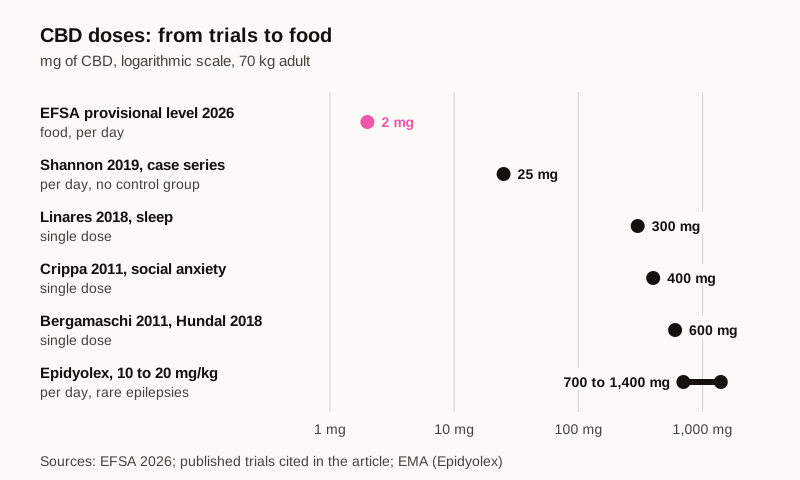
The gap spans several orders of magnitude. On 9 February 2026 EFSA published a provisional safe level of 0.0275 mg per kilo per day, about 2 mg for a 70 kg adult. This level does not apply to people under 25, to pregnant or breastfeeding women, or to anyone taking medication. The article on how much CBD per day explains the calculation.
Why the agencies remain cautious
In 2022 EFSA concluded that the safety of CBD as a novel food could not yet be established, for lack of data on the liver, the digestive tract, the hormonal system, the nervous system, psychological effects and reproduction. In 2025 the French agency ANSES proposed classifying CBD as a presumed reproductive toxicant, category 1B.
The law draws the consequences of these uncertainties. Article 10 of Regulation (EC) No 1924/2006 prohibits any health claim on a food that has not been authorised and entered on the Union list. In France, foods containing CBD are not authorised under the novel food regulation; our overview of regulation in 2026 describes the situation. Medical cannabis is a separate matter, covered in our article on its general roll-out in France.
Reading a CBD study with five questions
Faced with a headline like "CBD improves sleep", five questions are enough to place the study.
- Is there a randomised placebo group? Without one, the effect may come from expectation or time.
- How many participants? At 12 per group, a result remains a lead.
- What dose, and for how long? A single 600 mg dose says nothing about 20 mg a day for months.
- CBD alone, or with THC? Sativex and many meta-analyses mix the two.
- Has another team reproduced the result? On anxiety, the 2018 trial contradicts the 2011 one.
Frequently asked questions
Does CBD have proven efficacy?
Yes, in one situation only: Dravet syndrome, Lennox-Gastaut syndrome and tuberous sclerosis complex, with Epidyolex on prescription. For anxiety, sleep and pain, the evidence is weak or negative.
What CBD dose was used in the positive trials?
From 300 to 600 mg in a single dose in the small anxiety trials, and 10 to 20 mg per kilo per day for Epidyolex, or 700 to 1,400 mg for 70 kg. For a food, EFSA retained in 2026 a provisional level of about 2 mg a day.
Why can a CBD seller promise nothing?
Because EU law prohibits any unauthorised health claim, and no trial supports an effect at the doses of an everyday product. A promise of care would also turn the product into a medicine by presentation under French law.
What is the difference between Epidyolex and a CBD oil?
Epidyolex is a medicine made of purified cannabidiol, dosed to the milligram, prescribed and monitored for three epilepsies. A CBD oil sold in a shop has no indication, and its content is checked on its batch analysis.
Written by the Phytogrammes team
Every article in this journal draws on primary sources (ANSM, EFSA, EUR-Lex, peer-reviewed publications) and on the lab's own practice: batch-by-batch HPLC analyses, measured cannabinoid profiles. Our approach.
Article published on . CBD is not a medicine.