CBD and reproductive toxicity: where the 1B listing stands
CBD is not yet classified as toxic for reproduction, but the file is moving. On 21 March 2025, the French agency ANSES proposed classifying it in category 1B, with hazard statements H360FD and H362, and the Risk Assessment Committee of the European Chemicals Agency issued a favourable opinion. The decision now lies with the European Commission. Nothing is banned today, but a final classification would have effects, first of all on cosmetics.
Contents
> Key takeaways > > - The ANSES proposal rests on studies in monkeys, rats and mice, not on human data. > - ECHA's Risk Assessment Committee backed it; the European Commission has not yet decided. > - A classification describes an intrinsic hazard, not the risk tied to a dose or a use. > - If adopted, CBD cosmetics would be banned in the EU, unless an exemption is granted after a scientific opinion. > - For pregnancy and breastfeeding, EFSA already finds that the safety of CBD cannot be established.
What ANSES proposed on 21 March 2025
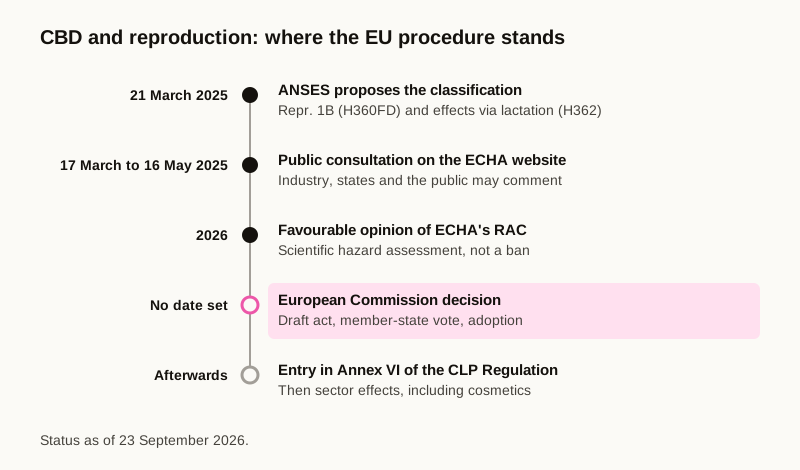
ANSES proposed an EU-wide harmonised classification of cannabidiol in the class "reproductive toxicity, category 1B". Two hazard statements come with it:
- H360FD: "May damage fertility. May damage the unborn child."
- H362: "May cause harm to breast-fed children."
The file relies on studies in monkeys, rats and mice. They show effects of CBD on sperm production, fertility, deaths around birth and brain development. The agency stresses that the process concerns "only" the assessment of hazards and does not, at this stage, set the measures that apply to products.
What "category 1B" means
The CLP Regulation sorts reproductive toxicants into three levels. Category 1A covers substances known to affect human reproduction, mainly on the basis of human data. Category 1B covers presumed reproductive toxicants, mainly on the basis of animal studies. Category 2 covers suspected ones, where the evidence is weaker.
CBD is therefore proposed at the middle level. This means the animal studies were judged clear enough, without direct proof in humans. H362 is a separate category: it covers effects on or via breastfeeding.
A classification describes what a substance can do, not what it does at a given dose. That is the difference between hazard and risk. A classified substance can remain usable if exposure is low and controlled, which the rules of each sector then decide.
Where the EU procedure stands
A harmonised classification follows a route set by Article 37 of the CLP Regulation. The ANSES file went to public consultation on the website of the European Chemicals Agency (ECHA) from 17 March to 16 May 2025. ECHA's Risk Assessment Committee, known as RAC, then has 18 months to give its opinion.
It has done so: according to the Belgian federal health service, which reported it on 5 May 2026, RAC adopted an opinion to classify CBD as toxic for reproduction. The opinion covers fertility, the unborn child and breast-fed children.
The political step remains. If the European Commission finds the classification appropriate, it prepares without undue delay a draft entry in Annex VI of the CLP Regulation, which goes to the member states. The regulation sets no deadline for this decision, and adoption is not automatic.
What would change, product by product
The CLP Regulation does not itself require hazard labels on finished consumer products. Its Article 1 excludes, among others, medicines, cosmetics and foods. The effects come through the rules of each sector, which refer to the classification.
| Product | Current status | If the classification is adopted |
|---|---|---|
| Cosmetics (creams, balms, massage oils) | Allowed, below 0.30% THC | Banned in the EU, unless exempted after an opinion from the EU scientific committee |
| Foods and supplements | Not authorised, withdrawn from the market according to the French Ministry of Agriculture (20 May 2026) | No change: they are already off the market |
| Flowers, resins, e-liquids | Allowed below 0.30% THC | Effects to be set by the rules of each sector |
| Medicine (Epidyolex) | Authorised on prescription | Medicines regime, outside CLP |
Cosmetics are the clearest case. Article 15 of Regulation (EC) No 1223/2009 bans from cosmetics any substance classified as carcinogenic, mutagenic or toxic for reproduction in category 1A or 1B. An exemption remains possible under four cumulative conditions: compliance with food safety requirements, no suitable alternative, a specific use with known exposure, and a favourable opinion from the Scientific Committee on Consumer Safety. Our article on claims for CBD cosmetics describes the current framework.
For foods, the classification changes nothing in practice. No CBD food has received the authorisation required under the novel food regulation, as our overview of CBD regulation in 2026 explains.
Hazard is not risk: what it means for you
The classification does not say that a CBD flower or oil makes people infertile. It says that animal studies show effects on reproduction clear enough to presume a hazard in humans. The actual risk depends on the dose, the duration and the person.
Two opinions point the same way for exposed groups. EFSA concluded on 9 February 2026 that the safety of CBD cannot be established for pregnant and breastfeeding women, people under 25 and people on medication. For other adults, it sets a provisional safe level of about 2 mg a day for 70 kg. Our article on CBD, pregnancy and breastfeeding brings the agencies' positions together.
If you are pregnant, breastfeeding or trying to conceive, the careful course is not to use CBD and to talk to a doctor or midwife. Beyond that, the file is a matter of regulatory watch: our page on CBD side effects sums up the known data.
Frequently asked questions
Is CBD banned in France because of this classification?
No. To date, the classification has not been adopted and has no legal effect. CBD products are still governed by the order of 30 December 2021 and its 0.30% THC limit, and foods by the novel food regulation.
What does the H360FD statement mean?
It is a CLP hazard statement: "May damage fertility. May damage the unborn child." F stands for fertility, D for the development of the unborn child.
When will the European Commission decide?
No date has been set. The CLP Regulation asks it to act without undue delay after the committee's opinion, and the draft then goes to the member states.
Will CBD cosmetics disappear?
They would be banned in the EU if the 1B classification were adopted, unless an exemption is granted after a scientific opinion. Until the Commission decides, they remain on sale.
Does the classification cover THC?
No. The file concerns cannabidiol alone. THC falls under drug law, and its content remains capped at 0.30% in CBD products.
Written by the Phytogrammes team
Every article in this journal draws on primary sources (ANSM, EFSA, EUR-Lex, peer-reviewed publications) and on the lab's own practice: batch-by-batch HPLC analyses, measured cannabinoid profiles. Our approach.
Article published on . CBD is not a medicine.