How much CBD a day? EFSA's 2 mg reference level
The only official reference in Europe comes from EFSA, the European Food Safety Authority: 0.0275 mg of CBD per kilo of body weight per day, or about 2 mg for a 70 kg adult. Published on 9 February 2026, it is provisional, applies to CBD at least 98% pure, and does not cover people under 25, pregnancy or people on medication. A single drop of 5% oil already holds roughly that amount.
Contents
- 01EFSA's reference: about 2 mg a day for 70 kg
- 02Where the figure comes from, and why it is so low
- 03EFSA, the UK, a medicine: orders of magnitude
- 04Counting in drops: what 2 mg means on a bottle
- 05Splitting, microdosing, increasing: what changes
- 06The French framework: no CBD food, no dosage
- 07Frequently asked questions
> Key takeaways > > - EFSA, 9 February 2026: 0.0275 mg/kg a day, about 2 mg a day for 70 kg, a provisional value. > - The figure comes from animal studies, divided by an uncertainty factor of 400. > - The UK food agency has advised since October 2023 not to exceed 10 mg a day. > - In France, CBD foods and supplements are not authorised, the Ministry of Agriculture restated on 20 May 2026. > - No amount "for" an effect exists: the word dosage, in the medical sense, is reserved for medicines.
EFSA's reference: about 2 mg a day for 70 kg
EFSA published on 9 February 2026 a provisional safe intake level of 0.0275 mg of CBD per kilo of body weight per day. For a 70 kg adult, that is about 2 mg a day. For 60 kg, the calculation gives 1.65 mg; for 90 kg, close to 2.5 mg.
The figure comes with strict conditions. It only applies to food supplements whose CBD is at least 98% pure, without nanoparticles, made by a process judged safe and for which genotoxicity, the ability to damage DNA, has been ruled out. The agency adds that the safety of CBD cannot be established for people under 25, pregnant or breastfeeding women and people taking medication. For them, there is no reference level.
This level is a safety limit, not a recommended dose. It marks the amount below which EFSA sees no risk given current data. It says nothing about the amount that would produce an effect.
Where the figure comes from, and why it is so low
The update of EFSA's statement, published in the EFSA Journal, sets out the reasoning. In 2022 the expert panel had identified gaps concerning possible effects of CBD on the liver, the digestive tract, the endocrine system, the nervous system and reproduction. A literature review closed in June 2024 confirmed these gaps: many recent studies are short, poorly standardised or run in patients taking other medicines.
In animals, liver toxicity comes up consistently, with heavier livers and damage visible under the microscope. In humans, trials show a potential for liver toxicity, especially in combination with other medicines. The experts modelled a reference point from subchronic animal studies, of intermediate length, run under good laboratory practice, then divided it by an uncertainty factor of 400. The starting point is therefore around 11 mg/kg a day, and the human reference level 0.0275 mg/kg.
EFSA also notes that CBD absorption varies with the product and with food intake. The summary of product characteristics of Epidyolex, published by the European Medicines Agency, puts a number on this: in healthy volunteers, a high-fat meal multiplied peak blood concentration by 5 and total exposure by 4, compared with a fasting dose. The same amount therefore does not give the same exposure depending on when it is taken.
EFSA, the UK, a medicine: orders of magnitude
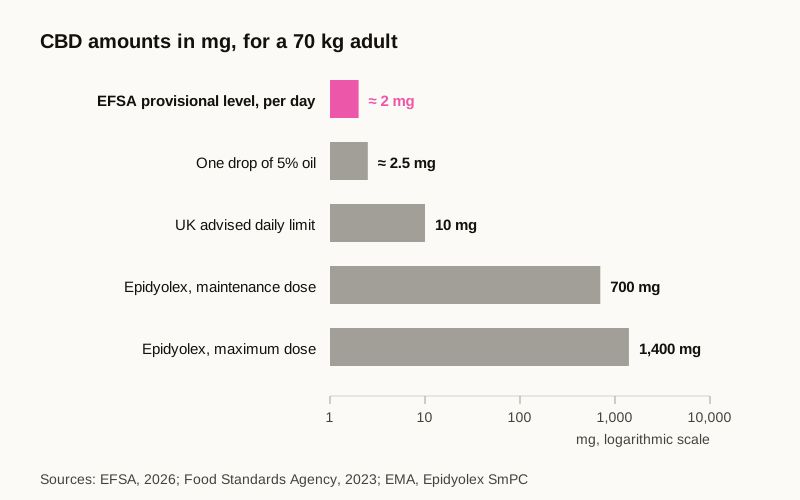
Published references span a range of 1 to 700. The United Kingdom sets a higher limit than the European Union: the Food Standards Agency has advised healthy adults since October 2023 not to exceed 10 mg of CBD a day, "about 4-5 drops of 5% CBD oil". It advises against CBD for minors, for people on medication without medical advice, and during pregnancy, breastfeeding or when trying to conceive.
| Reference | Amount for 70 kg | Source |
|---|---|---|
| Provisional safe level, food | About 2 mg a day | EFSA, February 2026 |
| One drop of 5% oil | About 2 to 2.5 mg | Derived from FSA advice |
| Advised daily limit, food | 10 mg a day | FSA, October 2023 |
| Epidyolex, maintenance dose | 700 mg a day (10 mg/kg) | EMA, SmPC |
| Epidyolex, maximum dose | 1,400 mg a day (20 mg/kg) | EMA, SmPC |
Epidyolex is the only authorised CBD-based medicine. It is prescribed for rare forms of epilepsy, with a maintenance dose of 10 mg/kg a day and a maximum of 20 to 25 mg/kg depending on the indication. At these doses, under medical supervision, the most frequent side effects are sleepiness (23% of patients), reduced appetite (21%) and diarrhoea (20%), and a rise in liver enzymes requires monitoring. These figures are not a target: they show that CBD's effects depend on the dose. Our article on Epidyolex details its framework, and the one on CBD side effects the available data.
Counting in drops: what 2 mg means on a bottle
An oil's percentage gives its concentration, not the amount swallowed: that depends on the number of drops. A 10 ml bottle labelled 10% holds 1,000 mg of CBD when the percentage is expressed as mass per volume, or 100 mg per ml. The total amount in mg, shown on the label, remains the safest figure.
The volume of a drop varies with the dropper and the oil's viscosity. The FSA advice, 10 mg for 4 to 5 drops of 5% oil, corresponds to about twenty drops per ml. On that assumption:
| Concentration | CBD per ml | CBD per drop | Share of a drop for 2 mg |
|---|---|---|---|
| 5% | 50 mg | 2.5 mg | 4/5 of a drop |
| 10% | 100 mg | 5 mg | 2/5 of a drop |
| 20% | 200 mg | 10 mg | 1/5 of a drop |
Above 5%, EFSA's reference fits in a fraction of a drop that no dropper can deliver. A 20 mg capsule exceeds it tenfold, a 10 mg gummy fivefold. Our guide to sublingual use describes the dropper method, and the oils in the catalogue state their total CBD content in mg.
Splitting, microdosing, increasing: what changes
EFSA's reference is a daily total. Splitting the same amount into two or four doses does not change it. "Microdosing", taking very small amounts several times a day, rests on no comparative study: it is a user practice, not a validated method. The "start low, go slow" rule, common in the trade, serves to calibrate a felt effect. It does not make an amount above the reference safe.
Two points are worth knowing before any regular use. CBD goes through the liver enzymes that clear many medicines, hence possible interactions, described in our article on the grapefruit effect. And CBD's effect does not necessarily rise with the dose, as our article on the biphasic effect explains. As for microdosing THC, it has no legal framework: a product with more than 0.30% THC is a controlled drug, whatever amount is taken.
The French framework: no CBD food, no dosage
In France, the question "how much to swallow" first runs into the law. The Ministry of Agriculture restated on 20 May 2026 that foods containing CBD, including supplements, oils and gummies, are not authorised under Regulation (EU) 2015/2283 on novel foods, and must be withdrawn from the market. Hemp seeds, their derivatives such as seed oil, and leaves intended for infusions remain authorised, with no added cannabinoid extract. Our overview of CBD regulation in 2026 and our article on the withdrawal of gummies detail the situation.
The vocabulary follows the same logic. Article L. 5111-1 of the Public Health Code makes a medicine of any product presented as having curative or preventive properties with regard to diseases. A brand that writes "25 mg to sleep" presents its product as a medicine. That is why no serious product page gives a dosage.
Some people have no reference level at all. EFSA excludes under-25s, pregnancy, breastfeeding and ongoing treatment. ANSES proposed in March 2025 classifying CBD as presumed toxic to reproduction, as our article on CBD during pregnancy explains. For drivers, a full-spectrum oil contains traces of THC that a saliva test can detect, as our drug testing guide explains.
Frequently asked questions
What is the maximum amount of CBD per day?
The European reference is EFSA's: 0.0275 mg per kilo per day, about 2 mg for 70 kg. It is provisional and only applies to adults over 25, excluding pregnancy, breastfeeding and medical treatment. The United Kingdom sets 10 mg a day.
How many drops for 2 mg of CBD?
With a dropper of about 20 drops per ml, one drop of 5% oil holds about 2.5 mg, one drop of 10% oil about 5 mg. EFSA's reference therefore equals less than one drop, whatever the usual concentration.
Why is EFSA's reference so low?
Because it starts from animal studies showing effects on the liver, divided by an uncertainty factor of 400 to cover gaps in the data. The agency will review this value when new toxicological and human data become available.
Is CBD dangerous above 2 mg?
The reference does not mark a danger threshold, but the limit below which EFSA considers the risk ruled out on current data. Above it, safety has not been demonstrated. At medical doses, far higher, sleepiness, digestive problems and raised liver enzymes are documented.
Can I buy a CBD oil to swallow in France?
Not as a food or food supplement: the Ministry of Agriculture restated on 20 May 2026 that foods containing CBD are not authorised. The only authorised CBD to swallow is a medicine, Epidyolex, on prescription.
Written by the Phytogrammes team
Every article in this journal draws on primary sources (ANSM, EFSA, EUR-Lex, peer-reviewed publications) and on the lab's own practice: batch-by-batch HPLC analyses, measured cannabinoid profiles. Our approach.
Article published on . CBD is not a medicine.