CBD biphasic effect: why 300 mg beat 600 mg
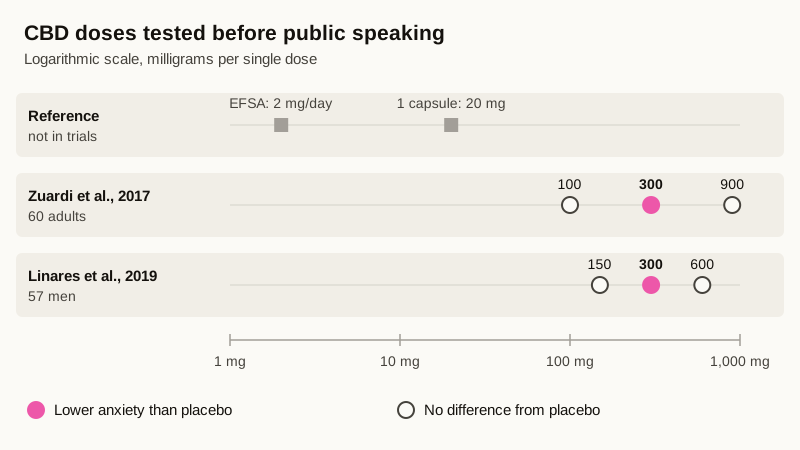
A biphasic effect rises with the dose, peaks, then falls: the curve forms an inverted U. For CBD, two Brazilian trials saw this pattern in the anxiety caused by speaking in public: only the 300 mg dose differed from placebo, not 100, 150, 600 or 900 mg. These doses have nothing in common with those of a retail product, and the result holds only for this test.

Contents
> Key takeaways > > - Biphasic, or "bell-shaped": the effect climbs with the dose, peaks, then comes back down. > - In 2017 (60 volunteers) and again in 2019 (57 men), 300 mg of CBD lowered the anxiety measured during a speech. Lower and higher doses did not. > - One possible mechanism comes from rats: at high doses, CBD may also activate TRPV1 receptors that work against its effect. > - THC shows the same profile: 7.5 mg eased the distress of a stress test, 12.5 mg worsened mood. > - 300 mg is 150 times the EFSA's provisional reference level of 2 mg per day for 70 kg.
What "biphasic effect" means
We usually expect a bigger dose to produce a bigger effect. A biphasic response breaks that rule. Put the dose on the horizontal axis and the effect on the vertical axis: the curve rises, peaks, then falls. Pharmacologists call it an inverted U-shaped or bell-shaped curve.
The pattern is not specific to CBD. In animals, the anxiolytic effect of cannabidiol already followed bell-shaped curves, the authors of the 2019 trial point out. Anxiolytic here means: lowering the anxiety measured during the experiment. The open question was whether the same profile would appear in humans.
Two trials, the same peak at 300 mg
The first answer came from the University of São Paulo, in Ribeirão Preto. In 2017, Antonio Zuardi and colleagues split 60 volunteers of both sexes, aged 18 to 35, into five groups: placebo, clonazepam 1 mg (a reference anti-anxiety drug), and CBD at 100, 300 or 900 mg. Each person had to speak in front of the other participants. After the speech, only two groups reported lower anxiety than placebo: clonazepam and CBD 300 mg.
In 2019, the same team ran the test again with other doses. The trial by Linares and colleagues, published in the Brazilian Journal of Psychiatry, gave 150, 300 or 600 mg of CBD, or a placebo, to 57 healthy men. The capsules were taken 90 minutes before a simulated public speaking test. Only the 300 mg group showed clearly lower anxiety than placebo during the speech. Between 150 mg, 600 mg and placebo, scores did not differ.
| Trial | Participants | CBD doses tested | Dose that differed from placebo |
|---|---|---|---|
| Zuardi et al., 2017 | 60 adults, men and women | 100, 300 and 900 mg | 300 mg, after the speech |
| Linares et al., 2019 | 57 men | 150, 300 and 600 mg | 300 mg, during the speech |
Why a higher dose might do less
Nobody has demonstrated the mechanism in humans. The most cited lead comes from a rat experiment published in 2009. Alline Campos and Francisco Guimarães injected CBD into an area of the midbrain involved in anxiety responses. The low dose had an anxiolytic effect, the high dose did not. When they first blocked TRPV1 receptors, the high dose regained an effect.
Their hypothesis works in two steps. At high concentrations, CBD would also activate these TRPV1 receptors, which increase the release of glutamate, an excitatory chemical messenger. That effect would oppose the one that runs through other targets, such as serotonin 5-HT1A receptors. The authors of the 2019 trial repeat this explanation as a possibility, not as an established fact.
THC also shows a biphasic response. At the University of Chicago, Emma Childs and colleagues gave 0, 7.5 or 12.5 mg of oral THC to 42 adults before a social stress test. At 7.5 mg, reported distress after the test went down; at 12.5 mg, negative mood went up, both before and during the tasks. THC is a narcotic in France. The example only shows that this profile is not a CBD oddity.
What these trials do not allow us to conclude
These results hold for what they measure, and what they measure is narrow. The main limits, several of which the authors list themselves:
- groups of 12 to 15 people per dose;
- a single dose, not repeated use;
- one situation, public speaking, in volunteers with no anxiety disorder;
- in 2019, men only, and only self-reported anxiety, with no hormone measurement;
- several authors are co-inventors of a patent on CBD derivatives, which the paper discloses.
These trials do not make 300 mg a "good dose". They show that, in this protocol, the relationship between dose and effect was not linear. Nor do they allow anyone to credit CBD with an effect on an anxiety disorder. The only authorised CBD-based medicine, Epidyolex, is prescribed for rare forms of epilepsy. Our overview of what clinical studies really say puts this work in the context of the wider research.
Doses far beyond any retail product
300 mg is a lot. On 9 February 2026, the EFSA published a provisional safe level of 0.0275 mg per kilo of body weight per day for CBD in food supplements. For a 70 kg adult, that is about 2 mg. The dose in these trials is 150 times higher. It also equals 15 capsules of 20 mg, or 3 ml of an oil containing 100 mg per millilitre.
The EFSA states that this level does not cover people under 25, pregnancy and breastfeeding, or people taking medication. CBD changes the activity of some liver enzymes that clear medicines: our article on the grapefruit effect explains this risk. In France, CBD foods and supplements are also not authorised, as our piece on the EFSA reference dose explains.
The practical lesson is modest: "more" does not mean "stronger". For a CBD oil, the concentration on the label is what converts drops into milligrams. Our article on taking CBD under the tongue explains how the route of intake changes the amount that reaches the blood.
Frequently asked questions
What is a biphasic effect?
It is a response that increases with the dose up to a maximum, then decreases as the dose keeps rising. On a chart, it traces an inverted U.
Has CBD's biphasic effect been demonstrated?
For one specific situation, yes: two trials by the same Brazilian team, in 2017 and 2019, found lower anxiety than placebo only at 300 mg, during public speaking. It has not been demonstrated for other uses or for repeated intake.
Does a higher dose of CBD have more effect?
Not in these trials: 600 and 900 mg did no better than placebo, while 300 mg stood out. Beyond a certain point, increasing the amount did not increase the measured effect.
Why 300 mg and not 30 mg?
The researchers tested doses close to those used in clinical trials, from 100 to 900 mg. No dose below 100 mg was assessed in these two protocols, which therefore say nothing about the amounts in an everyday product.
Does THC also have a biphasic effect?
Yes, in a 2017 trial on 42 adults: 7.5 mg of THC reduced reported distress after a stress test, while 12.5 mg increased negative mood. THC remains a narcotic in France.
Written by the Phytogrammes team
Every article in this journal draws on primary sources (ANSM, EFSA, EUR-Lex, peer-reviewed publications) and on the lab's own practice: batch-by-batch HPLC analyses, measured cannabinoid profiles. Our approach.
Article published on . CBD is not a medicine.