CBD and hot flushes: no trial published to date
As of 23 September 2026, no published clinical trial has tested CBD against menopausal hot flushes. The only data on this symptom come from a study in rats. In two surveys, women who use cannabis at the menopause cite sleep and anxiety first, and only 5 to 13% cite hot flushes.
Contents
> Key takeaways > > - Hot flushes affect between a third and a half of women at the menopause, according to France's Inserm. > - No published trial in women; a trial of 50 women, completed in 2024, has not published results. > - In 2023 the North American Menopause Society listed cannabinoids among the "not recommended" options for this symptom. > - Treatments exist and require medical advice: hormone therapy, and since 2023 a non-hormonal medicine, fezolinetant. > - In France, no CBD product may be presented as acting on the menopause.
Hot flushes: common and better understood
The menopause occurs between 45 and 55, at 51 on average in France. According to Inserm, the French national health research institute, hot flushes affect between a third and a half of women. They fade over time, but a quarter of women still have them after ten years.
Their mechanism is now better understood. A 2023 review describes the role of neurons in the hypothalamus, called KNDy, which send their signals to the temperature-regulating centre. When oestrogen falls, these neurons become more active, and their messenger, neurokinin B, triggers the episodes of heat. This finding led to a new medicine, described below.
CBD and hot flushes: what research has tested
In women, nothing has been published. The international trials registry lists a Czech placebo-controlled trial in 50 women, using 100 mg CBD vaginal suppositories for 30 days. It ended in February 2024 with no published results. An American trial of 104 women, completed in October 2025, mainly measured mood and anxiety; its results are not published either.
The only study aimed at this symptom was done in rats. Published in April 2026, it gave 10 mg of CBD per kilo per day to female rats whose ovaries had been removed, a model of oestrogen deficiency. CBD prevented the rise in tail temperature measured in untreated rats. A result in animals does not transfer to women, in dose or in effect.
Another lead often comes up online: the TRPV1 receptor, which plays a part in sensing heat. In 2014 an Italian team showed that CBD activates and then desensitises this receptor in cultured cells. The study was about epilepsy and did not measure body temperature. It says nothing about the menopause.
What women who use cannabis report
Two surveys questioned perimenopausal or postmenopausal women. In the United States, 258 women answered a Harvard team in 2022; in Canada, 1,485 women in Alberta in 2023, of whom 499 were then using cannabis. In both cases this means cannabis in all its forms, with or without THC, not CBD alone.
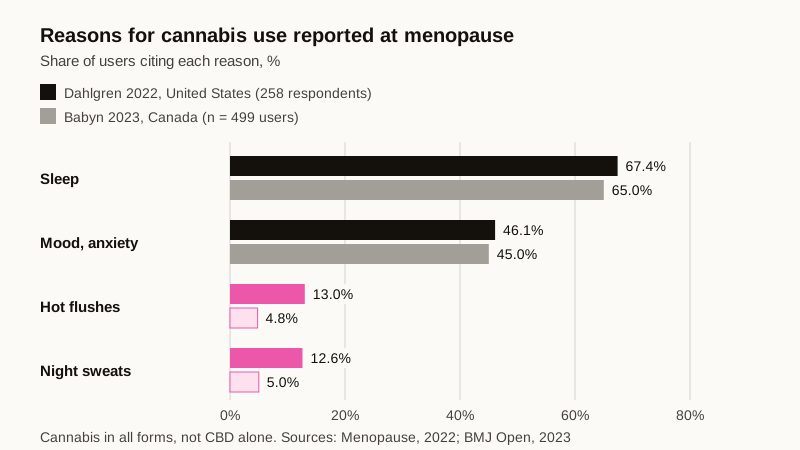
Sleep comes first, cited by 67.4% and 65% of users, ahead of mood and anxiety. Hot flushes come only after: 13.0% in the American survey and 4.8% in the Canadian one. In Canada, 74% of users found cannabis helpful, but this self-reported feeling, with no comparison group, does not measure an effect. The Canadian authors themselves conclude that safety and efficacy remain to be assessed.
What medical societies and authorities say
In 2023 the North American Menopause Society reviewed the non-hormonal options for hot flushes. It placed cannabinoids among the "not recommended" options, alongside yoga, acupuncture and soy extracts, for lack of sufficient evidence.
In France, the HAS, the national health authority, considers menopausal hormone therapy useful when symptoms impair quality of life, at the lowest dose and for the shortest time, with at least a yearly review. A non-hormonal medicine, fezolinetant, has been authorised in the European Union since 7 December 2023. It blocks the action of neurokinin B. Since late 2024 the European Medicines Agency has required liver checks before and during this treatment. These choices are made with a doctor.
CBD at the menopause: the precautions that apply
A woman considering CBD at this time should know two limits. The first concerns medicines. CBD goes through the same liver enzymes as many treatments, and the article on the grapefruit effect details these interactions. The second concerns the dose. In February 2026 EFSA published a provisional level of about 2 mg of CBD a day for a 70 kg adult, which does not apply to people on medication.
Talk to your doctor or pharmacist if you take hormone therapy, an antidepressant or an anticoagulant. Our article on the daily CBD dose explains the EFSA calculation, and the one on CBD in older people covers age-related precautions.
What the law allows sellers to say
Regulation (EC) No 1924/2006 prohibits any unauthorised health claim on a food. Presenting a product as acting on a disease or its symptoms also makes it a medicine by presentation under French law. A seller therefore cannot present a CBD product as a way to reduce hot flushes or menopausal complaints, whatever its form.
If a website does so, that is a warning sign about the seller. Our review of clinical studies on CBD shows what is demonstrated, and at what dose.
Frequently asked questions
Does CBD reduce hot flushes?
Nobody knows. No published trial had tested it in women as of 23 September 2026. The only data come from a study in rats, published in April 2026.
Why do some women use cannabis at the menopause?
Mainly for sleep and anxiety, according to two North American surveys from 2022 and 2023. Hot flushes are cited by only 5 to 13% of users. These surveys cover cannabis in general, not CBD alone.
Can CBD replace menopausal hormone therapy?
No. CBD is not a medicine and has no indication in the menopause. Hormone therapy and fezolinetant are prescribed after a medical assessment.
Can you take CBD with hormone therapy?
Ask your doctor or pharmacist first. CBD can interact with medicines, and the EFSA provisional level does not apply to people on medication.
Written by the Phytogrammes team
Every article in this journal draws on primary sources (ANSM, EFSA, EUR-Lex, peer-reviewed publications) and on the lab's own practice: batch-by-batch HPLC analyses, measured cannabinoid profiles. Our approach.
Article published on . CBD is not a medicine.