CBD and migraine: what the first controlled trial found
*In the first randomised trial of cannabinoids for acute migraine, published in the February 2026 issue of Headache, CBD on its own did no better than placebo: pain dropped to mild or none within two hours in 53% of attacks, against 47% on placebo. Only the two arms containing 6% THC beat placebo, which is twenty times the French legal limit. In France, no CBD product may be presented as a migraine treatment.*
Contents
> Key takeaways > > - Migraine affects about 20% of women and 10% of men, according to Inserm. An attack lasts 4 to 72 hours. > - The 2026 trial followed 92 adults and 247 attacks treated with vaporised flower. CBD at 11% did not beat placebo. > - The blend of 6% THC and 11% CBD did better than placebo, but a flower with 6% THC is a controlled drug in France. > - The other data come mostly from studies without placebo: reviews of observational studies, tracking apps. > - CBD changes how some medicines are cleared. A preventive treatment is a matter for your doctor, not a shop.
Migraine or tension-type headache: two different conditions
Migraine is not just a worse headache. It is a neurological disease that comes in attacks. According to the Inserm report on migraine, about 15% of the population is affected, 20% of women and 10% of men. Without effective treatment, an attack lasts 4 to 72 hours.
Tension-type headache is more common. The pain is diffuse and steady, not throbbing, and comes without nausea. Inserm notes that migraine-specific treatments do not work on it. Any study that mixes the two kinds of pain gives results that are hard to read.
A third picture matters here: medication-overuse headache. It develops when a person with migraine takes painkillers too often, and turns into an almost daily pain. Managing it means stopping the medicine involved, sometimes in hospital. Adding one more product to already frequent use moves in the wrong direction.
The 2026 trial: CBD alone does not beat placebo
Before this study, no randomised trial had tested a cannabinoid against an acute migraine attack, the authors note. The team at the University of California San Diego enrolled 92 adults with migraine. Each treated up to four attacks, one with each product, in random order and without knowing which one they had: a vaporised flower with 6% THC, one with 11% CBD, a blend of the two, or a placebo flower. The dose was taken within four hours of the start of the attack, in four inhalations, with at least one week between two treated attacks. In total, 247 attacks were treated. The study was funded by the Migraine Research Foundation and the US National Institutes of Health (NIH).
The main endpoint was the share of attacks where pain, moderate or severe at the start, had dropped to mild or none after two hours.
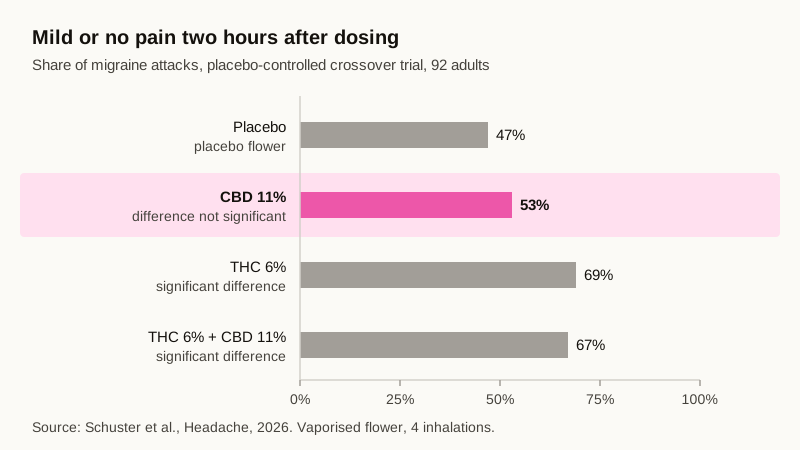
| Vaporised product | Mild or no pain at 2 h | No pain at all at 2 h | Difference from placebo |
|---|---|---|---|
| Placebo | 47% | 16% | Reference |
| CBD 11% | 53% | No significant difference | Not significant |
| THC 6% | 69% | No significant difference | Significant on pain relief only |
| THC 6% + CBD 11% | 67% | 35% | Significant on all three endpoints |
Several points limit what this result means for a French consumer. CBD was tested by vaporising a flower, not as an oil or a capsule. The "CBD" flower itself contained 0.35% THC, slightly above the French limit. Each participant treated only one attack per product. Above all, the two arms that worked contained 6% THC: the decree of 30 December 2021 caps Δ⁹-THC in authorised hemp at 0.30%, and a flower at 6% is a controlled drug. Our article on the legal THC level explains this threshold.
What the other studies are worth
Researchers are interested because of the endocannabinoid system, a network of receptors involved in passing on pain signals. That is a reason to do research, not proof that anything works.
The other data are weaker. A review published in 2022 in Frontiers in Neurology pooled 12 publications and 1,980 participants in Italy and the United States. Most concerned medical cannabis containing THC, often in studies without a control group. The authors find the results promising but call for well-designed trials. They also flag an unfavourable signal: one study they cite found medication-overuse headache in 81% of people with migraine who used medical cannabis, against 41% of non-users. That is an association, not proof that cannabis causes it.
A 2020 study in the Journal of Pain analysed 12,293 sessions logged in a tracking app for headache, and 7,441 for migraine. Users reported pain roughly halved after inhaling cannabis. There was no placebo and no check on the product, and the effect seemed to fade over time, with doses rising. These figures describe what people report, not what the molecule does.
None of these studies looks at a THC-free CBD oil, the product sold in French shops.
Why no CBD product can call itself "anti-migraine"
MILDECA points out that products containing CBD may not make therapeutic claims, on pain of criminal penalties, unless they have been authorised as medicines. Article L5111-1 of the French Public Health Code defines as a medicine any product presented as having curative or preventive properties. An oil sold "for migraine" would therefore be an unauthorised medicine.
The only cannabidiol medicine authorised in France is Epidyolex, prescribed for rare childhood epilepsies. Migraine is not one of its indications. Our article on CBD and pain sets out what the legal framework allows anyone to say on the subject.
Precautions if you take a treatment
CBD is cleared by the liver, by the same enzymes as many medicines. The Epidyolex summary of product characteristics, published by the European Medicines Agency, states that it inhibits the CYP2C19 enzyme and can therefore raise blood levels of other drugs. Our article on the grapefruit effect explains this mechanism.
For a person with migraine, three simple rules follow:
- do not stop or space out a prescribed preventive treatment to replace it with CBD;
- tell your doctor or pharmacist about any CBD product, as you would a food supplement;
- see a doctor if attacks change in pattern, become more frequent, or if you take painkillers more than a few days a week.
Frequently asked questions
Does CBD work for migraine?
Nothing shows that it does so far. In the only randomised trial published on acute migraine, in 2026, the 11% CBD flower did no better than placebo at two hours.
Why did the THC and CBD blend work in the trial?
The blend contained 6% THC, and the THC-only flower also beat placebo on pain. The result is therefore at least partly due to THC, a controlled drug in France above 0.30% in hemp.
Can you buy an "anti-migraine" CBD product in France?
No. A product presented as having curative properties is a medicine under the Public Health Code, and no CBD product is authorised for migraine.
Can CBD replace my preventive treatment?
No. CBD is not a migraine medicine and can change the blood level of some treatments. Any change is decided with the doctor who follows you.
Written by the Phytogrammes team
Every article in this journal draws on primary sources (ANSM, EFSA, EUR-Lex, peer-reviewed publications) and on the lab's own practice: batch-by-batch HPLC analyses, measured cannabinoid profiles. Our approach.
Article published on . CBD is not a medicine.