CBD and the liver: what blood tests show, dose by dose
CBD can raise liver enzymes, and the risk grows with the dose. In a trial run by the FDA, 5.6% of healthy adults went above three times the upper limit of normal after four weeks at 5 mg/kg a day, with no symptoms at all. Among consumers taking about 50 mg a day, an observational study found only 0.36%. For most people, the more practical issue lies elsewhere: CBD slows the clearance of several medicines.
Contents
> Key takeaways > > - The marker to watch is ALT (alanine aminotransferase), an enzyme that leaks into the blood when liver cells are under strain. > - On Epidyolex, 3% of patients at 10 mg/kg a day and 15% at 20-25 mg/kg went above three times normal. > - In healthy adults, 250 to 550 mg a day for 28 days was enough to produce these rises in 8 people out of 151. > - The rises are silent: only a blood test picks them up. Levels went back to normal one to two weeks after stopping. > - EFSA sets a provisional reference of about 2 mg a day for 70 kg and excludes people on medication.
What a blood test measures
A liver panel measures several enzymes. The transaminases, ALT and AST, sit inside liver cells. When those cells are damaged, they release them into the blood and the measured level goes up. CBD studies use one threshold: three times the upper limit of normal. Above it, the rise is considered clinically notable. Combined with a raised bilirubin and no other explanation, it signals serious liver injury, as the Epidyolex summary of product characteristics points out.
A rise is not liver disease. But it shows the organ is reacting, and it justifies stopping the product involved or lowering the dose.
From the bottle to the medicine: five studies, five dose levels
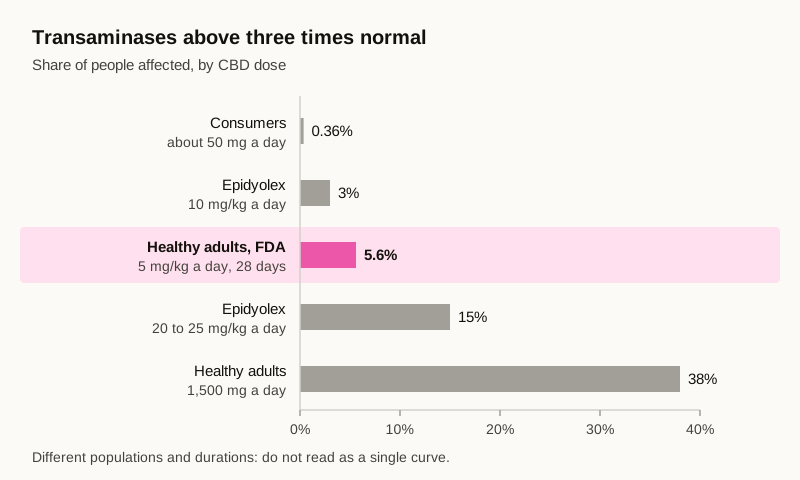
The data come from very different populations: consumers, healthy volunteers, children with epilepsy on several treatments. The chart ranks them by dose without pretending to draw a single curve.
| Study | Population | CBD dose | Above 3 times normal |
|---|---|---|---|
| Kaufmann, 2023, observational | 839 consumers | 50 mg a day on average | 0.36% |
| FDA, 2025, randomised, placebo-controlled | 151 healthy adults on CBD | 250 to 550 mg a day, 28 days | 5.6% (placebo: 0%) |
| Epidyolex, controlled trials | Patients with epilepsy | 10 mg/kg a day | 3% |
| Epidyolex, controlled trials | Patients with epilepsy | 20 to 25 mg/kg a day | 15% |
| Watkins, 2021, phase I | 16 healthy adults | 1,500 mg a day | 38% |
The randomised trial run by the FDA, published in 2025 in JAMA Internal Medicine, is the most useful for a consumer. It gave purified CBD or a placebo to 201 healthy adults, at 2.5 mg/kg twice a day, or 250 to 550 mg a day, for 28 days. Eight people on CBD out of 151 went above three times normal, none on placebo. Seven reached the stopping threshold set for possible drug-induced liver injury. None had symptoms, and levels returned to normal one to two weeks after stopping.
At higher doses, the signal climbs. In a phase I trial published in 2021, 16 healthy adults received up to 1,500 mg a day. Seven saw their ALT go above normal, five beyond five times normal, and six had to leave the study. The rises appeared between the second and fourth week.
At the other end, a 2023 observational study followed 839 consumers of shop products, at 50 mg a day on average. The share with ALT above normal, 9.1%, was close to that of the general US population. Only three people went above three times normal. The study had no control group and was funded by twelve CBD companies, which calls for a cautious reading.
What the Epidyolex leaflet says
Epidyolex is the only authorised CBD-based medicine. Its summary of product characteristics, published by the European Medicines Agency, gives the most complete figures. In controlled trials, 12% of patients on CBD went above three times normal, against less than 1% on placebo.
The same document identifies the risk factors:
- the dose: 3% of patients at 10 mg/kg a day, 15% at 20 or 25 mg/kg;
- valproate, an antiepileptic: 19% of patients taking it, 23% with clobazam as well, against 3% with neither;
- an already abnormal panel: 29% had rises when ALT was above normal at the start, against 12%.
Rises usually occur in the first two months, sometimes up to 18 months in patients on valproate. The doctor orders transaminase tests before treatment, then at 1, 3 and 6 months.
The most common risk: drug interactions
The liver clears CBD through the cytochrome P450 enzymes and the UGT enzymes, the same ones that handle a large share of medicines. CBD slows several of them down. According to the Epidyolex summary of product characteristics:
| Situation | Measured effect |
|---|---|
| CBD and clobazam | Active metabolite of clobazam multiplied by 3 to 4, via the CYP2C19 enzyme |
| CBD at 1,500 mg a day and caffeine | Caffeine exposure increased by 95% |
| CBD and everolimus, an immunosuppressant | Everolimus exposure multiplied by about 2.5, blood level monitoring recommended |
| CBD and St John's wort, rifampicin or carbamazepine | CBD level lowered by these enzyme inducers |
| CBD and alcohol | CBD exposure increased by 63%, stronger drowsiness |
Narrow-margin medicines, where the effective dose is close to the toxic dose, are the most affected. Our article on the grapefruit effect explains this mechanism. In practice, tell your doctor or pharmacist about any CBD product, as you would a food supplement.
What dose, and who should abstain
EFSA published on 9 February 2026 a provisional safe level of 0.0275 mg of CBD per kilo per day, or about 2 mg for a 70 kg adult. The agency lists the liver among its data gaps. It considers that the safety of CBD cannot be established under 25, during pregnancy or breastfeeding, or in people on medication. Our article on the EFSA reference dose converts this benchmark into drops.
The doses linked to enzyme rises remain far above it: 250 mg a day is more than a hundred times this benchmark. Between 2 and 250 mg, human data are scarce.
Be more careful if you:
- have a known liver disease or an already abnormal liver panel;
- take a long-term treatment, especially an antiepileptic, an anticoagulant or an immunosuppressant;
- drink alcohol regularly.
Enzyme rises cause no symptoms at first. If you take CBD alongside a treatment monitored by blood tests, mention it to the prescriber. Our article on the side effects of CBD covers the other adverse effects described.
Frequently asked questions
Does CBD damage the liver?
It can raise liver enzymes, especially at high doses: 5.6% of healthy adults at 250-550 mg a day in the FDA trial. Around 50 mg a day, a study without a control group found a rate close to the general population.
From what dose does the risk appear?
Documented rises start around 5 mg/kg a day, or about 350 mg for 70 kg. Below that, the data are too thin to set a threshold. EFSA uses 2 mg a day as a provisional benchmark.
Does CBD interact with my medicines?
It can. It inhibits the CYP2C19 enzyme in particular and, more weakly, CYP1A2, which can raise the blood level of other drugs. Talk to your pharmacist before combining the two.
Should I have a blood test if I take CBD?
At shop doses, no guideline requires it. On Epidyolex, monitoring is mandatory. If you already have a liver panel followed for another reason, tell the doctor who orders it about the CBD.
Written by the Phytogrammes team
Every article in this journal draws on primary sources (ANSM, EFSA, EUR-Lex, peer-reviewed publications) and on the lab's own practice: batch-by-batch HPLC analyses, measured cannabinoid profiles. Our approach.
Article published on . CBD is not a medicine.