Is CBD legal in France in 2026? What is still on sale
Yes, CBD is still legal in France in 2026, but no longer in every form. Since 15 May 2026, CBD products meant to be swallowed (oils sold as food supplements, capsules, sweets, drinks, infusions made from flowering tops) have been withdrawn from sale because none holds an authorisation under the EU novel food regulation. Flowers and resins that are not presented as food, and cosmetics, remain on sale with no more than 0.30% Δ⁹-THC.
Contents
- 01CBD in 2026: it all depends on how the product is used
- 02What changed on 15 May 2026: products you swallow
- 03Why CBD is not banned all the same
- 04What EFSA said in 2026, and what it did not say
- 05The "tobacco" tax on CBD: proposed, then dropped from the budget
- 06Quality: what official analyses show
- 07Frequently asked questions
> Key takeaways > > - CBD is not a narcotic: the Court of Justice of the European Union ruled so on 19 November 2020. > - Flowers and resins can be sold since the Conseil d'État annulled their ban on 29 December 2022. > - Since 15 May 2026, every food or supplement containing CBD is withdrawn: none has a "Novel Food" authorisation. > - The EFSA reference level published on 9 February 2026, 2 mg of CBD a day for a 70 kg adult, is not an authorisation. > - The tobacco-style tax considered in the 2026 budget was dropped from the text in January 2026.
CBD in 2026: it all depends on how the product is used
The same molecule falls under three different sets of rules depending on how the product is presented. Hemp law sets the THC threshold. Food law decides whether you may swallow it. Cosmetics law covers what goes on the skin. The table sums up the situation in September 2026.
| Product | Status in September 2026 | Applicable text |
|---|---|---|
| Oil presented as a food supplement, capsules | Withdrawn from sale | Regulation (EU) 2015/2283, DGAL control plan |
| CBD sweets, chocolates, drinks | Withdrawn from sale | Regulation (EU) 2015/2283 |
| Infusion made from flowering tops | Withdrawn from sale | Regulation (EU) 2015/2283 |
| Seeds, seed oil, leaves for water infusion | Allowed, with no added cannabinoid extract | Foods consumed before 1997 |
| Flowers and resins not presented as food | On sale, Δ⁹-THC ≤ 0.30% | Order of 30 December 2021, as amended by the Conseil d'État |
| CBD cosmetics | On sale | Regulation (EC) 1223/2009 |
| Products containing HHC, H4CBD or THCP | Banned | French narcotics list (ANSM) |
Presentation matters as much as content. A flower sold in a bag "for infusion" becomes a foodstuff and falls under the withdrawal. The same flower, sold raw with no food claim, stays within hemp rules. Our article on the legal THC level explains the 0.30% threshold.
What changed on 15 May 2026: products you swallow
The Directorate-General for Food (DGAL), part of the French Ministry of Agriculture, told the industry unions on 15 April 2026 about a national control plan, applied from 15 May. The Provence-Alpes-Côte d'Azur chamber of agriculture lists the targets: sweets, sublingual oils labelled "food supplement", capsules, softgels, chocolates, drinks, infusions made from flowering tops. The trigger is the label: a food product that mentions CBD, THC or any other cannabinoid is covered, whatever its content.
On 20 May 2026 the ministry stated its position plainly. In its view, food products containing CBD are illegal and must be withdrawn from the market, because the safety of CBD has not been demonstrated. The ministry says it has run targeted checks since 2023 and is now extending them to every channel, online sales included. It also reports a clear rise in poisonings linked to CBD foods since 2024.
The legal basis is Regulation (EU) 2015/2283 on novel foods. It covers any food not consumed to a significant degree in the Union before 15 May 1997, and only authorised ones may be sold. No CBD ingredient has been authorised, as the Belgian Federal Public Service for Health recalled in a warning dated 5 May 2026. Our article on CBD gummies follows one of the hardest-hit formats.
Why CBD is not banned all the same
The withdrawal targets a food status, not the molecule. Two court rulings set this framework.
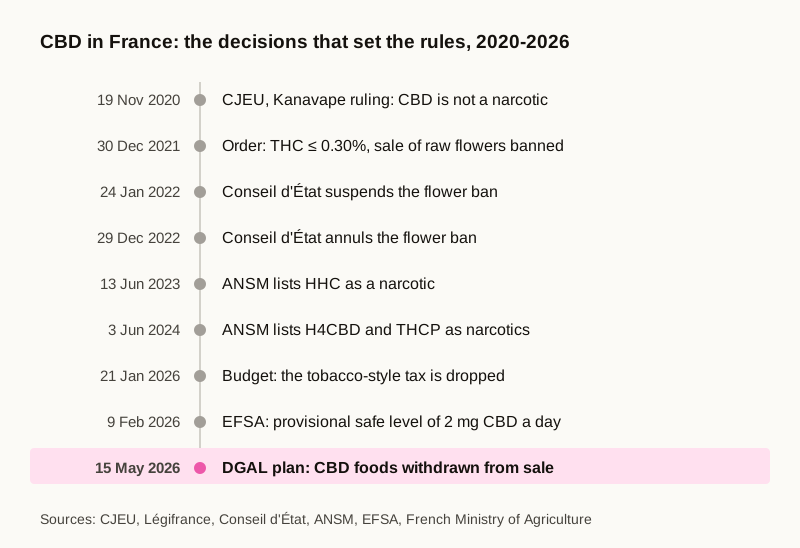
The first came from Luxembourg. In the Kanavape case (C-663/18), the Court of Justice of the European Union ruled on 19 November 2020 that a Member State may not ban the marketing of CBD lawfully produced in another Member State, even when extracted from the whole plant. An exception is possible if the measure protects public health and goes no further than necessary. The Court also found that CBD, on current knowledge, is not a narcotic drug under the 1961 UN Single Convention. Our article on the Kanavape ruling covers its effects.
The second came from the Conseil d'État, France's highest administrative court. The order of 30 December 2021 allowed hemp varieties with no more than 0.30% Δ⁹-THC, but banned the sale of raw flowers and leaves to consumers. The Conseil d'État suspended that ban on 24 January 2022, then annulled it on 29 December 2022, finding it disproportionate. The 0.30% threshold itself was upheld. The article on the order that tried to ban flowers tells the story.
What EFSA said in 2026, and what it did not say
The European Food Safety Authority (EFSA) concluded in June 2022 that the available data did not establish the safety of CBD as a novel food. On 9 February 2026 it published a provisional safe level of 0.0275 mg of CBD per kilo of body weight per day, about 2 mg a day for a 70 kg adult. The figure includes a safety factor for the uncertainties.
Three limits define its scope. It applies only to food supplements made from CBD at least 98% pure, with no nanoparticles. Safety is not established for people under 25, during pregnancy or breastfeeding, or for people taking medication. And EFSA says it will assess each application on its applicant's own data: a safe level authorises no product.
For scale: an oil titrated at 10% holds roughly 100 mg of CBD per millilitre. The 2 mg reference is one fiftieth of a millilitre. Our article on the EFSA reference dose runs the numbers for other strengths.
A second file is moving in parallel. ANSES, the French food and health safety agency, proposed on 21 March 2025 to classify CBD as toxic for reproduction, category 1B, based on animal studies. The Risk Assessment Committee of the European Chemicals Agency (ECHA) has issued an opinion in favour of this classification, according to the Belgian health authority. It is a hazard assessment: the European Commission has yet to decide, and the opinion bans no product. Details are in our article on the classification proposed by ANSES.
The "tobacco" tax on CBD: proposed, then dropped from the budget
Article 23 of the draft 2026 finance bill dealt with the taxation of smoking and vaping products. Along the way, treating CBD flowers as manufactured tobacco was on the table, Le Monde du Tabac reported on 20 January 2026. The National Assembly had in fact adopted amendment I-1277 on 20 November 2025, which deleted the article.
On 21 January 2026, Article 23 no longer appeared in the text on which the government staked its responsibility (Article 49.3 of the Constitution). The 2026 finance act was promulgated on 19 February 2026. No excise duty specific to CBD flowers came into force by this route. The debate over how to regulate smoked CBD is not over.
Quality: what official analyses show
The legal framework says nothing about what a product actually contains. A study backed by MILDECA, the French inter-ministerial drugs agency, and run in 2023 by the addiction-monitoring centres of Paris, Lyon and Montpellier, analysed 223 samples sold over the counter. 81% showed a CBD content different from the label. 6% contained undeclared semi-synthetic cannabinoids such as HHC or H4CBD. 87% met the 0.3% Δ⁹-THC threshold.
In June 2025, ANSES and ANSM warned of several hundred poisonings recorded since early 2024 after people used products sold as containing CBD. In most cases the cause was a banned substance added without the buyer's knowledge, or THC above 0.3%. ANSM listed HHC as a narcotic on 13 June 2023, then H4CBD and THCP on 3 June 2024.
The only check within a buyer's reach is the batch certificate of analysis. It should carry the same batch number as the product, show Δ⁹-THC below 0.30% and, ideally, show no HHC, H4CBD or THCP. Our guide to reading a certificate of analysis goes through each line, and the laboratory page describes the measurement methods. The CBD flowers in the catalogue fall under hemp rules, not food law.
Frequently asked questions
Is CBD legal in France in 2026?
Yes, with conditions. CBD flowers, resins and cosmetics from authorised varieties, with no more than 0.30% Δ⁹-THC, remain on sale. CBD foods and supplements have been withdrawn since 15 May 2026, for lack of a Novel Food authorisation.
Are all CBD oils banned?
No. An oil presented as a food supplement, or meant to be swallowed, is covered by the withdrawal. An oil sold as a cosmetic falls under Regulation (EC) 1223/2009 and stays on sale, provided it claims no food use.
Can you still buy CBD flowers?
Yes. Since the Conseil d'État decision of 29 December 2022, selling raw flowers and leaves is no longer banned. The flower must come from an authorised variety and contain no more than 0.30% Δ⁹-THC. Sold as an infusion, it becomes a food and falls under the withdrawal.
When might CBD products you swallow come back?
When the European Commission authorises an application, after assessment by EFSA. The provisional safe level published on 9 February 2026 is a step, not an authorisation. There is no official timetable to date.
Are CBD flowers taxed like tobacco?
No. Article 23 of the draft 2026 finance bill no longer appeared in the text adopted in January 2026. No excise duty specific to CBD flowers applies by this route.
Why is an infusion of hemp leaves still allowed?
Because hemp leaves infused in water, like seeds and seed oil, were consumed before 1997. According to the French Ministry of Agriculture, they are not novel foods, as long as no cannabinoid extract is added and THC limits are met.
Written by the Phytogrammes team
Every article in this journal draws on primary sources (ANSM, EFSA, EUR-Lex, peer-reviewed publications) and on the lab's own practice: batch-by-batch HPLC analyses, measured cannabinoid profiles. Our approach.
Article published on . CBD is not a medicine.