Full-spectrum CBD capsules: dosage, EFSA and the 2026 ban
Since 15 May 2026, CBD capsules meant to be swallowed have been withdrawn from sale in France, whether full spectrum, broad spectrum or isolate: no CBD-based ingredient has received "Novel Food" authorisation. The provisional reference EFSA published on 9 February 2026, 2 mg of CBD a day for a 70 kg adult, only applies to CBD at least 98% pure. A full-spectrum capsule dosed at 25 mg is therefore outside that framework twice over.
Contents
- 01Softgel, full spectrum: what are we talking about?
- 02The 15 May 2026 withdrawal: what the texts say
- 03EFSA's reference: 2 mg a day, and for which CBD
- 04Absorption: what the label does not tell you
- 05Full spectrum and THC: the point people forget
- 06Interactions and claims: the rules that have not changed
- 07Frequently asked questions
> Key takeaways > > - From 15 May 2026, France's food authority (DGAL) targeted CBD capsules, along with other foods and supplements containing CBD. > - EFSA's reference, 0.0275 mg per kilo a day, is not an authorisation to sell. > - A 25 mg capsule is 12.5 times that reference. > - Swallowed on an empty stomach, about 6% of CBD reaches the blood, and four times more with a high-fat meal.
Softgel, full spectrum: what are we talking about?
A softgel is a soft, sealed shell, usually made of gelatine, filled with an oil that holds the CBD extract. It differs from a hard capsule, made of two halves fitted together and filled with powder. On the label, the dose is given in milligrams of CBD per capsule.
The extract comes in three types. Full spectrum keeps all the compounds of hemp, including traces of THC and minor cannabinoids such as CBG. Broad spectrum removes the THC and keeps the rest. Isolate contains only CBD, purified to about 99%. Our articles on full spectrum, broad spectrum and isolate cover each format. The idea that full spectrum works better, the "entourage effect", remains an unproven hypothesis.
The 15 May 2026 withdrawal: what the texts say
The legal basis is Regulation (EU) 2015/2283 on novel foods. It covers any food whose consumption in the EU was negligible before 15 May 1997, and only allows those that have been authorised. CBD extracts fall into this category, and none has been authorised.
The DGAL announced to trade bodies on 15 April 2026 a control plan applied from 15 May. The Provence-Alpes-Côte d'Azur chamber of agriculture, which relayed the announcement, lists hard capsules and softgels among the products targeted, along with sweets, chocolates, drinks and sublingual oils labelled "food supplement". The trigger is the label: a food that mentions CBD, THC or another cannabinoid is covered, whatever its content.
On 20 May 2026, the Ministry of Agriculture published its position: foods containing CBD are not authorised, food supplements included. Only hemp seeds, their derivatives such as seed oil, and leaves for infusion in water remain allowed. Our overview of CBD regulation in 2026 covers the whole framework, and the article on CBD gummies follows another affected format.
EFSA's reference: 2 mg a day, and for which CBD
On 9 February 2026, the European Food Safety Authority published a provisional safe level of 0.0275 mg of CBD per kilo of body weight a day, about 2 mg a day for a 70 kg adult. Three conditions limit its scope:
- it only covers food supplements made with CBD at least 98% pure, without nanoparticles;
- safety is not established under 25, during pregnancy or breastfeeding, or for people taking medicines;
- EFSA will assess each application on its applicant's data, and gaps remain on the liver and the hormonal, nervous and reproductive systems.
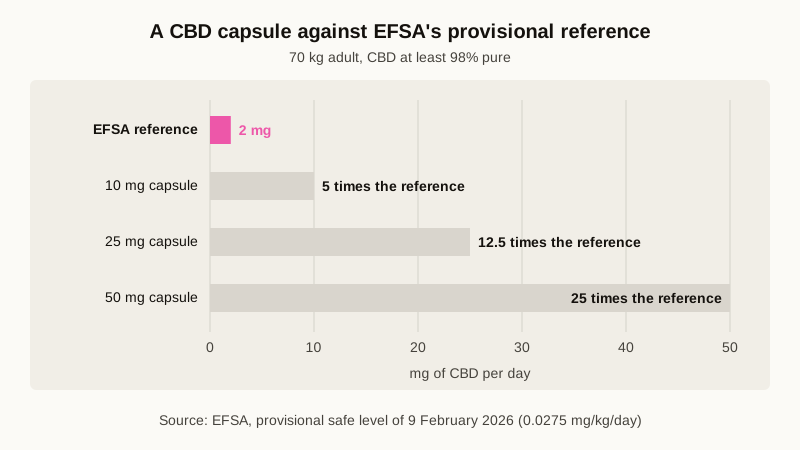
A full-spectrum or broad-spectrum extract does not reach 98% CBD, by definition. This reference therefore says nothing about its safety. For an isolate, the maths is simple: a 10 mg capsule is 5 times the reference, a 25 mg capsule 12.5 times, a 50 mg capsule 25 times.
Our article on EFSA's reference dose runs the same calculation for oils.
Absorption: what the label does not tell you
Once swallowed, CBD passes through the gut and then the liver before reaching the circulation. A 2020 review in CNS Drugs estimates that the oral bioavailability of CBD on an empty stomach is about 6%. In other words, of 25 mg swallowed, around 1.5 mg reaches the blood. The authors calculate that the liver removes 70 to 75% of the absorbed dose before it circulates.
The meal matters a lot. The same review reports that exposure rises about fourfold when CBD is taken with a high-fat meal. A phase 1 trial in healthy volunteers, using an oral solution of purified CBD, measured a blood peak 4 to 5 hours after the dose. The same capsule therefore gives very different exposures depending on whether it is taken fasting or with a fatty meal. This is one reason why the stated dose cannot be used to compare two swallowed products.
Full spectrum and THC: the point people forget
The French threshold of 0.30% Δ⁹-THC, set by the decree of 30 December 2021, applies to the plant and to the products made from it. It is expressed as a percentage of mass. An example shows what that means: a capsule whose contents weigh 500 mg, at the 0.30% threshold, can contain up to 1.5 mg of THC.
Even in traces, this THC is the molecule drug tests look for. Our guide to CBD and drug testing explains what saliva tests measure. On the road, driving after drug use has carried 3 years in prison and a €9,000 fine since the law of 9 July 2025, as our article on CBD and driving details.
Interactions and claims: the rules that have not changed
The liver clears CBD with the same enzymes as many medicines, including CYP3A4 and CYP2C19. Swallowed CBD can therefore change the blood level of an anticoagulant, an antiepileptic or an immunosuppressant. Our article on the grapefruit effect lists the drug families involved. The only authorised CBD-based medicine, Epidyolex, is an oral solution prescribed for rare epilepsies, under medical supervision.
No capsule may promise better sleep or less stress. Regulation (EC) No 1924/2006 only allows health claims that are authorised and on the EU list, and none concerns CBD.
What remains on sale falls under other frameworks: CBD flowers and resins not presented as food, with no more than 0.30% Δ⁹-THC, and cosmetics. To check a product, our guide to the certificate of analysis covers each line.
Frequently asked questions
Are CBD capsules still on sale in France?
Not legally. Since 15 May 2026, CBD capsules meant to be swallowed have been among the products targeted by DGAL checks, for lack of Novel Food authorisation.
What dose of CBD does EFSA consider safe?
In February 2026 EFSA set a provisional level of 0.0275 mg per kilo a day, about 2 mg for a 70 kg adult. It only applies to CBD at least 98% pure and authorises no product.
What is the difference between full spectrum and isolate?
Full spectrum keeps all the compounds of hemp, including traces of THC. Isolate contains only CBD. No authority has recognised either as more effective than the other.
Capsule or oil: which is absorbed better?
Both pass through the digestive tract and the liver once swallowed. On an empty stomach, about 6% of CBD reaches the blood, and about four times more with a fatty meal. Data on the under-the-tongue route remain scarce.
Can a full-spectrum CBD capsule make a saliva test positive?
It is possible, because it contains traces of THC, the molecule these tests look for. The risk depends on the amount of THC actually present, which only the batch certificate of analysis shows.
Written by the Phytogrammes team
Every article in this journal draws on primary sources (ANSM, EFSA, EUR-Lex, peer-reviewed publications) and on the lab's own practice: batch-by-batch HPLC analyses, measured cannabinoid profiles. Our approach.
Article published on . CBD is not a medicine.