CBN in France: legal status and 2 sleep trials
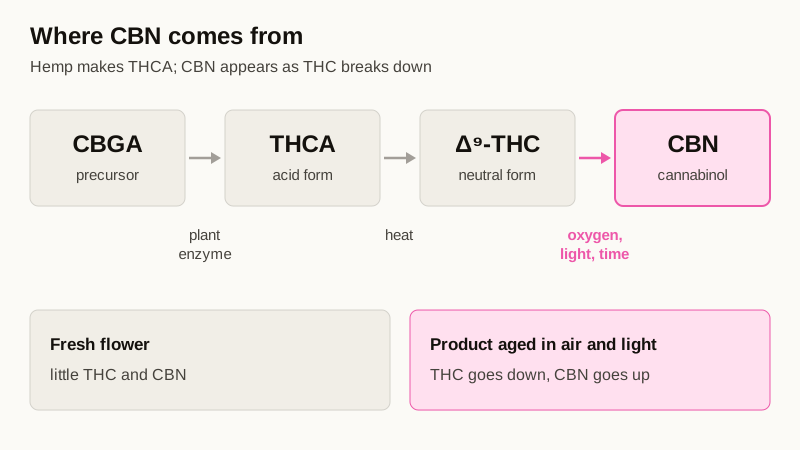
CBN, or cannabinol, is a cannabinoid that hemp hardly makes at all: it appears when THC oxidises over time, with heat and light. In France it is not classified as a narcotic, but since spring 2026 a food or food supplement containing it can no longer be sold. On sleep, two controlled trials exist, and neither met its primary endpoint.
Contents
> Key takeaways > > - CBN was the first cannabinoid ever isolated, in 1896, from Indian hemp. > - It forms mainly as THC breaks down: a fresh flower holds little, an aged product more. > - It is not on the narcotics list, unlike HHC, H4CBD and THCP. > - On 20 May 2026 the French Ministry of Agriculture declared foods containing CBD or other extracted cannabinoids illegal. > - 2024 trial (293 adults) and 2026 trial (20 patients): partial effects, primary endpoint missed in both.
Definition: a cannabinoid born from ageing THC
Cannabinol was the first cannabinoid ever isolated. A 2021 review in Frontiers in Pharmacology notes that it was extracted in 1896 from Indian hemp, and that its structure was worked out in the 1940s. For a long time it was believed to cause the effects of cannabis, until THC was identified.
The same review makes a point many product pages leave out: the plant does not synthesise CBN. It comes from the breakdown of Δ⁹-THC, which heat and ultraviolet light convert little by little. A fresh flower therefore contains very little. A flower or resin stored for a long time, exposed to air and light, builds up more as its THC declines.
At the receptor level, CBN is a weak partial agonist. According to the 2021 review, it binds less well than THC to the CB1 and CB2 receptors, and it is less potent than THC at CB1, the receptor behind the psychoactive effect.
| Molecule | Origin in the plant | Psychoactive effect | Status in France |
|---|---|---|---|
| THC | Heating of THCA | Yes | Narcotic, tolerated below 0.30% in authorised hemp |
| CBD | Heating of CBDA | No | Allowed, except in food |
| CBN | Oxidation of THC | Weak, less than THC | Not classified, except in food |
Our article CBD or CBN goes through the chemical comparison between the two molecules.
Legal status of CBN in France
CBN is not on any narcotics list. Do not confuse it with the semi-synthetic molecules the ANSM, the French medicines agency, has classified: HHC and two derivatives from 13 June 2023, then H4CBD, THCP and other derivatives from 3 June 2024. A "CBN" product containing any of them would fall under those decisions.
A product containing CBN must also respect the hemp framework: the order of 30 December 2021 caps Δ⁹-THC at 0.30%. A CBN-rich extract comes from degraded THC, so the remaining THC level has to be checked on the certificate of analysis.
The deciding question is ingestion. On 20 May 2026 the Ministry of Agriculture published a statement titled "Foods containing cannabidiol (CBD): illegal products that must be withdrawn from the market". It covers foods containing CBD or other extracted cannabinoids, food supplements included, on the basis of the EU novel food regulation. A CBN gummy, capsule or oil to swallow is therefore caught by the same ban as its CBD equivalent. Gummies that combine CBN and THC raise a narcotics problem on top of that: our article on CBN + THC gummies explains why.
CBN and sleep: what the two controlled trials measured
The "sleep cannabinoid" reputation came before the data. The 2021 review cited above still found little evidence of a CBN effect on sleep. Two randomised, placebo-controlled trials have been published since.
| Bonn-Miller et al., 2024 | Lavender et al., 2026 | |
|---|---|---|
| Participants | 293 adults analysed, sleep rated "poor" | 20 adults with diagnosed insomnia |
| Dose | 20 mg of CBN, 7 nights in a row | 30 or 300 mg, one night only |
| Primary endpoint | Sleep quality: not significant (p = 0.082) | Wake after sleep onset: not significant |
| Secondary results | Fewer night-time awakenings (p = 0.025) | At 300 mg, falling asleep 7 minutes faster |
| Measurement | Questionnaires | Laboratory polysomnography |
The first trial, published in Experimental and Clinical Psychopharmacology, compared a placebo, 20 mg of CBN alone and three CBN + CBD combinations (10, 20 or 100 mg of CBD). CBN alone reduced the number of awakenings and the overall sleep disturbance score. Adding CBD improved nothing. Neither the time to fall asleep nor next-day fatigue changed.
The second trial, published in 2026 in the Journal of Sleep Research, measured more rigorously but was tiny. At 300 mg, fifteen times the dose of the earlier trial, CBN shortened sleep onset by 7 minutes and slightly reduced arousals. At 30 mg, nothing changed. The authors list the limits themselves: 20 participants, one night, many outcomes tested.
These results do not make CBN a sleep aid. No health authority has recognised it as one, and no health claim may accompany its sale. Under Article L5111-1 of the French Public Health Code, a product presented as having curative properties becomes a medicine by presentation. Our review of CBD and sleep does the same exercise for CBD.
What the HAS recommends for insomnia
France's national health authority, the HAS, describes a three-step approach: sleep hygiene first, then cognitive behavioural therapy, then a sleeping pill as a last resort, for four weeks at most. CBN appears at none of these steps. Lasting insomnia is a matter for a doctor, not a shop shelf.
Precautions: residual THC, medicines, driving
The first risk of a CBN product lies in what else it contains. In June 2025 the ANSM and ANSES, the French food safety agency, reported several hundred poisonings since 2024 linked to products sold as CBD, most often because of synthetic cannabinoids or THC above 0.3%. Both agencies also point out that CBD taken with some medicines can reduce their effectiveness or increase their side effects. For CBN, interaction data are missing: the same caution applies, and a pharmacist's advice is needed if you take any treatment.
Pregnant or breastfeeding women and minors are excluded as a precaution. Finally, CBN itself is not what a saliva test looks for, but a full-spectrum hemp extract contains THC. French law penalises driving after narcotic use with no minimum threshold: our article on CBD and driving sets out the penalties since 2025.
Reading the analysis of a CBN product
On a certificate of analysis, look for four lines: CBN as a percentage or in mg/ml, Δ⁹-THC at 0.30% or less, THCA (which turns back into THC when heated), and the absence of HHC, H4CBD and THCP when the lab tested for them. The batch number must match the one on the bottle. Our guide to the certificate of analysis covers each section, and our laboratory page describes the measurement methods.
Frequently asked questions
Is CBN classified as a narcotic in France?
No. It is on no ANSM list. HHC has been classified since 13 June 2023, H4CBD and THCP since 3 June 2024.
Can you buy CBN gummies in France?
Not legally as food. The Ministry of Agriculture statement of 20 May 2026 declares foods containing CBD or other extracted cannabinoids illegal, food supplements included.
Does CBN make you sleep?
Neither published controlled trial met its primary endpoint. They observed limited secondary effects: fewer awakenings at 20 mg over 7 nights, falling asleep 7 minutes faster at 300 mg over one night. That is not enough to call it a sleep aid.
Does CBN get you high?
It acts weakly on the CB1 receptor, much less than THC. The real risk lies mostly in the residual THC a CBN product may contain.
Why does CBN cost more than CBD?
Because the plant makes almost none. You have to start from THC and let it break down, then check the THC that remains, which makes production harder.
Written by the Phytogrammes team
Every article in this journal draws on primary sources (ANSM, EFSA, EUR-Lex, peer-reviewed publications) and on the lab's own practice: batch-by-batch HPLC analyses, measured cannabinoid profiles. Our approach.
Article published on . CBD is not a medicine.