CBG (cannabigerol): definition of the mother cannabinoid
*CBG, or cannabigerol, is a hemp cannabinoid (Cannabis sativa L.) that does not produce the psychoactive effect of THC. Its acidic form, CBGA, is the molecule the plant turns into CBD, THC and CBC, which is why little of it remains in a mature flower: 0.4 to 1.0% across eight flowers in the Phytogrammes catalogue. In France it is sold under the same conditions as CBD: no more than 0.30% Δ⁹-THC in the finished product.*
Contents
> Key takeaways > > - CBG is one of more than 100 cannabinoids in hemp, and the precursor of the most abundant ones. > - The plant makes CBGA; heat turns it into CBG, just as it turns CBDA into CBD. > - CBG-rich varieties carry a barely active version of the enzyme that converts CBGA. > - The first controlled human trial, published in 2024, involved 34 adults and a single 20 mg dose. > - CBG is not classified as a narcotic, unlike HHC, H4CBD and THCP.
Definition: a minor cannabinoid that feeds the major ones
Hemp produces more than 100 different cannabinoids, notes a 2021 review in the Journal of Pharmacology and Experimental Therapeutics. The same review presents CBG as the precursor of the most abundant cannabinoids. It is called "minor" because little of it is left in the mature plant, not because it matters little. The "ger" in cannabigerol refers to the geranyl group in its structure.
Like CBD, CBG does not get you high. In the 2024 trial described below, participants reported no intoxication or measurable impairment after 20 mg.
Biosynthesis: why it is called the "mother molecule"
The plant joins two precursors, olivetolic acid and geranyl pyrophosphate (GPP). The enzyme that links them, olivetolate geranyltransferase (GOT), produces cannabigerolic acid, or CBGA. Three enzymes, THCA synthase, CBDA synthase and CBCA synthase, then compete for this same substrate and turn it into THCA, CBDA and CBCA. The variety's genetics decide which one wins: CBD hemp carries mainly CBDA synthase.
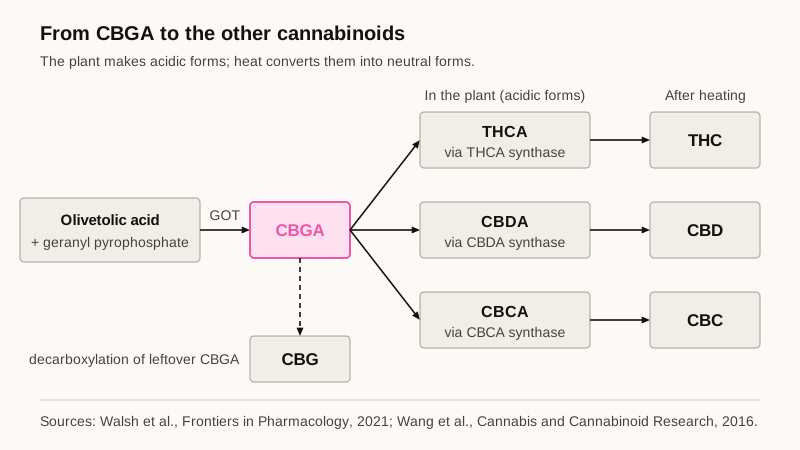
All these compounds start out in acidic form. Heat strips off a carboxyl group and yields the neutral forms, CBG, CBD, THC and CBC: this is decarboxylation. A 2016 study followed the reaction between 80 and 145 °C, for up to 60 minutes. CBGA and CBDA decarboxylated at almost identical rates, roughly half as fast as THCA. Our guide to decarboxylation covers the methods, and our CBDA explainer describes the acidic form of CBD.
Why so little is left in a mature flower
During flowering, the synthases convert CBGA almost as fast as it is made. At harvest, only a residue remains. A 2023 clinical toxicology study states that CBGA is commonly present at around 1% of dry weight in flowers on sale, while bred varieties can hold about ten times more. The Phytogrammes catalogue pages, checked on 22 September 2026, give a similar order of magnitude: across eight CBD-dominant flowers, CBG measured by HPLC ranges from 0.4 to 1.0%.
To get CBG in quantity, growers work on genetics. In 2005, researchers crossed CBG-rich plants with THC and CBD lines. Their results, published in Euphytica, trace CBG accumulation to two copies of a barely functional version of the converting enzyme, labelled B₀. CBGA is then hardly converted at all and builds up. These plants appeared mostly in European hemp populations.
This breeding is what makes CBG-dominant resins possible, such as the catalogue's CBG 90µ hash: 19.3% CBG and 4.2% CBD on batch PG-26-83EF. CBG products sit in the resins, hash and pollen category.
What research has measured, and its limits
In the lab, CBG acts on several targets. The review by Walsh and colleagues (2021) describes it as a weak partial agonist of CB1 and CB2 receptors: it binds to them and activates them a little, without activating them fully. It also acts as an agonist at α2 adrenergic receptors and as an antagonist at 5-HT1A serotonin receptors, and it activates several TRP channels as well as the nuclear receptor PPARγ. These data come from cells and animal models.
Human data are thin. The first controlled trial, published in 2024 in Scientific Reports, gave 20 mg of CBG or a placebo to 34 healthy adults who already used cannabis. Each took part in two sessions one week apart, followed remotely by video call. The authors observed a slightly larger drop in self-reported anxiety with CBG (26.5%) than with placebo (22.5%), better scores on a verbal memory test, and no measured intoxication.
The authors list the limits themselves: a single dose, a small sample, no vital signs recorded, no correction for multiple comparisons. A trial of this size supports no promise. CBG is not a medicine. The only authorised cannabidiol-based medicine, Epidyolex, contains CBD, not CBG.
Legal status of CBG in France
CBG is not on the narcotics list. It follows the hemp framework: the French order of 30 December 2021 authorises Cannabis sativa L. varieties listed in the official catalogues whose Δ⁹-THC content does not exceed 0.30%, and caps extracts and products containing them at the same level. The Conseil d'État decision of 29 December 2022 struck down the ban on selling raw flowers and leaves. The threshold is explained in our article on the legal THC level.
Do not confuse CBG with semi-synthetic molecules. The French medicines agency, ANSM, classified HHC, HHCO and HHCP as narcotics from 13 June 2023, then H4CBD, THCP and other derivatives from 3 June 2024. A "CBG" product containing any of them would fall under those decisions.
Swallowed, a CBG extract is treated as a novel food, like CBD extracts. Regulation (EU) 2015/2283 covers any food not consumed to a significant degree in the Union before 15 May 1997, and only allows authorised ones on the market. Our overview of CBD regulation in 2026 describes the situation in France.
Spotting CBG on an analysis
On a certificate of analysis, CBG appears as a percentage by mass (flower, resin) or in mg/ml (oil), often next to CBGA. Adding the two without correction overstates the total: when CBGA loses its carboxyl group, it loses about 12% of its mass. The usual calculation is therefore total CBG = CBG + 0.878 × CBGA. Example: a flower with 0.2% CBG and 0.5% CBGA contains at most 0.64% CBG after heating.
Three other lines deserve a look: the batch number, which must match the product sold, Δ⁹-THC at 0.30% or less, and the absence of HHC, H4CBD or THCP when the lab tested for them. Our guide to the certificate of analysis goes through each line, our laboratory page describes the measurement methods, and our article on CBG formats covers precautions for use.
Frequently asked questions
Is CBG the same as CBD?
No. Both are hemp cannabinoids without psychoactive effect, allowed under the same THC limit. CBG is the precursor the plant turns into CBD, and the two molecules do not act on the same receptors in the same way.
Does CBG get you high?
No. In the 2024 trial, 20 mg of CBG produced no intoxication or measurable impairment in 34 adults. The risk lies in what the product really contains: THC above 0.30% or an added semi-synthetic cannabinoid.
Why does CBG cost more than CBD?
Because a standard flower contains only around 1%. A CBG-rich product requires rarer, bred varieties in which CBGA is barely converted.
What is the difference between CBGA and CBG?
CBGA is the acidic form the plant makes. CBG is the neutral form obtained by heating, when CBGA loses its carboxyl group.
Is CBG legal in France?
Yes, under the same conditions as CBD: from authorised hemp varieties, with no more than 0.30% Δ⁹-THC in the finished product. As a food or supplement, it also falls under the novel food rules.
Written by the Phytogrammes team
Every article in this journal draws on primary sources (ANSM, EFSA, EUR-Lex, peer-reviewed publications) and on the lab's own practice: batch-by-batch HPLC analyses, measured cannabinoid profiles. Our approach.
Article published on . CBD is not a medicine.