CBG: measured effects, products and precautions in France
CBG, or cannabigerol, is a hemp cannabinoid that does not get you high, but its effects in humans have barely been measured: a 2024 trial in 34 adults recorded a slightly larger drop in anxiety than with a placebo, and a 2025 trial in 63 veterans found no difference. In France it is sold mainly as resins, which contain 16 to 20% of it, and as flowers, which contain about 1%. CBG products meant to be swallowed are not authorised.
Contents
> Key takeaways > > - Two controlled trials exist in humans, with 20 mg and then 25 to 50 mg of CBG a day: one measured a small gap with placebo, the other none. > - No health claim is authorised for CBG, and EFSA's benchmark of 2 mg a day applies to CBD only. > - The CBG-rich resins in the Phytogrammes catalogue assay at 16.3 to 20.5% CBG with 0.1 to 0.2% Δ⁹-THC. > - Lab tests show that CBG slows liver enzymes that clear many medicines. > - Since May 2026, a food or supplement that displays CBG on its packaging can be withdrawn from sale.
What studies in humans have measured
CBG is the neutral form of CBGA, the molecule the plant turns into CBD and THC. Our article on the definition of CBG covers that chemistry. The question here is practical: what has been observed in people who took it?
| Study | People | Dose | Method | Result |
|---|---|---|---|---|
| Cuttler et al., 2024 | 34 healthy adults | 20 mg, single dose | Placebo-controlled, double-blind | Anxiety down 26.5% vs 22.5% on placebo, no intoxication |
| Emerson et al., 2025 | 63 veterans | 25 then 50 mg a day, 4 weeks | Placebo-controlled, triple-blind | No difference on sleep, quality of life or post-traumatic stress |
| Russo et al., 2022 | 127 users | Variable | Online survey | Effects reported by users themselves, no control group |
The first controlled trial, published in Scientific Reports, compared 20 mg of CBG with a placebo in the same 34 participants, one week apart, in remote sessions. The difference in anxiety between the two conditions is small, 4 percentage points. Word memory improved slightly, by about one word on a list. No intoxication or impairment was measured.
The second trial, published in 2025 in Medical Cannabis and Cannabinoids, followed 33 veterans on CBG and 30 on placebo for four weeks. It found no difference on its outcomes. CBG was well tolerated. The trial was funded by the maker of the product tested.
The survey by Russo and colleagues questioned 127 Americans using preparations with more than 50% CBG. Participants describe their own uses and impressions. With no placebo and no measurement, this kind of survey shows what people are looking for, not what the product does.
In the lab, CBG acts on many targets: it weakly activates the CB1 and CB2 receptors, activates α2-adrenergic receptors and blocks the serotonin 5-HT1A receptor, according to a 2021 review in Frontiers in Pharmacology. These results in cells and animals say nothing about the effect of a dose in humans.
The CBG formats sold in France, and their status
The format decides which law applies. Hemp falls under the order of 30 December 2021: authorised varieties, no more than 0.30% Δ⁹-THC in the finished product. Anything swallowed also falls under food law.
| Format | Typical CBG level | Status in September 2026 |
|---|---|---|
| CBD-dominant flower | About 1% | On sale, if not presented as a food |
| CBG-rich resin | 16 to 20% in the batches measured | On sale, under 0.30% Δ⁹-THC |
| Oil, capsule or gummy to swallow | As labelled | Unauthorised novel food, withdrawn from sale |
| CBG cosmetic | Depends on the formula | On sale, with no medical care claim |
For products to swallow, France's food directorate (DGAL) has been running a control plan since 15 May 2026. The Provence-Alpes-Côte d'Azur chamber of agriculture sums up the rule: a food product that mentions CBD, THC "or any other cannabinoid" on its packaging may be withdrawn. CBG is one of them. The full framework is in our update on CBD rules in 2026.
CBG-rich resins: what the analyses show
A mature flower keeps little CBG, because the plant converts almost all of it into CBD or THC. To get a lot of it, growers use varieties whose conversion enzyme works poorly, then concentrate their trichomes by sieving. The catalogue product pages, read on 23 September 2026, give the following levels, measured by HPLC:
| Product | Format | CBG | CBD | Δ⁹-THC | Batch |
|---|---|---|---|---|---|
| Strawsift Cbg/cbd | Resin | 20.5% | 4.7% | 0.2% | PG-26-50C3 |
| Rosift Cbg/cbd | Resin | 20.2% | 4.6% | 0.2% | PG-26-3A2B |
| CBG 90µ | Resin | 19.3% | 4.2% | 0.1% | PG-26-83EF |
| Afghan | Resin | 18.5% | 4.0% | 0.2% | PG-26-ED80 |
| Rosift | Resin | 18.4% | 3.9% | 0.1% | PG-26-EF5C |
| Strawsift | Resin | 16.3% | 3.1% | 0.2% | PG-26-32AE |
| Junky Milk CBD-CBG | Flower | 1.0% | 8.3% | 0.2% | PG-26-BA8C |
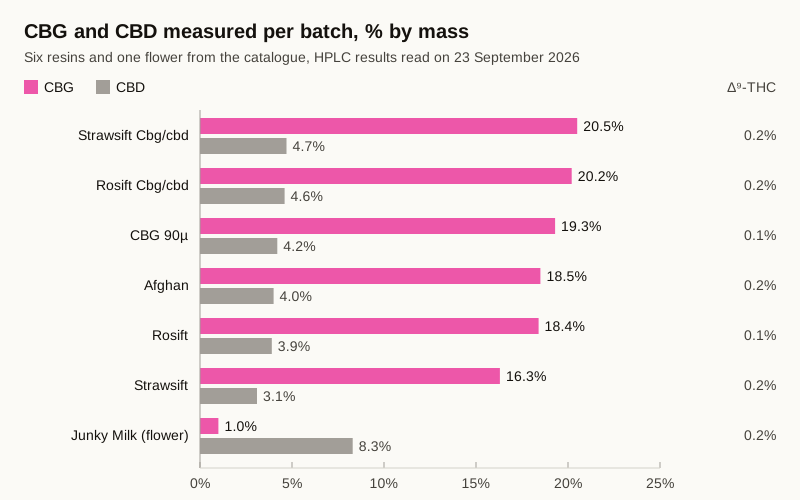
Three observations. In these resins, CBG weighs four to five times as much as CBD. Δ⁹-THC stays between 0.1 and 0.2%, below the 0.30% threshold. Finally, the product name is not enough: the Junky Milk flower has "CBG" in its name but contains only 1.0%, and some resin names show a CBD level that does not match the measured batch. Only the line on the analysis counts. All these products are listed in the resins, hash and pollens category.
Reading the analysis of a CBG product
Four lines are enough to sort products. The batch number must match the product sold. CBG is read together with CBGA, its acid form: the total after heating is CBG + 0.878 × CBGA, because CBGA loses about 12% of its mass when it decarboxylates. Δ⁹-THC must stay at 0.30% or less. Finally, the absence of HHC, H4CBD and THCP, classified as narcotics by the French medicines agency (ANSM) in 2023 and 2024, can be checked when the lab has tested for them.
Our guide to the certificate of analysis goes through each section, and the laboratory page describes the measurement methods.
Precautions: medicines, pregnancy, driving
CBG has no dose benchmark. The provisional safe level published by EFSA on 9 February 2026, about 2 mg a day for 70 kg, applies to CBD at least 98% pure and to CBD alone. No agency has assessed CBG in the same way. Our article on EFSA's reference dose explains where that figure comes from.
On medicines, tests on human enzymes have shown that CBG, like other cannabinoids, inhibits CYP2C9, a liver enzyme that clears many treatments (Doohan et al., 2021). A CBG-rich extract also slowed CYP2C9 and CYP3A4 in human liver fractions (Treyer et al., 2023). These in vitro results do not quantify the real risk, but they are a reason to talk to your doctor or pharmacist if you take a treatment. The mechanism is described in our article on the grapefruit effect.
There are no data on CBG during pregnancy or breastfeeding. For CBD, the French food safety agency ANSES proposed on 21 March 2025 classifying it as presumed toxic for reproduction: as a precaution, these periods rule out CBG too. The same reservations apply to minors.
When driving, the saliva test looks for THC, not CBG. A resin with 0.2% Δ⁹-THC still contains traces of it, which a test can detect after use. Our drug testing guide details the timings.
What marketing is not allowed to claim
CBG is often sold as the "focus" cannabinoid. No trial shows it. Regulation (EC) No 1924/2006 only allows health claims on foods that are listed in the EU register, and none concerns hemp or its cannabinoids. Under French law, a product presented as treating or preventing a disorder becomes a medicine by presentation.
The only authorised medicine in this family contains CBD, not CBG: Epidyolex, prescribed for rare forms of epilepsy. A product page that promises a specific effect on mood, sleep or pain from CBG goes beyond what research has measured.
Frequently asked questions
What are the effects of CBG?
In humans, only two controlled trials. In 2024, 20 mg produced a 26.5% drop in anxiety in 34 adults, against 22.5% on placebo, with no intoxication. In 2025, 25 to 50 mg a day for four weeks showed no difference from placebo in 63 veterans.
Does CBG get you high?
No. In the 2024 trial, 20 mg produced no intoxication and no measurable impairment. The risk lies in what the product really contains: Δ⁹-THC above 0.30% or an added semi-synthetic cannabinoid.
How much CBG should you take?
No authority sets a dose for CBG. The trials used 20 mg in a single dose, then 25 to 50 mg a day, which is neither advice nor a safety threshold. EFSA's 2 mg a day benchmark concerns CBD alone.
Can you buy CBG legally in France?
Yes, as flowers, resins or cosmetics from authorised varieties, with no more than 0.30% Δ⁹-THC. CBG oils, capsules or gummies meant to be swallowed are not authorised under novel food rules.
Can CBG make a saliva test positive?
The test looks for THC, not CBG. A CBG-rich resin still contains 0.1 to 0.2% Δ⁹-THC in the batches measured, and those traces can be enough to make a test positive after use.
Written by the Phytogrammes team
Every article in this journal draws on primary sources (ANSM, EFSA, EUR-Lex, peer-reviewed publications) and on the lab's own practice: batch-by-batch HPLC analyses, measured cannabinoid profiles. Our approach.
Article published on . CBD is not a medicine.