CBD certificate of analysis: 6 lines to read on a COA
A certificate of analysis (COA) is a laboratory's report on a sample from one specific batch: it quantifies the cannabinoids, THC included, and sometimes the contaminants. Six lines are enough to judge whether it is worth anything: the batch, the laboratory, total THC, banned cannabinoids, contaminants and quantification limits. In France no rule obliges a seller to publish one, yet it is the only document that puts a number against the legal limit of 0.30% Δ⁹-THC.
Contents
- 01What a certificate proves, and what it does not
- 02Lines 1 and 2: batch, laboratory, date
- 03Line 3: THC, in two lines and one calculation
- 04Line 4: cannabinoids tested, banned ones included
- 05Lines 5 and 6: contaminants and quantification limits
- 06Warning signs that should stop you
- 07What the certificate does not cover: driving
- 08Frequently asked questions
> Key takeaways > > - A certificate covers one batch, on one date. If its batch number does not match the product's, it proves nothing. > - THC is read on two lines: Δ⁹-THC and THCA. The usual total THC calculation is Δ⁹-THC + 0.877 × THCA. > - HHC, H4CBD and THCP are narcotics in France: a serious certificate states whether it looked for them. > - "ND" or "< LOQ" only means something with the numeric limit next to it. > - A laboratory's accreditation is checked in the Cofrac directory, test by test.
What a certificate proves, and what it does not
A certificate of analysis is a measurement: a laboratory received a sample, prepared it, ran it through an instrument and reported numbers. It describes only that sample, taken from one batch, on one date. It is neither a label nor a brand guarantee.
Three consequences for the reader. A certificate for another batch says nothing about the pouch in your hand. An old certificate says nothing about a flower that has aged since, because THCA slowly turns into THC and then CBN during storage. And a "range" certificate with no batch number is tied to no product at all.
No French rule requires a certificate to be published. The limit, however, is fixed: the order of 30 December 2021 caps the Δ⁹-THC content of authorised hemp varieties at 0.30%, and sets the same cap for "hemp extracts, and the products that contain them". The certificate is the only document that puts a figure against that limit.
Lines 1 and 2: batch, laboratory, date
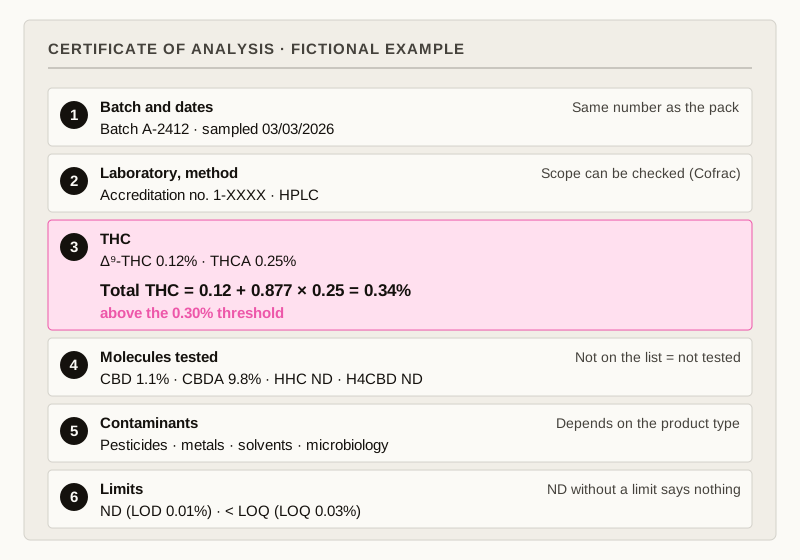
Start with the header. The batch number must match the one printed on the pack, character for character. Note the date the sample was taken or received, then the report date. For a flower, a report more than a year old deserves a question to the seller.
The laboratory must be named, with an address and a report number. The words "ISO 17025" are not enough: that standard sets competence requirements for testing laboratories, but it is accreditation that confirms a laboratory meets them for defined tests. In France, Cofrac is the only body allowed to grant these accreditations. Its directory publishes each laboratory's scope, meaning the exact list of tests covered. Our guide to checking the scope of an accreditation walks through it in five steps.
Finally, look at the method. For cannabinoids, liquid chromatography (HPLC) separates the acidic and neutral forms and quantifies each one. Gas chromatography (GC) heats the sample: a 2022 study shows that the injector temperature decarboxylates acidic cannabinoids, so a GC result blends THCA and THC. A certificate that does not name its method leaves you guessing what it measured.
Line 3: THC, in two lines and one calculation
Hemp makes THC in an acidic form, THCA, which becomes THC when heated. An HPLC certificate therefore shows two lines: Δ⁹-THC and THCA. To add them up, THCA is corrected for the mass it loses when it becomes THC. The 0.877 factor is the ratio of the molar masses, 314.5 g/mol for THC and 358.5 g/mol for THCA.
A fictional example, to show the arithmetic. A flower reads 0.12% Δ⁹-THC and 0.25% THCA. Its total THC is 0.12 + 0.877 × 0.25, or 0.34%. The Δ⁹-THC line is under the limit; the total is not. And the annex to the 2021 order sets out a gas chromatography test for varieties, whose heat turns most of the THCA into THC during the measurement. Our article on THCA explains this reading, and the one on the 0.3% limit covers the official method.
Line 4: cannabinoids tested, banned ones included
The list of molecules tested matters as much as the results. A certificate that only quantifies CBD and THC says nothing about semi-synthetic cannabinoids. The ANSM, the French medicines agency, listed HHC, HHCO and HHCP as narcotics from 13 June 2023, then H4CBD, THCP and other derivatives from 3 June 2024. The same page states that THCA is excluded when the THC content complies with the 0.3% limit. THCA in compliant hemp is therefore not banned.
On a product sold as CBD, look for these molecules on the list. If they are missing from the list, they were not tested for, which does not mean they are missing from the product. Our article on synthetic cannabinoids explains why this check matters.
Lines 5 and 6: contaminants and quantification limits
A complete certificate adds contaminant panels. The main ones:
| Panel | What it looks for | Usual method | Further reading |
|---|---|---|---|
| Pesticides | Treatment residues | LC-MS/MS, GC-MS/MS | Pesticides and MRLs |
| Heavy metals | Lead, cadmium, mercury, arsenic | ICP-MS | Heavy metals |
| Residual solvents | Butane, propane, ethanol | Headspace GC | Solvents and hash |
| Microbiology | Yeasts, moulds, bacteria | Culture | Mould on flower |
For pesticides, the European Commission notes that a default limit of 0.01 mg/kg applies when a substance is not named in the tables. Solvents only concern extracts made with a solvent: a sieved or ice-water resin contains none by design.
That leaves the small results. "ND" (not detected) means the instrument saw nothing above its limit of detection. "< LOQ" means the molecule may be present, but below the limit of quantification, the smallest amount the method measures with validated accuracy. Both limits are among the characteristics a method must establish under the ICH Q2(R2) guideline. An "ND" with no numeric limit does not tell you from what amount the instrument would have seen anything.
Warning signs that should stop you
| What you see | Why it is a problem |
|---|---|
| Batch number missing or different from the pack | The document is not tied to the product |
| Laboratory with no name, address or report number | Impossible to check |
| "Compliant" with no figures | An opinion is not a measurement |
| Δ⁹-THC alone, no THCA line | Total THC is unknown |
| Method not stated | You cannot tell whether the acids were heated |
| "ND" with no detection or quantification limit | The sensitivity is unknown |
| Mixed units (% and mg/g) with no conversion | 1% equals 10 mg/g |
| Cropped report, laboratory logo missing | Document possibly altered |
If in doubt, write to the laboratory with the report number: only it can confirm that it issued the document. Our page on how a sample moves through our laboratory describes each step, and the CBD laboratory page covers the measurement methods.
What the certificate does not cover: driving
A compliant level offers no protection behind the wheel. On 21 June 2023 (no. 22-85.530), France's Court of Cassation ruled that the authorisation to sell products at 0.30% THC does not prevent prosecution: driving after using a narcotic is an offence whatever the dose. Since the law of 9 July 2025, the penalty is up to 3 years in prison and a €9,000 fine. The certificate tells you how much THC the product contains, not what a saliva test will detect. Our drug testing guide covers the details.
Frequently asked questions
Is a certificate of analysis mandatory in France?
No. No rule requires a CBD seller to publish a certificate. The product must, however, comply with the 0.30% Δ⁹-THC limit set by the order of 30 December 2021, and only a certificate lets you check it.
What do "ND" and "< LOQ" mean?
"ND" means not detected above the limit of detection. "< LOQ" means possibly present, but below the limit of quantification. Both entries are only meaningful with the numeric limit next to them.
My certificate shows 0.28% Δ⁹-THC: is the product compliant?
Look at the THCA line before concluding. With 0.10% THCA, total THC reaches 0.28 + 0.877 × 0.10, or 0.37%. The Δ⁹-THC line alone is not enough for a flower or resin rich in THCA.
Does an organic label replace the certificate?
No. An organic label covers how the crop was grown. It does not measure THC, semi-synthetic cannabinoids or microbial contamination.
How can I tell whether the laboratory is accredited?
Search for its name in the Cofrac directory, or that of the accreditation body in its country, then read the scope: the accreditation must cover the test shown on the certificate, not just the laboratory in general.
Written by the Phytogrammes team
Every article in this journal draws on primary sources (ANSM, EFSA, EUR-Lex, peer-reviewed publications) and on the lab's own practice: batch-by-batch HPLC analyses, measured cannabinoid profiles. Our approach.
Article published on . CBD is not a medicine.