Mould on CBD flower: the signs and their limits
Mouldy CBD flower sometimes gives itself away through brown, decaying bracts, grey fuzz or a musty smell: if you see any of these, do not use it. The reverse does not hold: a flower that looks healthy can carry spores you cannot see. The real safeguard is drying, which must bring the flower's water activity below 0.70, and only a microbiological analysis of the batch measures contamination.
Contents
> Key takeaways > > - More than 100 fungal species have been associated with hemp and cannabis, including genera that can produce toxins. > - Below a water activity of 0.70, most fungi can no longer grow. The ASTM D8197 standard targets 0.55 to 0.65 for dried flower. > - White fuzz and trichomes look alike: telling them apart reliably takes a microscope or a laboratory culture. > - Ochratoxin A was found in one third of 142 illicit cannabis samples, and in none of more than 9,000 samples from regulated legal markets.
The signs that should make you reject a flower
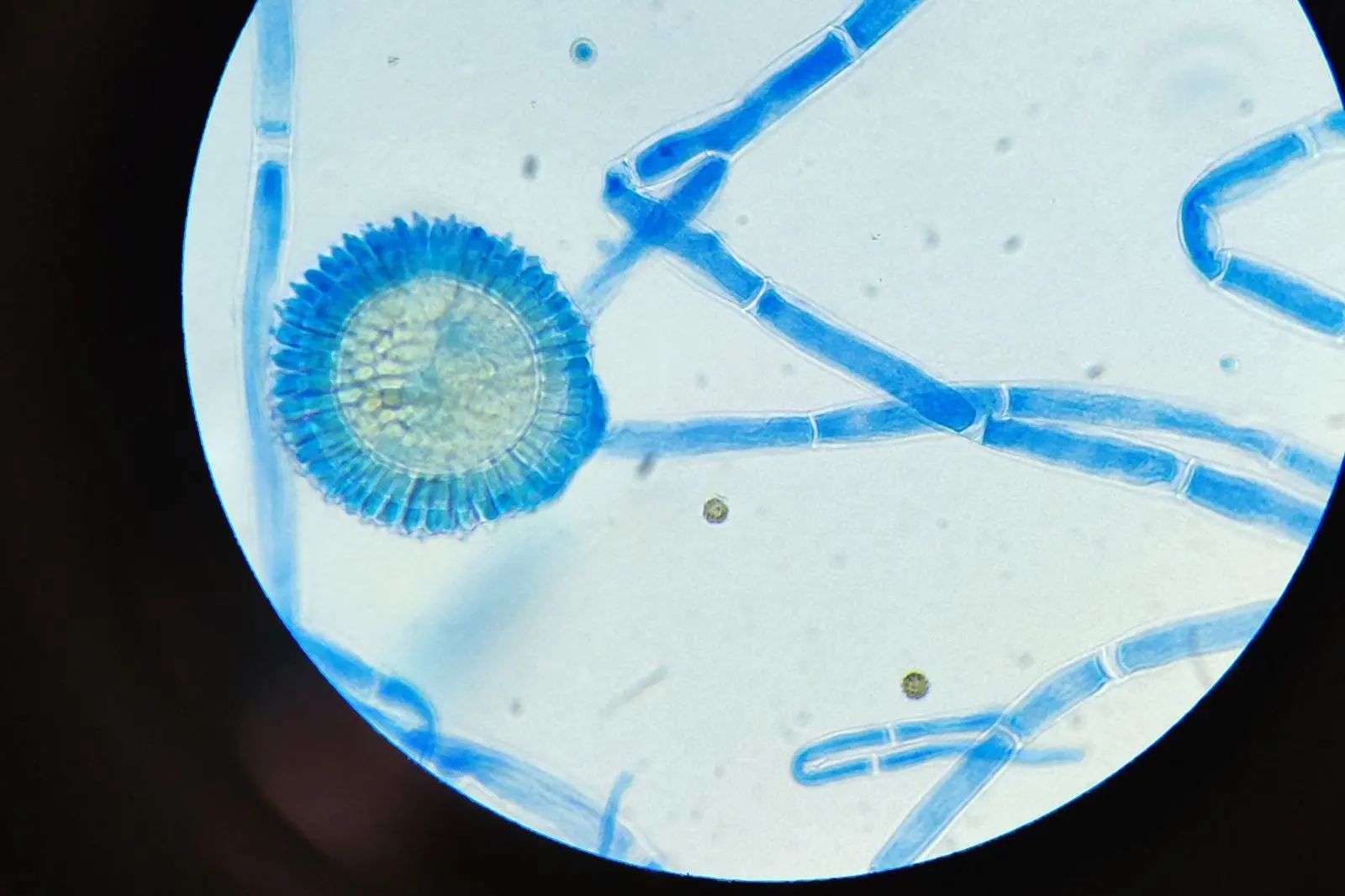
Some signs are enough to reject a product, even without an analysis. Work by Zamir Punja and his team, published in 2019 in Frontiers in Plant Science, describes grey mould caused by Botrytis cinerea: the bracts turn brown and decay, until the whole head is destroyed in advanced stages. The same authors describe powdery mildew as a white felt of mycelium that gives leaves a powdery look, and Penicillium colonies as blue-green.
| What you see or smell | What it may indicate | What to do |
|---|---|---|
| Brown, soft bracts that fall apart | Grey mould (Botrytis) | Do not use, tell the seller |
| Grey or grey-brown fuzz in the centre of the bud | Botrytis mycelium | Do not use |
| Blue-green spots | Possible Penicillium colonies | Do not use |
| Powdery white film on the leaves | Possible powdery mildew | Reject if in doubt |
| Musty, cellar or wet-hay smell | Excess moisture, fermentation | Do not use |
| Spongy flower that does not snap between the fingers | Insufficient drying | Do not store in a closed jar |
Two points to add. First, on a dense bud the outside does not show everything: break it open through the middle before you decide. Second, the grey-brown fuzz Punja and his colleagues describe appeared after tissues had been incubated for 48 hours in a closed plastic bag. That is a laboratory method, not a shop-counter test.
White fuzz or trichomes: why the eye gets it wrong
Trichomes are the tiny mushroom-shaped glands that cover the bracts and produce resin. To the naked eye they give the flower a frosted, white or silvery look. Early powdery mildew also leaves a white film. We found no study validating a visual method that lets a consumer tell the two apart.
A jeweller's loupe helps a little. Trichomes have a distinct stalk and round head, and they sit mainly on the bracts. A felt of mycelium looks more like a network of tangled filaments, which also spreads over the leaves. But reliable identification requires a microscope or a culture on growth medium, as in the 2019 work where researchers placed 2 mm fragments on agar to see what grew within seven days. Our article on trichomes shows their shape at different stages.
Above all, remember the reverse rule: no visible sign proves nothing. Spores can be present on a flower that looks perfect.
The threshold that matters: water activity
Water activity, written aw, measures the "free" water in a product, the water micro-organisms can use. It runs from 0 (dry) to 1 (pure water). Multiplied by 100, it gives the relative humidity of air in equilibrium with the flower: an aw of 0.62 corresponds to 62% relative humidity in a closed jar.
A 2023 review in Frontiers in Microbiology, by Kimberly Gwinn, Zamir Punja and two co-authors, sets out the rule: sufficient drying brings water activity below 0.70, which prevents most fungi from growing. It immediately adds a caveat: Penicillium and Aspergillus can survive between 0.62 and 0.70. The ASTM D8197 standard recommends a range of 0.55 to 0.65 for dried flower, which keeps a margin below that threshold.
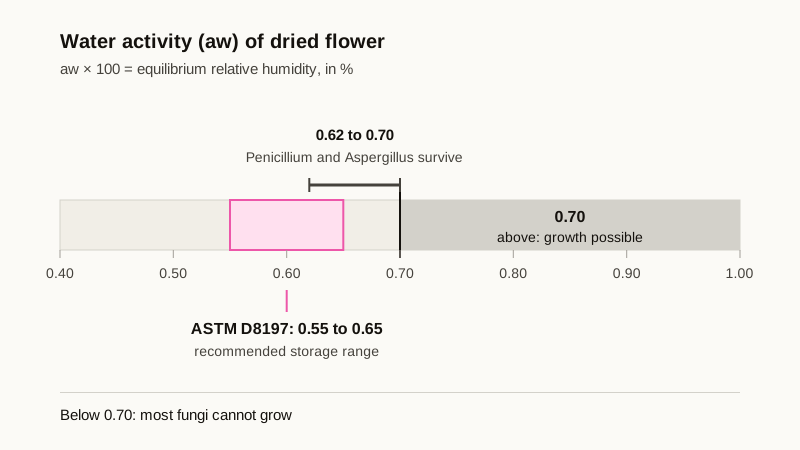
In practice, three habits follow from this threshold. Keep flower in an airtight container, away from heat. If you use a humidity-control pack, choose one between 58 and 62%, inside the ASTM range. And never put a flower that is still damp back in a jar. Temperatures and containers are covered in our article on storing CBD flower, and the step where it is all decided, upstream, in our article on drying and curing.
What is known about the health risk
The 2023 review lists more than 100 fungal species associated with hemp and cannabis, whether pathogens, epiphytes or endophytes. The toxin-producing genera it names first are Aspergillus, Penicillium, Fusarium and Mucor, and Penicillium is the toxigenic fungus most often recovered from the tissues analysed.
The most telling figure concerns ochratoxin A, a mycotoxin produced by some Aspergillus and Penicillium species. According to the same review, it was detected in one third of 142 illicit cannabis samples, and in none of more than 9,000 flower and extract samples from about 300 producers on regulated legal markets. For context, the EFSA panel on contaminants concluded in 2020 that the tolerable weekly intake of 120 ng per kilo of body weight set in 2006 was no longer valid. That opinion concerns food, not cannabis.
Then there is the inhalation of spores. A CDC study of 2016 insurance records found that people who used cannabis were 3.5 times more likely to have a fungal infection than others (confidence interval 2.6 to 4.8). The authors describe an association, not a proven cause: among the patients, cannabis users were more often immunocompromised (43% vs 21%), smoked tobacco more often, and the route of use was unknown. The risk falls first on people whose immune defences are weakened.
What a batch analysis should show
In France, no text sets a microbiological limit specific to CBD flower. Quality therefore depends on the testing chosen by the producer and the seller. On a certificate of analysis, look beyond the cannabinoids for:
- a total yeast and mould count, expressed in CFU per gram (colony-forming units);
- testing for named pathogens, for example Aspergillus or Salmonella;
- a mycotoxin screen, aflatoxins and ochratoxin A, with the limit of quantification;
- a batch number identical to the one on the pouch, and a date of analysis.
A certificate that only mentions CBD and THC says nothing about mould. Our guide to reading a certificate of analysis goes through each line, and the laboratory page explains the measurement methods. Pesticide residues, the other contaminant to watch on flower, are covered in our article on MRLs.
Frequently asked questions
How can you tell if CBD flower is mouldy?
Reject any flower with brown, soft bracts, grey fuzz, blue-green spots or a musty smell. Break dense buds open through the middle, because the outside does not show everything. A flower that looks healthy can still carry spores: only an analysis can check.
Can white mould be mistaken for trichomes?
Yes. Trichomes give a frosted look, and so does early powdery mildew. Under a loupe, trichomes have a stalk and a round head, while mycelium forms tangled filaments. If in doubt, do not use the product.
At what humidity does CBD flower go mouldy?
The reference is the flower's water activity, not the humidity of the room. Below 0.70, most fungi stop growing. Penicillium and Aspergillus can survive between 0.62 and 0.70. ASTM D8197 recommends 0.55 to 0.65, that is 55 to 65% relative humidity in a closed container.
Can a slightly mouldy flower be saved?
No. Removing the visible part removes neither nearby spores nor any mycotoxins. Heat does not solve the problem: according to the 2023 review, aflatoxin B1 is destroyed at 180 °C under experimental conditions, but ochratoxin A loses only 25 to 44% at 200 °C in wheat, and some breakdown products remain just as toxic. Throw the product away and tell the seller the batch number.
Written by the Phytogrammes team
Every article in this journal draws on primary sources (ANSM, EFSA, EUR-Lex, peer-reviewed publications) and on the lab's own practice: batch-by-batch HPLC analyses, measured cannabinoid profiles. Our approach.
Article published on . CBD is not a medicine.