Hemp vs cannabis: one species, split by 0.3% THC
*Hemp and cannabis are one species, Cannabis sativa L. What separates them is chemistry and law: in France, authorised hemp comes from a listed variety and contains no more than 0.30% Δ⁹-THC, the psychoactive molecule. Above that, the plant and its products are controlled drugs; herbal cannabis seized in France in 2023 averaged 14.0% THC.*
Contents
- 01One species, *Cannabis sativa* L.
- 02What separates them: THC, measured
- 03Where the 0.3% threshold comes from
- 04Seeds, seed oil, flowers: three products, three limits
- 05Growing hemp in France: a farmer's job
- 06Medical and recreational cannabis: two separate cases
- 07Checking that a product comes from authorised hemp
- 08Frequently asked questions
> Key takeaways > > - One botanical species: "hemp" means plants low in THC, "cannabis", in everyday use, means plants grown for THC. > - The 0.3% threshold comes from a proposal by two botanists in 1976, adopted by France in 2021 and by EU farm subsidies in 2023. > - Food hemp seeds have their own limits: 3.0 mg of THC per kilo, 7.5 mg/kg for hemp seed oil. > - Only active farmers may grow hemp flowers and leaves, from certified seed. > - The threshold applies to a product, not to a driver: at the wheel, any detected trace of THC is enough.
One species, *Cannabis sativa* L.
Hemp and so-called recreational cannabis belong to the same species, Cannabis sativa L. What changes is the selection. Farm hemp was bred for fibre, seed or, more recently, CBD. Drug-type cannabis was bred for its THC content.
The labels sativa, indica and "hybrid" do not change this. A genetic study published in 2019 of 30 strains sold in three US states found no clear genetic support for those three categories. Our article indica or sativa explains what the distinction still covers.
"Marijuana" is not a botanical term. French law speaks of "cannabis" for the plant classified as a drug and of "hemp" (chanvre) for authorised varieties.
What separates them: THC, measured
The line is drawn by one content level, that of Δ⁹-THC, delta-9-tetrahydrocannabinol. The table sets out the criteria that follow from it in France.
| Criterion | Authorised hemp | Cannabis as a controlled drug |
|---|---|---|
| Δ⁹-THC | 0.30% at most | 14.0% on average for herb seized in 2023, 29% for resin |
| Variety | Listed in the catalogue, certified seed | No authorised variety |
| Growing | Reserved for active farmers | Prohibited |
| Sale | Flowers, resins and cosmetics under conditions; CBD foods not authorised | Prohibited |
| Use | No offence for a compliant product | Offence: 1 year in prison and €3,750, or a €500 fixed fine |
The figures for seized cannabis come from the French Monitoring Centre for Drugs and Drug Addiction (OFDT). In 2011, herb averaged 10.4% and resin 12.3%. Seized herb therefore now contains on average nearly 47 times the hemp cap. Our article beuh or weed compares the two products on other criteria.
Where the 0.3% threshold comes from
The figure was not calculated from any effect on humans. In 1976, botanists Ernest Small and Arthur Cronquist proposed 0.3% THC in dried female flowers to classify plants: above it, drug type; below it, hemp. The Canadian Food Inspection Agency notes that this line is still the reference in North America.
In France, the order of 30 December 2021 authorises the growing and commercial use only of Cannabis sativa L. varieties whose Δ⁹-THC content does not exceed 0.30%, and applies the same cap to hemp extracts and to products containing them. On 29 December 2022 the Conseil d'État struck down the ban on selling raw flowers and leaves: it held that the threshold is not a safety threshold, but that no proven risk justified a general and absolute ban. For EU farm subsidies, the cap rose from 0.2% to 0.3% on 1 January 2023. Our article on the legal THC level explains how the content is measured.
Seeds, seed oil, flowers: three products, three limits
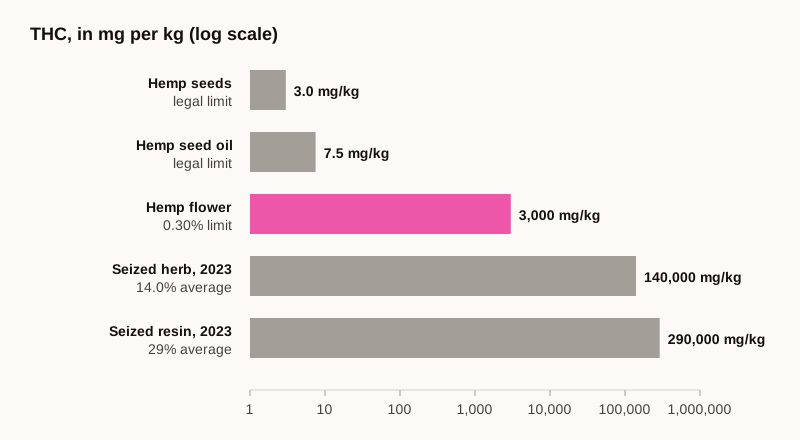
Hemp is not just flowers. Its seeds are eaten, and food law gives them far lower limits. Regulation (EU) 2022/1393, in force since 1 January 2023, sets 3.0 mg of THC per kilo for hemp seeds and derived products, and 7.5 mg/kg for hemp seed oil. The calculation adds Δ⁹-THC and its acid form, THCA, corrected by a factor of 0.877.
Yet 0.30% equals 3,000 mg per kilo. The limit for a hemp flower is therefore 1,000 times that for a seed.
Seeds, seed oil and leaves for infusions are the only hemp products accepted as food, the French Ministry of Agriculture recalls in its note of 20 May 2026, provided they respect these levels and are not enriched with cannabinoids. Foods containing CBD are not authorised. Our article on CBD oil and hemp seed oil details the difference.
Growing hemp in France: a farmer's job
The 2021 order is explicit: "Only active farmers within the meaning of the European and national regulations in force may grow hemp flowers and leaves." Flowers and leaves must come from plants grown from certified seed of listed varieties. A private person growing cannabis at home, even from "CBD" seeds, falls outside that framework. Our article on CBD seeds explains why buying them is legal but growing them is not.
France remains the EU's largest hemp producer, mainly for fibre and seed. Our overview of hemp farming in France gives the areas and outlets.
Medical and recreational cannabis: two separate cases
Medical cannabis is neither hemp nor recreational cannabis. It consists of THC and CBD products prescribed by doctors within an experimental framework. According to the ANSM, the French experiment has not enrolled new patients since 27 March 2024; those already followed keep their treatment during a transition phase that will end three months after the opinion of the French National Authority for Health (HAS). Our article on medical cannabis in 2026 follows the timetable.
Recreational cannabis remains prohibited. According to Service-public.fr, drug use is punishable by one year in prison and a €3,750 fine. Since 20 August 2026, the fixed fine that can replace prosecution is €500, reduced to €400 if paid within 15 days.
Driving concerns hemp users too. On 21 June 2023, the Court of Cassation ruled that the authorisation to sell products under 0.30% THC changes nothing for the offence of driving after drug use, which applies whatever the dose. The penalties are set out in our article on CBD and driving.
Checking that a product comes from authorised hemp
A "hemp" or "CBD" label is not enough. Three lines of the batch analysis settle it: a batch number matching the product, Δ⁹-THC at 0.30% or less, and no semi-synthetic cannabinoids such as HHC, H4CBD or THCP, classified as drugs in 2023 and 2024. Our guide to the certificate of analysis covers each line, and our laboratory page describes the measurement methods. The catalogue's flowers are listed in the CBD flowers category.
Frequently asked questions
Does hemp get you high?
No. At 0.30% Δ⁹-THC or less, a hemp flower does not produce the psychoactive effect of recreational cannabis. Our article does CBD get you high explains why.
What is the difference between hemp and marijuana?
There is no difference in species: both are Cannabis sativa L. The difference lies in THC content, 0.30% at most for authorised hemp and 14.0% on average for herb seized in France in 2023, and in the legal status that follows.
Can you grow hemp at home in France?
No. The order of 30 December 2021 reserves the growing of flowers and leaves for active farmers, from certified seed. Outside that framework, growing counts as producing a controlled drug.
Do hemp seeds contain THC?
Very little, and the law caps it: 3.0 mg of THC per kilo for seeds and 7.5 mg/kg for seed oil, since 2023. They are authorised foods, provided they are not enriched with cannabinoids.
Is CBD a drug?
Not under French law: CBD is not on the list of controlled drugs. The product containing it must still respect the 0.30% Δ⁹-THC cap, because THC itself remains a controlled drug. Our article is CBD a drug gives the full answer.
Written by the Phytogrammes team
Every article in this journal draws on primary sources (ANSM, EFSA, EUR-Lex, peer-reviewed publications) and on the lab's own practice: batch-by-batch HPLC analyses, measured cannabinoid profiles. Our approach.
Article published on . CBD is not a medicine.