CBD seeds in France: legal to buy, illegal to plant
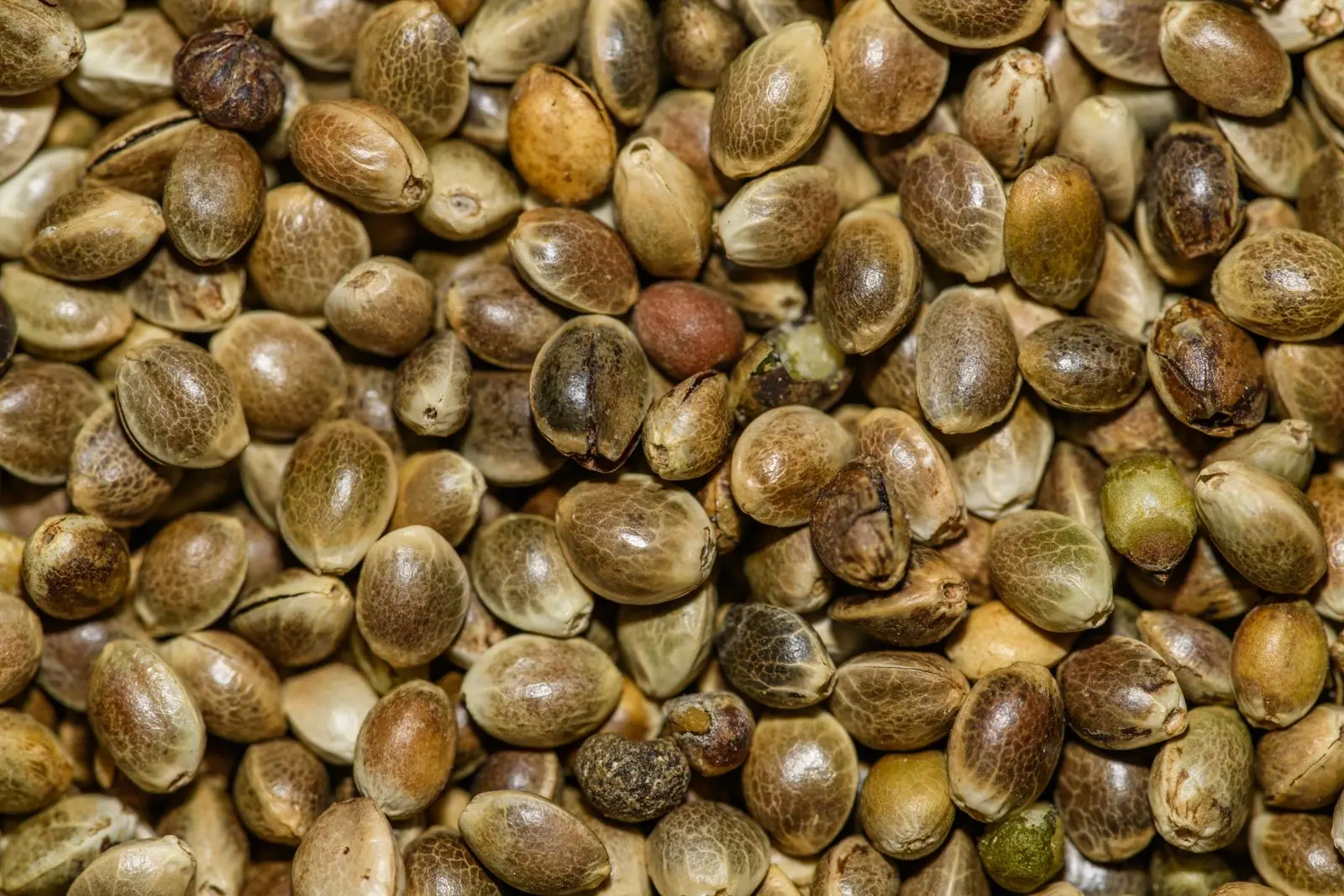
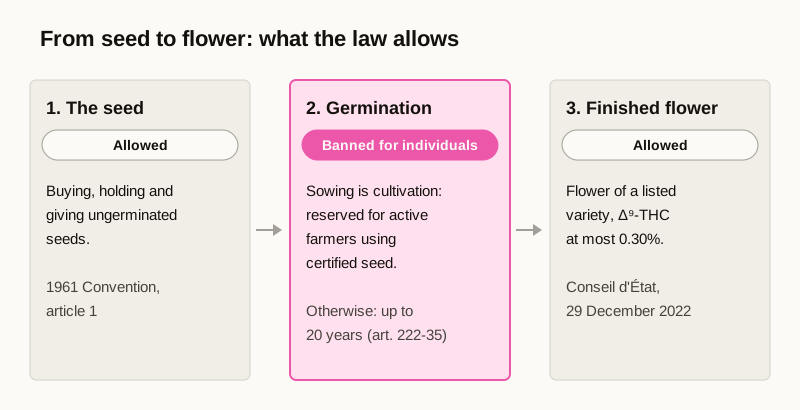
In France you may legally buy and hold CBD seeds, because the 1961 Single Convention leaves seeds out of its definition of cannabis. A private individual may not germinate them. The order of 30 December 2021 reserves the cultivation of hemp flowers and leaves for active farmers. Growing outside that framework counts as producing a controlled drug, punishable by up to 20 years in prison.
Key takeaways
- Under the 1961 Convention, cannabis means the flowering tops of the plant, "excluding the seeds".
- Sowing is another matter: only active farmers using certified seed may grow hemp.
- A "collector's seeds" label authorises nothing; it simply tells you not to sow.
- One plant is enough to constitute the offence, whatever the THC content of the variety.
- In 2024 the EU catalogue listed 116 hemp varieties, every one of them under 0.3% THC.
Buying seeds: why the sale is allowed
A seed carries neither flower nor resin, only genetics, and international law draws on that distinction. Article 1 of the 1961 Single Convention on Narcotic Drugs defines cannabis as "the flowering or fruiting tops of the cannabis plant (excluding the seeds and leaves when not accompanied by the tops)". Under its article 28, the Convention does not apply to growing cannabis "exclusively for industrial purposes (fibre and seed)".
Seed shops build on this exclusion. A written question from Senator Pierre Charon, published on 1 April 2021, describes how they work: seeds are sold "for genetic conservation", with a notice that germinating them in France is strictly forbidden. The question lapsed without any answer from the government.
Hemp seeds are also eaten. In May 2026 the French Ministry of Agriculture confirmed that seeds, derivatives such as the oil, and leaves for infusion are still authorised as food. The conditions are that no cannabinoid extract is added and that the THC limits are met. This point is covered in our article on the difference between CBD oil and hemp seed oil.
Germinating means growing: where the line falls
The principle comes from the Public Health Code, whose article R. 5132-86 prohibits the production, cultivation included, of "cannabis, its plant and its resin". Growing hemp is possible only as an exemption, on the conditions set by the order of 30 December 2021 and listed in its article 1:
"Only active farmers within the meaning of the European and national rules in force may grow hemp flowers and leaves."
The same article requires plants from certified seed and states: "The sale of plants and the practice of taking cuttings are prohibited." The variety has to be in the catalogue, with no more than 0.30% Δ⁹-THC. When the Conseil d'État annulled the ban on selling flowers to consumers in December 2022, it left these cultivation rules untouched. Our article on the order that tried to ban flowers traces the episode.
A private individual fulfils none of these conditions. Germination turns a seed into a plant, and at that moment the act changes in nature.
"Collector's seeds": a label, not a licence
The "collector's seeds" label names the one use the law leaves open to an individual, which is keeping seeds without sowing them. Whatever protection it offers goes to the seller and none to the buyer. No text creates a collector status, and the intention you state when buying has no bearing on how a cultivation is classified.
The variety does not change the analysis. Sow a seed of a catalogue-listed variety on a balcony and you are still growing without authorisation, since you are not an active farmer and the seed sits outside the certified chain. Hemp and cannabis belong to the same species yet fall under opposite regimes; our article on hemp and recreational cannabis explains why.
Penalties for growing
Small-scale growing gets no lighter regime under the Criminal Code. Unauthorised cannabis growing counts as producing a controlled drug, and article 222-35 provides for 20 years' imprisonment and a €7,500,000 fine, as Drogues Info Service points out. In practice, judges often reclassify personal growing under article 222-37, which provides for 10 years in prison and the same maximum fine.
| Act by an individual | Status | Text |
|---|---|---|
| Buying or holding ungerminated seeds | Allowed | 1961 Convention, art. 1 |
| Germinating a seed, growing a plant | Prohibited | Public Health Code, art. R. 5132-86; order of 30 December 2021 |
| Buying a plant, taking cuttings | Prohibited | Order of 30 December 2021, art. 1 |
| Buying a compliant hemp flower | Allowed | Order of 30 December 2021; Conseil d'État, 29 December 2022 |
One plant is enough to commit the offence, and the variety's THC content is irrelevant, because the law punishes growing outside the framework whatever the plant's chemistry.
The EU catalogue: 116 varieties, a closed chain
According to the European Commission, the common catalogue of varieties held 116 hemp varieties in 2024, all below 0.3% THC. Active farmers pick from that list and buy certified seed: controlled lots with a guaranteed genetic identity.
The ban on cuttings follows from this chain. A cutting reproduces the plant outside the seed chain, after which no one can guarantee that it still belongs to the declared variety. How a variety gets listed is described in our article on the varieties in the EU catalogue.
The legal alternative: the finished flower
For an individual, the compliant route is to buy the finished product and leave seeds unplanted. CBD flowers come from varieties grown by farmers, and a laboratory analysis lets you check their compliance: Δ⁹-THC under 0.30%, THCA, no controlled cannabinoids. Our article on the legal THC limit explains the threshold and how it is measured, and our overview of CBD regulation in 2026 sets out the wider framework.
Frequently asked questions
Yes. Seeds are excluded from the definition of cannabis in the 1961 Single Convention, and their sale for conservation rests on that exclusion. Buying and keeping ungerminated seeds is lawful, whereas germinating them is an offence.
No. Under the order of 30 December 2021, only active farmers may grow hemp flowers and leaves, from certified seed of catalogue-listed varieties. A private individual cannot meet these conditions, whichever variety is chosen.
Growing without authorisation counts as producing a controlled drug, punishable under article 222-35 of the Criminal Code by up to 20 years in prison and a €7,500,000 fine. Personal growing is often reclassified under article 222-37, which provides for 10 years in prison.
No. Hemp seeds, hemp seed oil and leaves for infusion are still authorised as food, as long as no cannabinoid extract is added. The ban concerns sowing to grow plants when you are not an active farmer.
Written by the Phytogrammes team
Each journal article draws on cited primary sources: ANSM, EFSA, EUR-Lex and peer-reviewed publications. Product profiles are distinguished from documented laboratory results. Our approach.
Article published on . CBD is not a medicine.