CBD oil vs hemp seed oil vs cannabis oil: what differs
*Hemp seed oil is a food oil pressed from the seeds, and seeds do not make cannabinoids. CBD oil is an extract of flowers and leaves, diluted in an oil and dosed in cannabidiol. "Cannabis oil" usually means a THC-rich extract, a controlled drug in France outside the medical framework. All three come from Cannabis sativa L., but not from the same part of the plant and not under the same rules.*
Contents
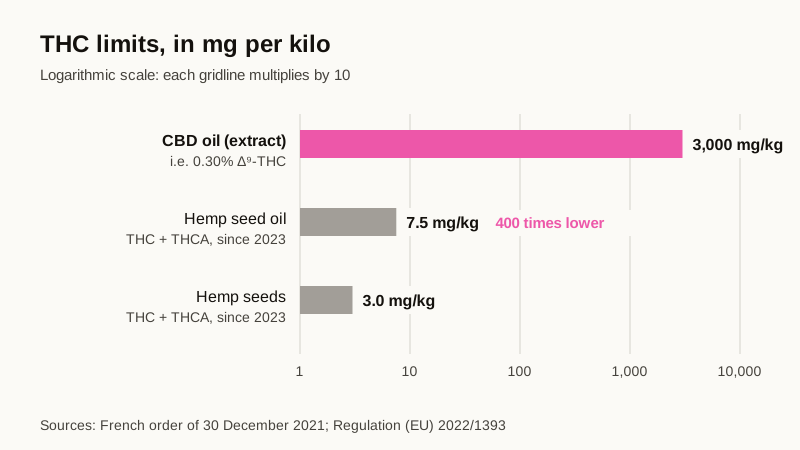
> Key takeaways > > - Hemp seeds do not produce cannabinoids: the traces found in their oil come from resin stuck to their surface. > - Since 1 January 2023, hemp seed oil may not exceed 7.5 mg of THC per kilo, THCA included. > - CBD oil is an extract subject to the 0.30% Δ⁹-THC limit, i.e. 3,000 mg per kilo. > - The French Ministry of Agriculture states that foods containing CBD are not authorised, but hemp seed oil is. > - On the label, the part of the plant and the stated CBD content are usually enough to tell them apart.
Three oils, three parts of the plant
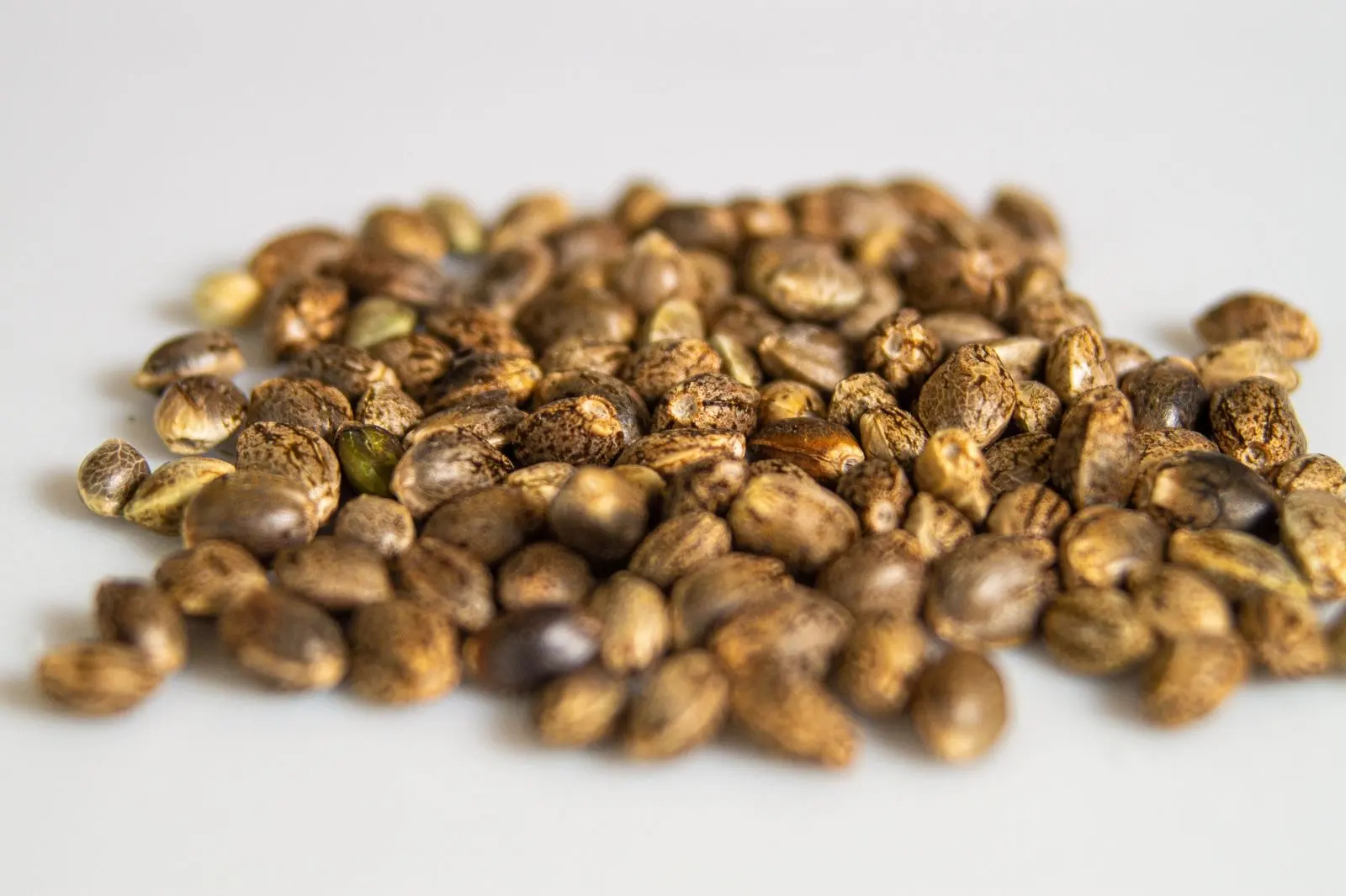
All three come from the same species. What separates them is the organ used and the process. Cannabinoids, CBD and THC alike, are made in trichomes, the tiny resin glands that mostly cover female flowers and the bracts around them. The seed itself does not produce them.
| Hemp seed oil | CBD oil | "Cannabis oil" | |
|---|---|---|---|
| Part of the plant | Seeds | Flowers and leaves | Flowers of THC-rich varieties |
| Process | Cold pressing | Extraction, then dilution in an oil | Extraction |
| Cannabinoids | Traces | Dosed CBD, in % or mg | THC in quantity |
| THC limit | 7.5 mg/kg (THC + THCA) | 0.30% Δ⁹-THC | None: controlled drug |
| Status in France | Authorised food | Not as a food; other uses depending on the product | Banned outside the medical framework |
Hemp seed oil: a food, not a CBD product
It is made by cold-pressing the seeds, like walnut oil. Its value is nutritional. An analysis published in 2020 in Scientific Reports measured 60.52% linoleic acid (omega-6) and 18.44% alpha-linolenic acid (omega-3), with 84.11% polyunsaturated fatty acids in total and an omega-6 to omega-3 ratio of 3.3 to 1.
So where do the traces of cannabinoids come from? Italian researchers explain it in a 2019 study of ten commercial oils: the seed is void of cannabinoids inside, but its surface can be contaminated by the sticky resin of the trichomes on the bracts. Properly cleaned seeds give an oil with only traces. The same authors note that an earlier study had found commercial oils above 10 mg of total THC and 1,000 mg of total CBD per kilo.
Even in that extreme case, the gap is huge. 1,000 mg per kilo is 0.1% CBD. A 10% CBD oil contains roughly 100,000 mg per kilo, 100 times more.
Food law has set limits. Regulation (EU) 2022/1393, applicable since 1 January 2023, caps hemp seed oil at 7.5 mg of THC per kilo, and seeds and their other derived products at 3.0 mg/kg. The calculation adds THC and its acid form, THCA, because food processing can convert one into the other. An oil above 10 mg/kg would therefore be out of bounds today.
This product remains on sale as a food. In its statement of 20 May 2026, the French Ministry of Agriculture specifies that hemp seeds and their derivatives, including seed oils, are authorised, provided they respect the maximum THC levels and are not enriched with cannabinoid extracts. Our article on hemp seeds covers their status in detail.
CBD oil: a dosed extract under the 0.30% limit
CBD oil starts from flowers and leaves. The cannabinoids are extracted, most often with supercritical CO₂ or ethanol, then the extract is diluted in a carrier oil: fractionated coconut oil (MCT), olive oil, or hemp seed oil itself. A CBD oil can therefore list "hemp seed oil" among its ingredients without being a plain seed oil. Our article on how CBD oil is made walks through each step.
Its content is shown as a percentage or in milligrams per bottle. Depending on the extract, it contains CBD alone (isolate) or other cannabinoids and terpenes too. What the words "full spectrum" cover is explained in our page on full spectrum.
The THC limit is the one set by the French order of 30 December 2021: 0.30% Δ⁹-THC in hemp extracts and products containing them, i.e. 3,000 mg per kilo. That is 400 times the limit for hemp seed oil.
Use changes the status. The same ministry states that foods containing CBD are not authorised under Regulation (EU) 2015/2283 on novel foods, and that they must be withdrawn from the market. A CBD oil sold as a food supplement is therefore targeted. Our overview of CBD regulation in 2026 describes the other regimes, including cosmetics. The catalogue references are grouped in the CBD oils category, for example the full-spectrum oil.
"Cannabis oil": a THC-rich extract, banned
The term has no legal definition. In everyday use, it means an extract of THC-rich varieties, such as "Rick Simpson Oil". Above 0.30% Δ⁹-THC, an extract leaves the framework of authorised hemp: it falls under the narcotics rules, and both selling and possessing it are prohibited.
Medical cannabis follows a separate path, supervised by the French medicines agency, the ANSM. The French experiment ended on 31 December 2024. According to the ANSM's dossier, updated on 20 April 2026, patients already enrolled continue their treatment in a transition phase, which will end three months after the opinion of the French health authority (HAS). Our article on medical cannabis in 2026 gives the latest. The only authorised CBD-based medicine, Epidyolex, is another case again: it is dispensed on prescription.
Reading the label: four reliable clues
Four lines on the label are usually enough to know what the bottle contains.
| Clue | Hemp seed oil | CBD oil |
|---|---|---|
| Main ingredient | "Hemp seed oil" alone | Hemp extract or CBD, plus a carrier oil |
| Cannabinoid content | None stated | CBD in % or mg per bottle |
| Spectrum mention | Absent | Full spectrum, broad spectrum or isolate |
| Stated use | Dressing, cooking | Depends on the product; never as a food in France |
In English, "hemp oil" can mean either: only the ingredient list settles it. For a CBD oil, the batch certificate of analysis gives the real CBD and THC content. Our guide to reading a certificate of analysis goes through each line, and the laboratory page describes the measurement methods.
Frequently asked questions
Does hemp seed oil contain CBD?
Only traces, which come from resin stuck to the surface of the seeds. Even the most loaded oils reported in the literature, around 1,000 mg per kilo, contain about 100 times less CBD than a 10% CBD oil.
Which oil can be eaten as a food in France?
Hemp seed oil, provided it respects the 7.5 mg of THC per kilo limit and is not enriched with cannabinoids. Foods containing CBD are not authorised, according to the Ministry of Agriculture's statement of 20 May 2026.
Does "hemp oil" mean CBD oil?
Not necessarily. The English term is used both for seed oil and for CBD oil. Check the ingredients and the stated CBD content: with no content shown, it is almost always a seed oil.
Is cannabis oil legal in France?
No, as soon as it exceeds 0.30% Δ⁹-THC: it is then a controlled drug. Medical cannabis goes through a separate channel, supervised by the ANSM and limited to patients from the experiment, in a transition phase.
Written by the Phytogrammes team
Every article in this journal draws on primary sources (ANSM, EFSA, EUR-Lex, peer-reviewed publications) and on the lab's own practice: batch-by-batch HPLC analyses, measured cannabinoid profiles. Our approach.
Article published on . CBD is not a medicine.