CBD oil: definition, spectrums and French law in 2026
CBD oil is a hemp extract rich in cannabidiol, diluted in a carrier vegetable oil such as MCT, hemp seed or olive oil. It comes as full spectrum, broad spectrum or isolate, and its strength is read in milligrams: one drop of a 10% oil holds about 5 mg of CBD. Since May 2026 it can no longer be sold in France as a food or food supplement, only under other regimes such as cosmetics.
Contents
> Key takeaways > > - A CBD oil = a hemp extract + a carrier oil that dilutes it. > - A 10 ml bottle at 10% holds about 1,000 mg of CBD, close to 5 mg per drop. > - EFSA's provisional reference is about 2 mg of CBD per day for a 70 kg adult. > - On 20 May 2026 the French Ministry of Agriculture declared foods containing CBD illegal. > - Full spectrum contains THC, up to 0.30%, and can trigger a positive saliva test.
Definition: a hemp extract diluted in oil
A CBD oil combines two things. The first is an extract of hemp flowering tops, most often obtained with supercritical CO₂ or ethanol. The second is a vegetable oil that dilutes it to the desired strength: MCT oil, made from coconut, hemp seed oil or olive oil. Cannabinoids are fat-soluble, which is why a fatty carrier is used. Our article on how CBD oil is made covers each step.
Do not confuse it with hemp seed oil. That oil is pressed from the seeds, which contain no significant amount of CBD, and remains an authorised food oil. The differences are set out in our comparison of CBD oil, hemp seed oil and cannabis.
Reading the strength: percent, milligrams and drops
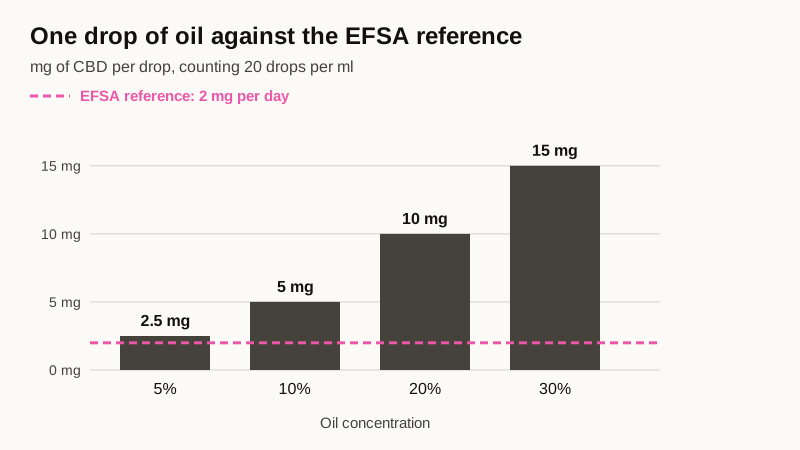
Strength is given as a percentage or in milligrams per bottle. On a 10 ml bottle, "10%" means about 1,000 mg of CBD, or 100 mg per millilitre. The number of drops per millilitre depends on the dropper; counting 20 drops per millilitre, one drop at 10% holds about 5 mg.
| Strength | CBD in 10 ml | Per ml | Per drop (20 drops/ml) |
|---|---|---|---|
| 5% | 500 mg | 50 mg | 2.5 mg |
| 10% | 1,000 mg | 100 mg | 5 mg |
| 20% | 2,000 mg | 200 mg | 10 mg |
| 30% | 3,000 mg | 300 mg | 15 mg |
These figures make sense next to the only official reference. On 9 February 2026 EFSA set a provisional safe intake level of 0.0275 mg per kilo of body weight per day, about 2 mg for a 70 kg adult. It applies to CBD at least 98% pure, and safety is not established under 25, during pregnancy or breastfeeding, or for people on medication. A single drop already exceeds it, whatever the strength in the table.
Our article on EFSA's reference dose explains how it was calculated and where its limits lie.
Full spectrum, broad spectrum, isolate
Oils differ by what the extract keeps from the plant.
| Type | What it contains | THC | Watch point |
|---|---|---|---|
| Full spectrum | CBD, minor cannabinoids, terpenes | Present, up to 0.30% | Can trigger a positive saliva test |
| Broad spectrum | CBD and minor cannabinoids | Removed, below the stated detection limit | Check the THC line on the certificate |
| Isolate | Purified CBD, often 99% | Absent | No terpenes or other cannabinoids |
Full spectrum is often sold in the name of the "entourage effect". The term comes from a 1998 study by Raphael Mechoulam's team, which concerned molecules made by the body, not by the plant. Extending it to terpenes and minor cannabinoids remains a hypothesis: our article on the entourage effect takes stock, and our comparison of full spectrum and isolate helps you choose.
French law in 2026: banned as food, allowed as a cosmetic
This is what has changed most. On 20 May 2026 the Ministry of Agriculture published a statement titled "Foods containing cannabidiol (CBD): illegal products that must be withdrawn from the market". It relies on the EU novel food regulation: CBD is not authorised under it, since its safety has not been demonstrated. An oil presented as a food supplement or to be swallowed is therefore covered, like capsules and gummies. The ANSM and ANSES had already written in June 2025 that foods containing CBD, oils included, are not authorised for sale in the European Union.
An oil sold as a cosmetic falls under a different text, Regulation (EC) No 1223/2009. It is meant for the skin, for massage or care, and its label must carry the cosmetic items, including the INCI list. Swallowing it goes beyond the use the maker intended. Our article on labelling a CBD product details these items, and our overview of the 2026 rules covers the rest of the framework.
In every case, the finished product must not exceed 0.30% Δ⁹-THC. And no oil may claim an effect on a disease: the only authorised CBD medicine is Epidyolex, available on prescription.
Choosing and checking an oil
Before buying, six lines can be checked on the label and on the batch certificate of analysis:
- The amount of CBD in mg per bottle, not just a percentage.
- The type of spectrum and the carrier oil.
- The batch number, identical on the bottle and on the analysis.
- The measured Δ⁹-THC, at 0.30% or less.
- The absence of HHC, H4CBD and THCP when the lab tested for them.
- The regime under which the oil is sold, cosmetic or other, and the use the label states.
There is a reason for these checks. In the 2023 report funded by MILDECA, ten products bought in pharmacies, mostly oils, were analysed: one in ten exceeded 0.3% THC, and the CBD content matched the label in only half the cases. Our guide to the certificate of analysis explains each section. Our products are listed in the CBD oils category.
Precautions and storage
On 21 March 2025 ANSES proposed classifying CBD as presumed toxic for reproduction (category 1B), based on animal studies. Pregnant or breastfeeding women, and people planning a pregnancy, therefore have a specific reason to abstain. Use is also not advised for minors.
The ANSM and ANSES point out that CBD taken with some medicines can reduce their effectiveness or increase their side effects: ask a doctor or pharmacist if you take any treatment. A full-spectrum oil contains THC, which can be enough to make a roadside saliva test positive.
For storage, light, heat and air degrade cannabinoids: keep the bottle closed, away from light and heat. Our article on storing CBD oil gives practical guidelines.
Frequently asked questions
What is the difference between CBD oil and hemp oil?
CBD oil contains an extract of the flowers, rich in cannabidiol. Hemp seed oil is pressed from the seeds: it is a food oil, with no significant amount of CBD.
How much CBD is in one drop?
It depends on the strength and the dropper. Counting 20 drops per millilitre, one drop holds about 2.5 mg at 5%, 5 mg at 10% and 10 mg at 20%.
Is CBD oil legal in France?
Yes under some regimes, such as cosmetics, with no more than 0.30% Δ⁹-THC. No as a food or food supplement: the Ministry of Agriculture declared these products illegal on 20 May 2026.
Can CBD oil make a saliva test positive?
Yes for full spectrum, which contains THC. On 21 June 2023 the Cour de cassation ruled that the legality of the product consumed does not clear a driver whose test is positive.
Is a 30% oil better than a 10% oil?
No, it is more concentrated. One drop at 30% holds about 15 mg of CBD, more than seven times EFSA's provisional reference for a whole day.
Written by the Phytogrammes team
Every article in this journal draws on primary sources (ANSM, EFSA, EUR-Lex, peer-reviewed publications) and on the lab's own practice: batch-by-batch HPLC analyses, measured cannabinoid profiles. Our approach.
Article published on . CBD is not a medicine.