Banana Kush CBD: where does the banana smell come from?
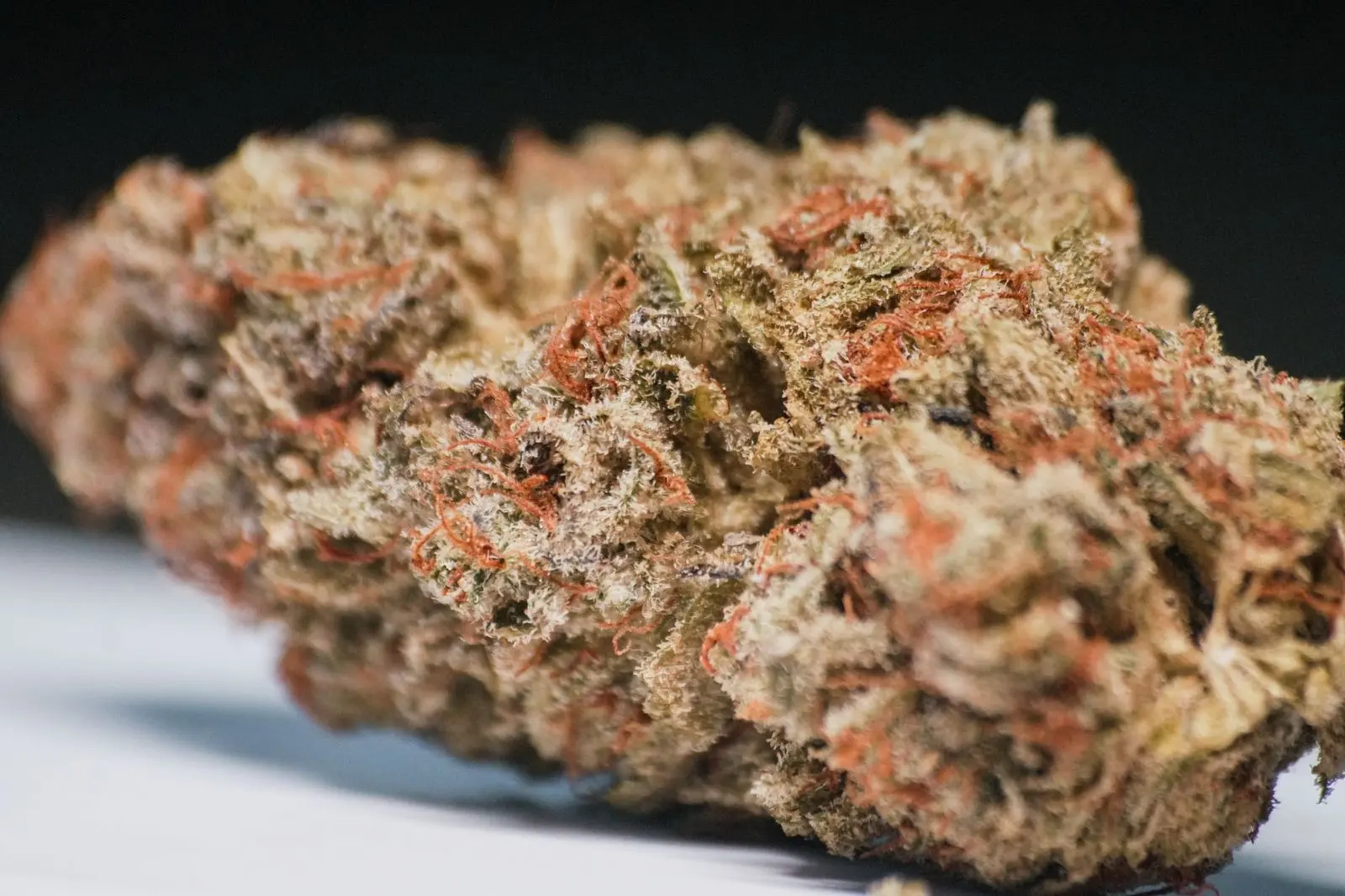
Banana Kush CBD is a hemp flower sold under a name taken from cannabis culture, with no official variety name behind it. Its dominant terpenes do not explain its banana smell: a 2023 study points to compounds present in tiny amounts, esters in particular. France allows its sale when it comes from an authorised variety and contains no more than 0.30% Δ⁹-THC.
Key takeaways
- "Banana Kush" is a street name with no administrative standing, and no official catalogue lists it.
- Flowers with very different smells show similar levels of the major terpenes.
- Researchers have identified more than 30 esters in cannabis, two of which carry a banana note.
- Check compliance on the batch certificate (Δ⁹-THC, CBD, batch number), since the name proves nothing.
A trade name, not a registered variety
Banana Kush comes from cannabis culture, and agronomy has no record of it. The name links the flower to the Kush family, whose history is told in our article on OG Kush and its CBD versions. Its lineage rests only on what seed banks say about it, and no public register exists to check their claims.
These names have no standing in French law. The decree of 30 December 2021 authorises only Cannabis sativa L. varieties listed in the EU common catalogue or the official French catalogue, with no more than 0.30% Δ⁹-THC. The catalogue uses agronomic breeding names such as Futura 75 or Santhica 27. Our guide to the EU variety catalogue explains why product pages nearly always display a street name.
Two sellers can therefore offer a "Banana Kush" grown from different plants. The name suggests an aromatic mood and says nothing reliable about composition.
Where the banana smell comes from
Terpenes, the volatile molecules behind the scent of citrus, pepper or hops, usually get the credit for a flower's smell. With fruity flowers, they explain only part of it.
A Californian team published an analysis of varieties with very different aromas in ACS Omega in 2023, together with a sensory panel. The major terpenes (myrcene, limonene, β-caryophyllene) changed little from flower to flower, yet the smells were clearly distinct. The differences followed minor compounds: sulfur compounds with tropical or citrus notes, skatole with a chemical note, and more than 30 esters, the chemical family responsible for the scent of most fruits.
The panel described two of these esters, butyl and isoamyl senecioate, as having banana notes. In the fruit itself, a 2018 study of two banana cultivars lists isoamyl acetate among the dominant volatile compounds. The resemblance comes from closely related esters on both sides, and terpenes have no part in it.
| Compound family | Example | Described note | Amount in the flower |
|---|---|---|---|
| Terpenes | Myrcene, limonene | Herbal, citrus, peppery | Major |
| Esters | Isoamyl senecioate | Fruity, banana | Traces |
| "Tropical" sulfur compounds | 3-mercaptohexanol | Citrus, tropical fruit | Traces, very potent |
| Indoles | Skatole | Chemical, mothballs | Traces |
Keep two caveats in mind. The study looked at cannabis sold in the United States, with no Banana Kush CBD among the samples, and several of its authors have filed patents linked to the findings. Its main lesson is that a terpene profile cannot predict a smell. Our feature on hemp terpenes covers what they do and what is wrongly attributed to them.
Why two Banana Kush flowers smell different
The compounds behind the fruity note occur in traces and evaporate easily. Their level shifts from batch to batch at three stages.
- Under the same name, genetics can differ from one grower to another.
- Drying too fast or too hot strips a flower of part of its volatiles, as our article on drying and curing describes.
- In storage, light, heat and air hasten the loss of aroma, as explained in our guide to storing CBD flowers.
When a pouch opens on a clear banana smell, that tells you about the freshness of the batch as much as about the plant.
What the label should tell you
The name guarantees nothing, so judge the flower by its certificate of analysis and look at four lines:
- the batch number, which must match the one on the pouch;
- Δ⁹-THC, which must be 0.30% or lower;
- CBD content, given as a percentage of mass;
- the date of analysis and the laboratory's name.
Where a terpene profile is given, it describes the general mood, and for the reasons above it cannot predict a banana note. Each line is explained in our guide to reading a certificate of analysis, and the laboratory page describes the measurement methods. There is no Banana Kush in the catalogue at present. Flowers with a sweet, tropical profile, such as Mango Zkittlez, appear in the CBD flowers category.
The legal framework in France
Selling raw hemp flowers has been legal since the Conseil d'État decision of 29 December 2022, which annulled the ban set by the 2021 decree. The story is told in our article on the decree that tried to ban flowers. Two conditions still apply: the variety must be listed in the catalogue, and Δ⁹-THC must not exceed 0.30%, a threshold covered in our article on the legal THC level.
How the flower is presented also counts. Sold "for infusion", it becomes a foodstuff, and CBD foods are being withdrawn from the French market in 2026, as our update on CBD regulation explains. These products are meant for adults only. A compliant flower still contains traces of THC that a saliva test can pick up, and our drug testing guide covers what to know before you drive.
Frequently asked questions
Yes, in traces, like every hemp flower. It may be sold in France only with no more than 0.30% Δ⁹-THC, and the exact figure appears on the batch certificate of analysis.
The fruity note comes from trace compounds, mostly esters, whose levels depend on the plant, the drying and the storage. A flower that is old or kept in the light loses part of these volatiles.
Not if it stays within the 0.30% Δ⁹-THC threshold. CBD lacks the psychoactive effect of THC, as our article does CBD get you high? explains.
Written by the Phytogrammes team
Each journal article draws on cited primary sources: ANSM, EFSA, EUR-Lex and peer-reviewed publications. Product profiles are distinguished from documented laboratory results. Our approach.
Article published on . CBD is not a medicine.