How to smoke without tobacco: 3 alternatives in a joint
To smoke without tobacco, you have three options: roll the flower on its own, finely ground; cut it with a nicotine-free herbal blend; or switch to a vaporiser, which heats without burning. The first two remove nicotine, not combustion: smoke from herbs still contains carbon monoxide and tar. Only the vaporiser removes combustion.
Contents
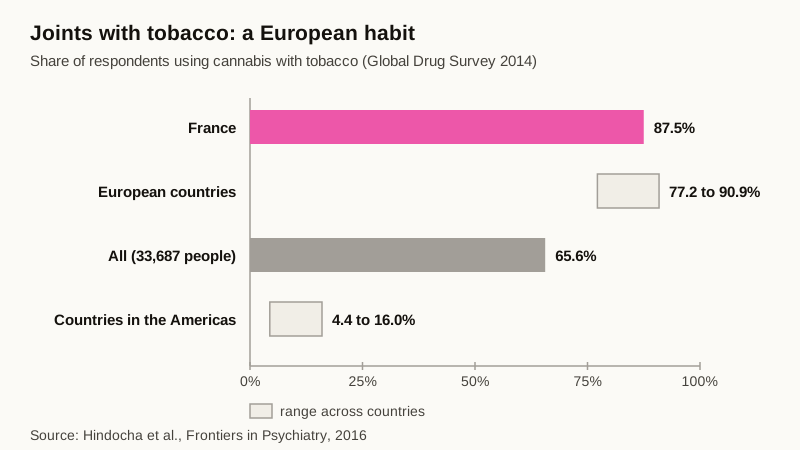
> Key takeaways > > - In a 2014 international survey, 87.5% of French respondents used cannabis with tobacco. > - According to the WHO, tobacco kills more than 7 million people a year and nicotine is highly addictive. > - A herbal cigarette analysed in 2015 contained no nicotine, but more carbon monoxide than a regular cigarette. > - A vaporiser reduces inhaled carbon monoxide compared with a joint, according to a trial in 18 volunteers. > - Removing tobacco does not change the legal status of what is inside: only flower with no more than 0.30% Δ⁹-THC is allowed in France.
Why tobacco ends up in joints
The tobacco joint is a regional habit, not a technical necessity. The 2014 Global Drug Survey, analysed in 2016 in Frontiers in Psychiatry, questioned 33,687 cannabis users. In France, 87.5% used a route involving tobacco. Across European countries, the share ranged from 77.2 to 90.9%. In the Americas, it fell to between 4.4 and 16.0%.
The same study found a link with wanting to quit. People who used cannabis without tobacco had 1.8 times the odds of saying they would like help to cut down on tobacco. This is an association observed in a survey, not a proven effect.
Tobacco carries a heavy toll on its own. The WHO states that tobacco kills more than 7 million people every year, including 1.6 million non-smokers, and that nicotine is "highly addictive". Our article on the differences between tobacco and cannabis compares the two kinds of smoke.
Option 1: flower alone, well ground
This is the most direct solution. Tobacco was used to stretch the material and even out the burn; well-prepared flower does the same job.
- Grind fine and even. A multi-chamber grinder gives a uniform texture that burns at a steady rate. With a knife, the pieces stay uneven. Our comparison of grinder types helps you choose.
- Check the moisture. Flower that is too moist rolls badly and goes out; too dry, it burns fast and hot. Our guide to storing flowers gives the reference points.
- Adapt the rolling. A slightly wider paper helps spread the flower. Lay it out in an even layer, with no denser patches, and put a cardboard filter at the mouth end to hold the structure.
- Plan for more flower. Without tobacco, you need more material for a joint of the same size.
These flowers are in our CBD flowers category, with the CBD level shown for each product.
Option 2: a nicotine-free herbal blend
Blends of dried plants are sold to replace the bulk of tobacco: mallow, chamomile, cornflower, rose petals, damiana. They contain no nicotine and burn fairly neutrally. Start with equal parts herbs and flower, then adjust to taste and draw. Avoid blends scented with synthetic flavourings, which mask the taste of the flower.
Nicotine-free does not mean smoke-free. In 2015, Korean researchers used a smoking machine to analyse the smoke from a herbal cigarette sold as a quitting aid. They found neither nicotine nor tobacco-specific nitrosamines. But the smoke contained more carbon monoxide and benzo(a)pyrene than a regular cigarette with the same tar level. Its condensates also proved mutagenic. Any burning plant material produces compounds of this kind.
Option 3: the vaporiser, no combustion
A vaporiser heats the flower without setting it alight, until the cannabinoids and terpenes turn into vapour. There is no flame, so there is nothing to add: the tobacco question disappears.
A trial published in 2007 in Clinical Pharmacology & Therapeutics compared, in 18 hospitalised volunteers, a desktop vaporiser and a cannabis cigarette. Blood THC levels were similar. Exhaled carbon monoxide was reduced with the vaporiser. The trial involved THC cannabis over six days: it describes a way of consuming, not a health benefit.
For settings, see our guide to vaporisation temperatures, and for equipment, our selection of useful accessories.
The three options side by side
| Option | Nicotine | Combustion | Equipment | What to know |
|---|---|---|---|---|
| Flower alone | No | Yes | Grinder, paper, filter | More flower per joint |
| Flower and herbs | No | Yes | Same, plus the blend | Carbon monoxide and tar remain |
| Vaporiser | No | No | Dry-herb vaporiser | Upfront cost, temperature setting |
If your main goal is to drop nicotine, all three options get you there. If you also want to avoid smoke, only the third does. Our article on CBD and quitting tobacco sets out what research has measured, without promises.
What this change does not alter: the law
Removing tobacco does not change the status of what is inside. In France, only hemp flower whose Δ⁹-THC does not exceed 0.30% is allowed. THC-rich cannabis remains a narcotic: using it is punishable by up to one year in prison and a 3,750 euro fine, or by a fixed fine of 500 euros. And a compliant flower can be enough to trigger a positive roadside saliva test. Our article on smoking hemp covers this framework.
Frequently asked questions
How do you roll a joint without tobacco?
Grind the flower finely, use a slightly wider paper, spread an even layer and add a cardboard filter. Plan for more flower than with tobacco.
What can replace tobacco in a joint?
Flower on its own, or a nicotine-free herbal blend such as mallow, chamomile or cornflower. These plants burn, so they still produce carbon monoxide and tar.
Is a tobacco-free joint harmless?
No. It removes nicotine and the compounds specific to tobacco, not those from combustion. Herbal smoke contains carbon monoxide and mutagenic substances.
Does a vaporiser replace the joint?
It replaces combustion. In the 2007 trial, it delivered THC levels close to a joint with less carbon monoxide. Feel and taste change: it is a different way of consuming.
Written by the Phytogrammes team
Every article in this journal draws on primary sources (ANSM, EFSA, EUR-Lex, peer-reviewed publications) and on the lab's own practice: batch-by-batch HPLC analyses, measured cannabinoid profiles. Our approach.
Article published on . CBD is not a medicine.