CBD accessories: 5 useful tools, from jar to scale
For CBD flower and resin, five accessories really earn their place: an opaque, airtight container, a grinder, a scale accurate to a hundredth of a gram, a vaporiser with adjustable temperature and, for oils, a graduated pipette. They protect the aromas and make quantities measurable. They change neither the composition of the product, nor its legal status, nor what a test detects.
Contents
> Key takeaways > > - Vacuum-sealed at 17 to 19 °C, a hemp flower lost 22.3% of its terpenes in 12 weeks, with no measurable loss of cannabinoids. > - Heat and light break down CBD: up to 20% in 30 days at 37 °C in e-liquids tested in 2020. > - On a flower with 9.6% CBD, a 0.01 g scale resolves 1 mg of CBD; a 0.1 g scale, 10 mg. > - A vaporiser heats without burning, which limits the carbon monoxide of smoke; it does not make THC undetectable.
1. The container: what storage costs you
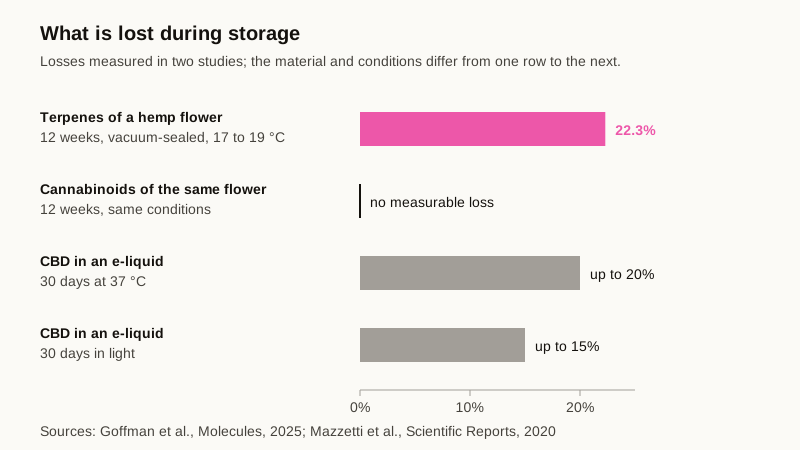
The first accessory is the most ordinary one: a jar. Above all, it protects the aromas. A study published in 2025 in Molecules followed hemp flowers vacuum-sealed in multilayer bags, in a room kept between 17 and 19 °C. After 12 weeks, terpenes had fallen by 22.3% on average, while CBD and the other cannabinoids had not changed measurably. The monoterpenes, the most volatile, went first.
CBD is more stable, but not immune. An Italian team tested CBD e-liquids in 2020: up to 20% of the CBD was lost in 30 days at 37 °C, and up to 15% in 30 days in light. A car in summer or a windowsill is enough to recreate those conditions.
In practice: amber or opaque glass, a lid with a seal, a cool, dark cupboard. Choose a jar sized to the quantity: the air in the empty space is renewed at every opening. Keep the original label with the batch number: it is what links the product to its analysis. Our guide to storing CBD flowers covers humidity, and the one on storing oils covers opened bottles.
2. The grinder: grind just before use
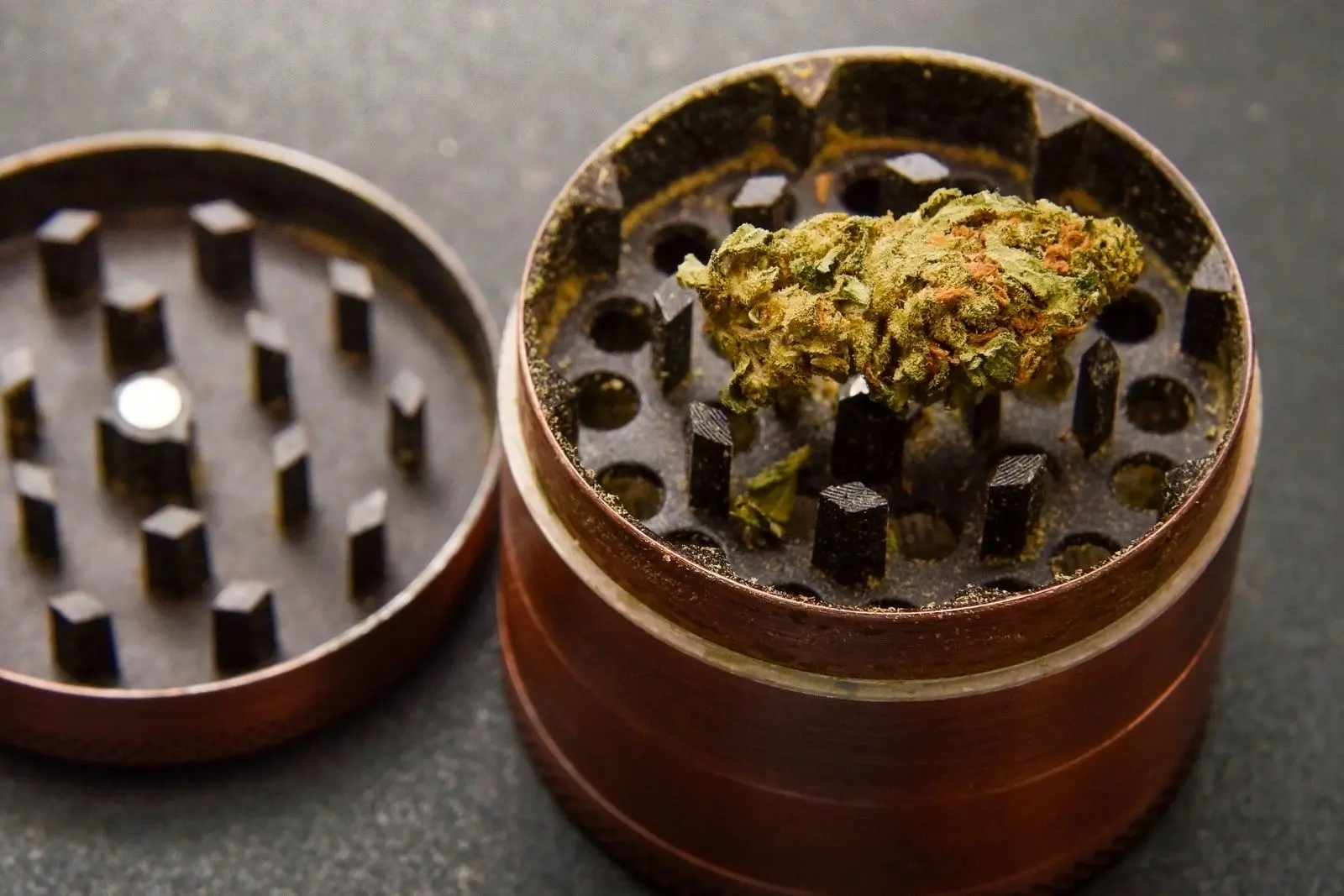
A grinder breaks flower into even fragments. It matters most in a vaporiser, where uniform material heats evenly. Three- or four-part models have a screen that collects kief, the trichome powder that falls off during grinding. A 2020 study in Scientific Reports notes that cannabinoids and terpenes are produced and stored in the secretory cells of these trichomes: kief is therefore more concentrated than the flower it comes from.
Grind at the last moment. Ground flower exposes far more surface to the air, and the volatile terpenes are exactly what leaves first. Choose a model that comes fully apart, so you can clean it. Our comparison of the four types of grinder reviews the formats.
Resin does not need a grinder. A hash that is too hard can be tempered with the warmth of your fingers; our guide to tempering a hash that is too hard or too soft explains how.
3. The scale: weigh milligrams, not pinches
A scale turns a percentage into a quantity. A flower's product page gives its measured CBD content; the weighed mass gives the rest. An example with two contents from the catalogue, a flower at 9.6% and a resin at 15.0%:
| Weighed mass | CBD, flower at 9.6% | CBD, resin at 15.0% |
|---|---|---|
| 0.05 g | 4.8 mg | 7.5 mg |
| 0.1 g | 9.6 mg | 15 mg |
| 0.25 g | 24 mg | 37.5 mg |
| 1 g | 96 mg | 150 mg |
Precision matters. A scale that reads to 0.1 g rounds to within 0.05 g: on the 9.6% flower, that is up to 4.8 mg of CBD of uncertainty. A 0.01 g scale brings that uncertainty below 0.5 mg. For small amounts, buy one that reads to the hundredth, with a calibration weight. The measured contents of each variety are listed on the CBD flowers page.
4. The vaporiser: heat without burning
A vaporiser heats flower or resin without setting it alight. Cannabinoids and terpenes turn to vapour; the plant material does not burn. A commentary published in 2021 in the Canadian Journal of Public Health sums up the data: compared with smoke, vaporising reduces exposure to carbon monoxide and to several toxic combustion compounds. The same authors point out its limits: it does not reduce THC-related impairment, and the lung injuries they cite were mostly linked to liquid THC cartridges containing vitamin E acetate.
Two criteria matter when buying: a temperature you can set in steps, and a chamber that is easy to clean. Our guide to vaporisation temperatures gives the published ranges, and the one on hash in a vaporiser covers the setting for resin.
5. The graduated pipette: read millilitres
For an oil, the bottle's graduated pipette replaces counting drops, whose volume varies with the pipette and the viscosity. The maths is simple: a 10% oil contains about 100 mg of CBD per millilitre, so 25 mg in 0.25 mL. The oils on the CBD oils page are sold for external use: the pipette then helps you apply the same amount each time.
Ingestion is another matter. On 20 May 2026 the French Ministry of Agriculture restated that foods containing CBD, supplements included, are not authorised in France.
What accessories do not change
No accessory changes what the product contains. The 0.30% Δ⁹-THC limit applies to the finished product, and only the batch analysis can confirm it. Our guide to reading a certificate of analysis shows where to look.
No accessory changes the rule behind the wheel either. The Cour de cassation ruled on 21 June 2023 (no. 22-85.530) that driving after using narcotics is punishable “regardless of the dose absorbed”. Smoke, vapour or oil: if the test detects THC, the way you consumed it does not count.
Frequently asked questions
Should CBD flowers go in the fridge?
Not necessarily. A cool, dark cupboard is enough for a well-dried flower in a closed jar. For resins separated in ice water, the catalogue's resin page recommends cold storage instead. Either way, let a cold jar return to room temperature before opening it, to avoid condensation.
How precise should the scale be?
A hundredth of a gram (0.01 g). At a tenth, rounding can amount to nearly 5 mg of CBD on a 9.6% flower, which is a lot for small quantities.
Does a vaporiser prevent a positive THC test?
No. It removes combustion, not THC. If the product contains THC, even below 0.30%, a saliva test can detect it, and French law penalises driving after use whatever the dose.
Is a metal grinder better than a plastic one?
Metal lasts longer and cleans more easily, which matters for a tool that collects sticky resin. The most useful criterion is still whether it comes fully apart.
Written by the Phytogrammes team
Every article in this journal draws on primary sources (ANSM, EFSA, EUR-Lex, peer-reviewed publications) and on the lab's own practice: batch-by-batch HPLC analyses, measured cannabinoid profiles. Our approach.
Article published on . CBD is not a medicine.