Best CBD to smoke: 6 checks for choosing flower or hash
The best CBD to smoke is not the one with the highest printed percentage. It is a flower or a resin whose batch is identified, within the 0.30% Δ⁹-THC limit, free of synthetic cannabinoids, and still fresh when you open it. Six checks let you judge that before buying, and none of them makes burning harmless.
Contents
> Key takeaways > > - In France, CBD flowers and resins are legal to sell if Δ⁹-THC does not exceed 0.30% and they are not presented as food. > - Of 223 CBD products tested in 2022-2023, 81% did not contain the CBD level printed on the label. > - Terpenes, which carry the smell, fade fast: more than half within four months in one storage study. > - A well-kept flower has a water activity between 0.55 and 0.65. > - A vaporiser lowers the carbon monoxide inhaled compared with a joint, without making use risk-free.
What is legal to smoke in France in 2026
Hemp flowers and resins have been on sale in France since the Conseil d'État struck down the ban on raw flowers and leaves on 29 December 2022. Two conditions remain: an authorised Cannabis sativa L. variety, and no more than 0.30% Δ⁹-THC. The limit is explained in our article on the legal THC level.
Presentation matters too. Since 15 May 2026, CBD products meant to be swallowed have been withdrawn from sale, because none has been authorised as a novel food. A flower sold "for infusion" falls under that withdrawal. Sold raw, with no food claim, it stays under hemp rules. The full picture is in our article on CBD regulation in 2026.
HHC, H4CBD and THCP, on the other hand, are narcotics. The ANSM listed the first from 13 June 2023, then H4CBD, THCP and other derivatives from 3 June 2024. A "CBD" flower that contains them is not a legal CBD flower, whatever its price.
Why the label is not enough
In 2022 and 2023, three French addictovigilance centres (Paris, Lyon, Montpellier) and the toxicology lab of Lille University Hospital tested 223 products sold as CBD, with support from MILDECA, the government drug-policy agency. Flowers, resins, wax and e-liquids made up 85% of them. The results:
- 81% had a CBD content different from the label, and 69% contained less than stated.
- 6% contained an undeclared neo-cannabinoid: HHC, Δ⁸-THC or H4CBD.
- 87% stayed under the 0.3% THC limit.
The figure printed on a bag is a promise, not a measurement. What counts is the document linking one specific batch to one analysis. Our guide to the best CBD applies the same logic to every format. Here we stick to what gets smoked.
The 6 checks for a flower or hash to smoke
| Check | What you verify | Warning sign |
|---|---|---|
| 1. The batch | A batch number on the bag, repeated on the certificate of analysis | Certificate with no number, or for another product |
| 2. THC | Δ⁹-THC ≤ 0.30%, and THCA reported | Just "THC < 0.3%" with no figure |
| 3. Derivatives | HHC, H4CBD, THCP tested for and not detected | A "strong" effect promised for a CBD flower |
| 4. Appearance | Visible trichomes, no grey fuzz or spots | Cellar smell, white dust that does not sparkle |
| 5. Smell | A clear aroma that matches the stated profile | Bland flower, hay smell |
| 6. Moisture | Firm flower, neither crumbly nor spongy | Flower that turns to powder, or feels sticky |
1 and 2. The batch and total THC
The certificate of analysis must carry the same batch number as the product. For a flower you will smoke, also read the THCA line. THCA is the acidic form of THC that the plant makes, and a flame turns it into THC. The THC you inhale therefore roughly matches total THC: Δ⁹-THC + 0.877 × THCA. Our guide to reading a certificate of analysis walks through this calculation line by line, and the laboratory page describes the measurement methods.
3. Synthetic derivatives
You cannot see or smell a neo-cannabinoid. Only an analysis that looks for it can rule it out. Be wary of a CBD flower sold for a "strong" effect: CBD does not cause the high of THC, and that promise should make you suspect a spiked product. Our article on synthetic cannabinoids in CBD lists the other signs.
4. Trichomes and appearance
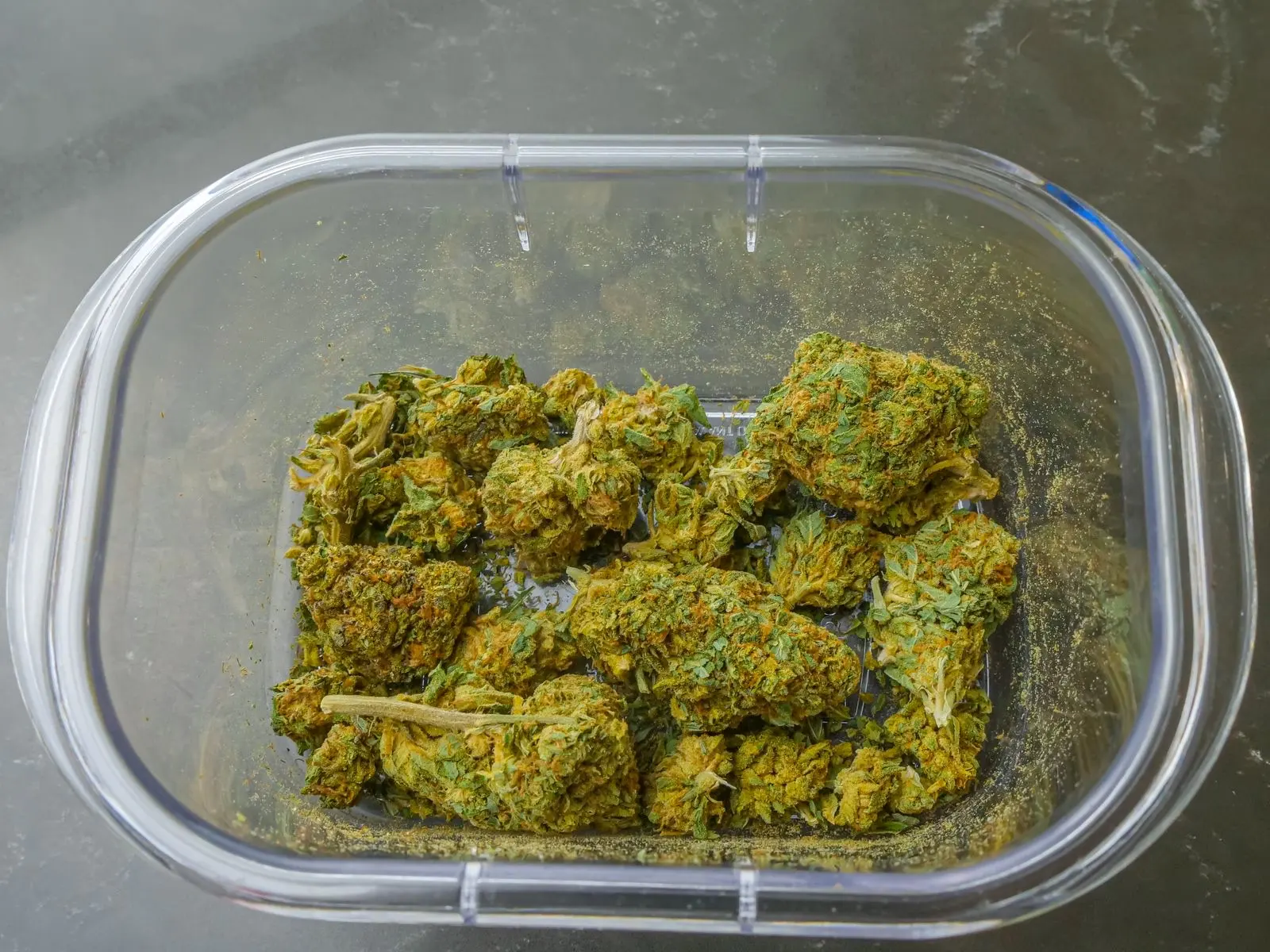
Cannabinoids and terpenes are made in the glandular trichomes, the tiny mushroom-shaped glands that cover female flowers. Careless handling knocks them off: they end up at the bottom of the bag as a golden powder. Greyish fuzz, spots or a musty smell, on the other hand, point to mould. Do not smoke such a flower. Our article on mould on CBD flowers shows how to tell it apart from trichomes.
5. Smell, the first sign of freshness
Terpenes are the volatile molecules behind the smell: myrcene, limonene, pinene, beta-caryophyllene. They evaporate long before cannabinoids break down. A study published in 2020 in Frontiers in Plant Science followed flowers stored for a year at four temperatures: average terpene content had dropped by more than 50% within four months, while cannabinoids had lost 26% on average over twelve months. A bland flower is not necessarily low in CBD. It is mostly old or badly stored. Our article on hemp terpenes explains their chemistry.
6. Moisture
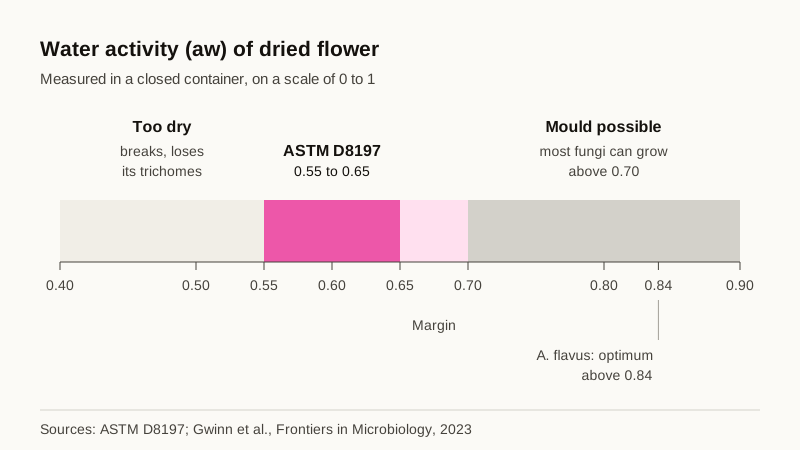
The ASTM D8197 standard sets a water activity of 0.55 to 0.65 for dried flower. Above that range, mould can grow. Below it, the flower breaks and sheds its trichomes. A review published in 2023 adds that drying below 0.7 prevents most fungi from growing.
An airtight, opaque container kept somewhere cool is still the best protection: our article on storing flowers details the conditions that have been measured.
CBD percentage does not measure quality
Two flowers at 10% CBD can smell completely different. CBD content depends on the chemotype, meaning the CBD-to-THC ratio set by the variety's genetics. CBD flowers belong to chemotype III, where CBD outweighs THC. The European Commission counted 116 registered hemp varieties in 2024, each with its own profile. Smell, on the other hand, depends on the terpene profile, which is also genetic, and then on drying and storage.
A very high percentage even deserves a question. Across 72 flowers in our catalogue surveyed in 2026, CBD ranged from 6.73 to 14.39%. A product labelled 30 or 45% is usually a moon rock, a flower coated in extract and trichome powder: it is no longer a raw flower. Our articles on the CBD levels certificates show and on choosing a strong flower compare real batches.
Indica and sativa labels tell you even less. They describe a plant shape, not a composition, as our article on indica and sativa explains. The CBD flowers in our catalogue state the dominant terpene instead, for example the pinene and beta-caryophyllene of Amnesia Haze.
Flower or hash: what changes in the smoke
Hash, or resin, is made of trichomes separated from the flower and then pressed. It therefore packs cannabinoids and terpenes into a smaller volume. The name tells you the separation method: dry sift is sieved dry, ice-o-lator is separated in ice water. Neither uses a solvent. A hash with a chemical taste or a sticky paste texture deserves a residual-solvent test, as our article on solvents in hash explains.
Weight for weight, a CBD hash therefore often contains more CBD than a flower. Residual THC, made in the same trichomes, can concentrate the same way: the 0.30% limit applies to the finished product all the same. The CBD resin in our catalogue, such as Drysift 90u, calls for the same checks as flower. Our flower or resin comparison details the four differences measured on one batch.
Smoking or vaping: what burning changes
No flower, however good, makes smoke harmless. Burning any plant matter produces carbon monoxide and tar. A machine-smoking analysis published in 2008 even measured up to 20 times more ammonia in cannabis smoke than in tobacco smoke, and 3 to 5 times more hydrogen cyanide and nitrogen oxides. Rolling without tobacco removes nicotine, not combustion, as our article on tobacco-free joints shows.
A vaporiser heats the flower without burning it. A trial published in 2007 compared a desktop vaporiser and a cannabis cigarette in 18 hospitalised volunteers. Blood THC levels were similar, and exhaled carbon monoxide was lower with the vaporiser. The trial lasted six days: it describes a way of consuming, not a health benefit. Useful temperatures are in our guide to vaping CBD.
One last point that is often forgotten: a compliant flower contains THC, up to 0.30%. Smoked regularly, it can turn a saliva test positive, and driving after drug use is judged with no threshold. Our guide to CBD and drug testing gives the figures.
Frequently asked questions
What is the best CBD to smoke?
The one whose batch is tested, under 0.30% Δ⁹-THC, free of HHC and H4CBD, and still fragrant. Between two compliant products, the choice comes down to taste: terpene profile, flower or hash. CBD percentage alone settles nothing.
Is it legal to smoke CBD in France?
The law regulates the sale, not how you consume. A flower from an authorised variety with no more than 0.30% Δ⁹-THC can be sold legally. Smoking it is still combustion, with its tar and carbon monoxide.
Is CBD resin stronger than flower?
It is more concentrated, since it is made of trichomes separated from the flower. It often holds more CBD per gram, and sometimes more residual THC. It does not produce the effect of THC-rich cannabis.
How can I tell if a CBD flower is fresh?
By smell first: a fresh flower clearly smells of its variety. Then by touch: it does not crumble to powder and is not sticky. A bland flower has lost its terpenes, which fade within a few months even when stored well.
Is 30% CBD normal for a flower?
Not for a raw flower: of 72 flowers surveyed in our catalogue, none exceeded 15%. Such a figure usually means a product coated in extract or trichome powder. Ask for the batch certificate and a list of what it contains.
Written by the Phytogrammes team
Every article in this journal draws on primary sources (ANSM, EFSA, EUR-Lex, peer-reviewed publications) and on the lab's own practice: batch-by-batch HPLC analyses, measured cannabinoid profiles. Our approach.
Article published on . CBD is not a medicine.