Synthetic cannabinoids: 12 of 223 'CBD' products hid one
A synthetic cannabinoid is a molecule made in a laboratory to act on the same receptor as THC, often more strongly, without ever being assessed in humans. Of 223 products sold as CBD in France and tested in 2022 and 2023, 12 contained a derivative of this kind that was not declared. CBD is not one of them: it is a hemp molecule, even when it is made by synthesis.
Contents
> Key takeaways > > - Three families not to confuse: CBD, derivatives made from CBD (HHC, H4-CBD) and fully synthetic molecules (PTC, MDMB-PINACA). > - HHC has been a controlled narcotic in France since 13 June 2023; H4-CBD, H2-CBD, THCP and the whole benzo[c]chromene family since 3 June 2024. > - An addictovigilance study found an undeclared derivative in 12 of 223 "CBD" products, or 5.4%. > - On 19 June 2025, the ANSM and Anses reported several hundred poisonings since early 2024 after products sold as CBD. > - A certificate of analysis only protects you if it lists these molecules among those tested for.
Synthetic cannabinoids: three families to tell apart
A cannabinoid is a molecule that acts on the CB1 and CB2 receptors of the endocannabinoid system. THC produces its psychotropic effects by binding to CB1. A "synthetic" cannabinoid is made by chemistry instead of being extracted from the plant. In practice the term covers two very different families, and it is often confused with CBD.
| Family | Examples | Origin | Status in France on 23 September 2026 |
|---|---|---|---|
| CBD | Cannabidiol | Extracted from hemp, or synthesised as the identical molecule | Sold if the product contains no more than 0.30% Δ⁹-THC |
| Semi-synthetic derivatives | HHC, HHCO, HHCP, H4-CBD, H2-CBD, THCP | Made from a hemp cannabinoid, often CBD | Narcotics since 13 June 2023 or 3 June 2024 |
| Fully synthetic cannabinoids | JWH-018, MDMB-PINACA, molecules sold as PTC | Chemical synthesis, no plant involved | Listed molecule by molecule, eight more on 3 June 2024 |
Semi-synthesis means transforming a natural molecule with a chemical reaction. H4-CBD, for instance, is made by adding hydrogen to CBD. Fully synthetic molecules often have no structural kinship with THC at all. They only mimic its action on the receptor.
A review published in 2014 in Drug and Alcohol Dependence sums up what makes them dangerous. Most of those found in herbal blends bind more strongly to the CB1 receptor than THC, with effects 2 to 100 times more potent depending on the molecule.
Synthetic CBD exists, and it is a different subject
Searches for "synthetic CBD" often mix up two things. Cannabidiol can be produced by chemical synthesis: the result is the same molecule as in hemp, trans-CBD. It is not a synthetic cannabinoid in the sense of this article, because it is not a new molecule.
That does not settle its safety as a food. In July 2025, the European Food Safety Authority (EFSA) assessed a synthetic CBD of 99.5% purity, proposed as a food supplement at 30 mg per day. It concluded that its safety could not be established, because the manufacturer did not supply the data requested. Flowers and resins are plant products: their CBD is not synthesised. The basics are in our article what is CBD.
From research labs to CBD shops
The first molecules came out of university laboratories studying the cannabinoid receptors. HU-210 comes from the Hebrew University of Jerusalem; the JWH series, including JWH-018, from the team of chemist John W. Huffman. In the early 2000s, clandestine labs began spraying them onto dried plants. These blends were sold in Europe as Spice, labelled "not for human consumption", according to the same 2014 review.
In France, the phenomenon reached the CBD market with HHC, a semi-synthetic derivative sold in shops until its classification as a narcotic on 13 June 2023. The ANSM, France's medicines agency, noted rising use at the time, "sometimes without the knowledge of users who think they are consuming another product, such as CBD". The full timeline is in our article on the HHC ban.
Replacements arrived at once. By a decision of 22 May 2024, the ANSM added new cannabinoids to the narcotics list from 3 June 2024: H4-CBD, H2-CBD, any molecule derived from the benzo[c]chromene core, including THCP, and eight fully synthetic cannabinoids. An amending decision of 3 June 2024, published the next day, excludes CBN, CBNA, THCV up to 0.3% and the THCA of compliant hemp. So the THCA in a legal flower is not banned, whatever you may read. The case of H4-CBD is covered separately.
The latest link in the chain: e-liquids sold as PTC, French slang for "blow your skull". On 6 February 2025, the ANSM reported new poisoning cases among teenagers hospitalised in 2024. Our feature on PTC describes these products.
What testing found in "CBD" products
Three addictovigilance centres, working with the toxicology laboratory of Lille University Hospital, bought 223 products sold as CBD, in July 2022 and again in April 2023. Flowers, resins, pollens, e-liquids, sweets: 85% were products to inhale. The results are published in a summary note from MILDECA, the French government's drug policy body.
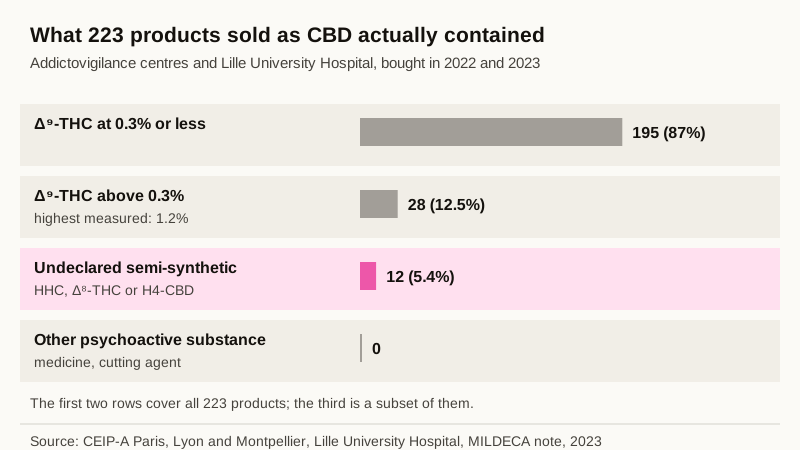
Four results matter to a buyer:
- Hidden derivatives. 12 products out of 223, or 5.4%, contained HHC, Δ⁸-THC or H4-CBD without saying so, mostly in the 2023 purchases.
- THC above the limit. 28 products, or 12.5%, exceeded 0.3% Δ⁹-THC, with a maximum of 1.2%.
- Wrong labels. Only one product in two stated its composition, and of those, 19% had a CBD content matching the label, within 20%.
- Nothing else. No medicine, no cutting agent and no other new psychoactive substance was found.
The authors warn that their sample does not represent the whole market. Two years later, on 19 June 2025, the ANSM and Anses warned of several hundred poisonings recorded since early 2024. The products involved contained HHC, HHC-O, H4-CBD, MDMB-PINACA or too much THC. They were e-liquids, smoking products and foods such as oils, capsules or sweets.
Why the danger is real, even at small doses
The first risk is potency. A molecule 2 to 100 times more active than THC leaves no margin. When it is sprayed on a flower or diluted in an e-liquid, nothing tells the buyer how much they are getting.
The second is the effects observed. For the molecules listed in 2024, the ANSM cites vomiting, loss of consciousness, coma, convulsions, paranoia, anxiety, high blood pressure, rapid heart rate and cases of kidney failure. Users often described them as more intense than those of cannabis.
The third, specific to the CBD market, is that users do not know. Someone buying a CBD flower expects a product with no psychotropic effect. If they get a synthetic derivative instead, they may drive, work or drink alcohol without suspecting anything. None of these molecules was assessed before being sold.
How to check a product before you buy
No visual check is enough: a sprayed flower looks like a flower. Four checks reduce the risk.
- Read the composition. HHC, H4-CBD, "tetrahydrocannabidiol", "hydrogenated CBD", THCP, PTC or "Buddha Blue" all name narcotics. A promise of an effect "close to THC" or "stronger than CBD" is a warning sign.
- Ask for the batch certificate of analysis. The batch number must match the product. Δ⁹-THC must be at 0.30% or less, in line with the legal limit.
- Check which molecules were tested for. The Lille study detected these derivatives with liquid chromatography coupled to mass spectrometry. A certificate that only lists CBD and THC says nothing about HHC or H4-CBD: they have to appear in the list, marked "not detected", with a limit of detection.
- Take an unexpected effect seriously. Heavy drowsiness, palpitations, anxiety: stop, keep the product so it can be tested and call a poison control centre. In an emergency in France, call 15.
Our guide to reading a certificate of analysis goes through every line, and the laboratory page describes the measurement methods.
Frequently asked questions
Is CBD a synthetic cannabinoid?
No. CBD is a natural hemp molecule. Even when produced by chemical synthesis, it remains the same molecule. Synthetic cannabinoids are different molecules, designed to act like THC on the CB1 receptor.
Is synthetic CBD dangerous?
It is not the same risk as synthetic cannabinoids, since the molecule is identical to hemp CBD. As a food, its safety is not established: in July 2025, EFSA could not reach a conclusion on a dossier for 30 mg per day, for lack of data.
Is H4-CBD legal in France?
No. The ANSM added it to the narcotics list by a decision of 22 May 2024, in force from 3 June 2024. Selling, possessing and using it are prohibited, whatever the dose.
How can you tell if a CBD flower has been sprayed?
You cannot tell by looking. Only an analysis shows it, provided the laboratory tested for these molecules. Ask for the batch certificate and check that HHC, H4-CBD and Δ⁸-THC appear in the list of compounds analysed.
Has THCA been banned since 2024?
No, not the THCA of compliant hemp. The amending decision of 3 June 2024 excludes from the list the THCA present in hemp that complies with the order of 30 December 2021.
Written by the Phytogrammes team
Every article in this journal draws on primary sources (ANSM, EFSA, EUR-Lex, peer-reviewed publications) and on the lab's own practice: batch-by-batch HPLC analyses, measured cannabinoid profiles. Our approach.
Article published on . CBD is not a medicine.