PTC drug ('pète ton crâne'): composition, effects, risks
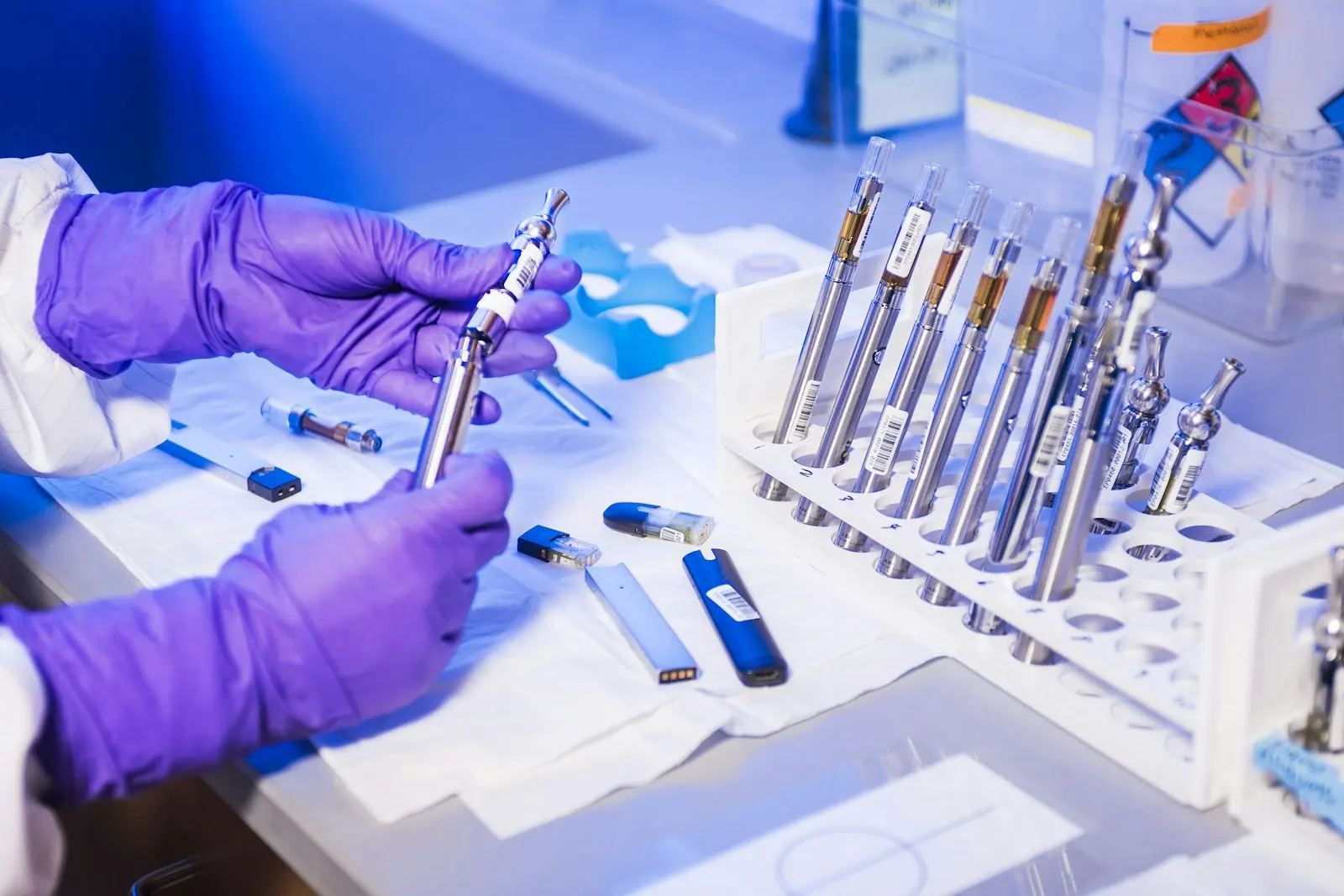
PTC, short for the French slang "pète ton crâne" ("blow your skull"), is not cannabis. It is an e-liquid or plant matter soaked in synthetic cannabinoids, lab-made molecules such as MDMB-4en-PINACA. They activate the CB1 receptor far more strongly than THC, at doses that vary from one bottle to the next. They are classified as narcotics in France, and the ANSM reported teenagers hospitalised in 2024 after vaping them.
Contents
> Key takeaways > > - PTC contains no THC: its effects come from synthetic cannabinoids added to a carrier. > - Of 1,142 samples sold as cannabis and tested in 8 European countries, 270 contained MDMB-4en-PINACA. > - THC levels off at the CB1 receptor; synthetic cannabinoids go all the way to maximum activation. > - Rapid cannabis tests do not detect these molecules. > - In an emergency in France, call 15; for questions, Drogues Info Service answers on 0 800 23 13 13.
This is an information and harm-reduction page. It does not link to any product.
What does PTC contain?
PTC has no fixed composition. The name describes a way of selling rather than a molecule. According to Drogues Info Service, the French national drug helpline, it comes as a liquid for e-cigarettes, as a powder, or sprayed onto a blend of dried plants. It contains no THC.
In a warning dated 6 February 2025, the ANSM, the French medicines agency, states that e-liquids sold as "PTC" or "Buddha Blue" mostly contain synthetic cannabinoids, sometimes combined with synthetic benzodiazepines.
The carrier can also be hemp. From spring 2020, nine European drug-checking services tested 1,142 samples sold as cannabis, as herb, resin or e-liquid. 270 contained MDMB-4en-PINACA. The plant samples contained less than 1% THC, and the e-liquids no plant cannabinoids at all. In other words, low-THC hemp had been used as a carrier for the synthetic molecule.
In Switzerland, a 2022 study run with three drug-checking services found up to three synthetic cannabinoids in 50% of the 94 samples received. MDMB-4en-PINACA was again the most common.
Why PTC has nothing to do with cannabis
THC and synthetic cannabinoids bind to the same receptor, CB1, but they do not activate it in the same way. THC is a partial agonist: even at high doses it only partly activates the receptor. Synthetic cannabinoids are full agonists: they can activate it to the maximum.
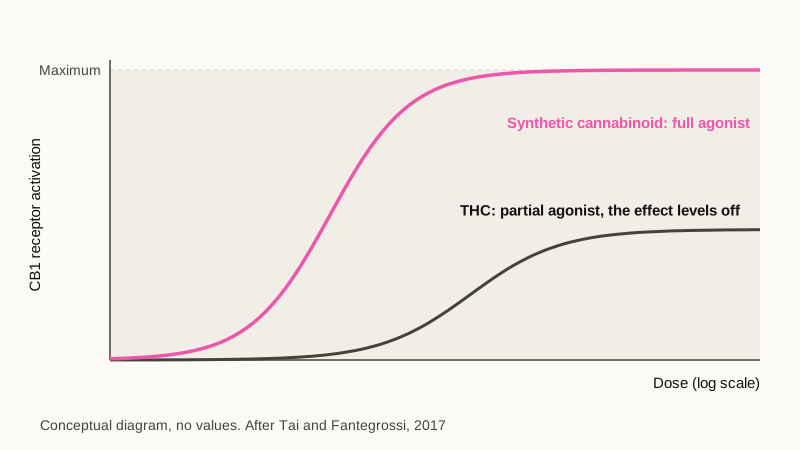
A review published in 2017 sums up the difference: where THC behaves as a partial agonist, synthetic cannabinoids act as full agonists of the CB1 and CB2 receptors, in cell assays as well as in animals. Several of their metabolites remain active themselves. The authors conclude that these products should not be seen as safe alternatives to cannabis.
That is what makes PTC unpredictable. Someone who thinks they are smoking or vaping cannabis doses as they would for cannabis, with a molecule that does not level off and a concentration that neither they nor the seller know. Our article on whether CBD gets you high explains, by contrast, why CBD does not.
Documented effects and risks
For the vaping of these e-liquids, the ANSM describes psychiatric episodes (delusions, hallucinations, suicidal thoughts), cardiovascular and digestive problems, kidney damage and severe dependence with withdrawal. In 2024, new cases of teenagers hospitalised after vaping PTC were reported to the agency.
When it classified new cannabinoids in 2024, the agency also listed vomiting, loss of consciousness, coma and seizures. In the Swiss study, users of products containing synthetic cannabinoids reported more adverse effects than those whose sample held only THC, especially psychological and cardiac ones.
Drogues Info Service adds that these products are more addictive than cannabis. Home-made mixtures raise the risk of overdose, because the dose is even less controlled.
What French law says
Synthetic cannabinoids are narcotics in France. Since the order of 31 March 2017, the narcotics list has covered whole chemical families, not only named molecules. Among them are the "3-carboxamide indazole derivatives", the chemical family of MDMB-4en-PINACA. Classifying by family targets the variants that manufacturers create to get around bans.
MDMB-4en-PINACA is also listed by name: an ANSM decision of 9 December 2021 placed it in Annex III of the list, following its European and international classification. The agency later added other synthetic cannabinoids and H4CBD from 3 June 2024.
Producing, selling, possessing or using PTC therefore falls under narcotics law. The difference from a compliant CBD product is also a matter of paperwork: a compliant product has a measured composition, with Δ⁹-THC at 0.3% or less and a certificate of analysis you can read line by line. A PTC has neither.
Spotting a suspect product
Nothing visible guarantees that a herb has not been soaked. The contaminated European samples were sold as ordinary cannabis, and only analysis revealed the molecule. Rapid cannabis tests do not detect these molecules either, the ANSM notes: a specialised analysis is needed.
Several signs should therefore raise a flag: a sudden effect unrelated to what the product claims, a "cannabis" e-liquid sold outside any identifiable channel, a seller unable to provide a batch analysis. A product sold as CBD that gets you high is not a "strong" CBD: it contains something else. Our feature on synthetic cannabinoids and harm reduction adds further pointers, and the one on HHC covers semi-synthetic molecules.
Drug-checking services run by harm-reduction associations can identify the molecule in a sample anonymously.
Where to find help
If someone shows agitation, chest pain, seizures or loss of consciousness after using, call 15 (SAMU, the French emergency medical service) or 112. Do not leave the person alone, and keep the product or its packaging if possible: it can guide medical care.
For questions or support in France, Drogues Info Service answers on 0 800 23 13 13, 7 days a week, anonymously and free of charge. Youth consumer consultations (CJC) see minors and their families. Adverse effects can be reported to the addiction-monitoring centres (CEIP-A), which feed national surveillance.
Frequently asked questions
Is PTC cannabis?
No. It is a carrier, liquid or plant, soaked in synthetic cannabinoids made in a laboratory. It contains no THC, and its effects and risks are not those of cannabis.
What is PTC made of?
It varies from batch to batch. Analyses mostly find synthetic cannabinoids such as MDMB-4en-PINACA, sometimes with synthetic benzodiazepines, on an e-liquid, a powder or dried plants, including low-THC hemp.
What is the difference between PTC and CBD?
CBD is a natural hemp cannabinoid with no psychoactive effect, sold legally with no more than 0.3% Δ⁹-THC. PTC contains full CB1 receptor agonists, classified as narcotics, at unknown doses. Since PTC has already been sprayed onto hemp, only analysis can tell them apart.
Is PTC detected by saliva tests?
Not by rapid cannabis tests, according to the ANSM: these molecules require a specialised laboratory analysis. Using them remains an offence, whether or not a test detects them.
What should you do if someone collapses after vaping PTC?
Call 15 or 112, describe what was used and do not leave the person alone. Keep the product if possible: it can be analysed.
Written by the Phytogrammes team
Every article in this journal draws on primary sources (ANSM, EFSA, EUR-Lex, peer-reviewed publications) and on the lab's own practice: batch-by-batch HPLC analyses, measured cannabinoid profiles. Our approach.
Article published on . CBD is not a medicine.