CBD and alcohol: four human trials, no protective effect
CBD does not lower blood alcohol in any useful way, and it does not protect the human liver or brain from alcohol. Four controlled trials, published between 1979 and 2026 with 10 to 44 participants, measured only minimal or zero differences. The one established point runs the other way: cannabidiol can cause drowsiness, and alcohol can make that drowsiness worse.
Contents
> Key takeaways > > - The idea that CBD "lowers blood alcohol" comes from a 1979 study of 10 people whose authors concluded that CBD was inactive. > - Three recent trials (2023, 2025, 2026) found no meaningful effect on blood alcohol, subjective effects or the amount people drank. > - The protective effects on the liver and brain were seen in animals, not in humans. > - The label of Epidyolex, the only authorised CBD medicine, warns that alcohol can increase the drowsiness caused by cannabidiol. > - Behind the wheel in France, CBD plus alcohol can mean up to 5 years in prison and a €15,000 fine if THC is detected.
The 1979 study: ten people and a misunderstanding
It all starts with a trial published in 1979 in Psychopharmacology. Consroe and colleagues gave ten healthy volunteers, six men and four women, four treatments one week apart: a placebo, 200 mg of CBD, alcohol at 1 g per kilo of body weight, and alcohol combined with CBD. Neither the volunteers nor the investigators knew which treatment was given.
There were two results. Alcohol, alone or with CBD, impaired motor and psychomotor performance; CBD alone did not. And the combination produced lower blood alcohol, measured with a breathalyser, than alcohol alone. But the authors also noted that the two alcohol conditions produced few differences in effects. Their conclusion fits in one sentence: CBD's inactivity on performance extends to its interaction with alcohol.
In other words, the blood alcohol figure went down, but the effects of alcohol did not. Yet this single observation, almost fifty years old, is where the sales pitch comes from.
Three recent trials, the same finding
Three teams have gone back to the question since then, with larger protocols.
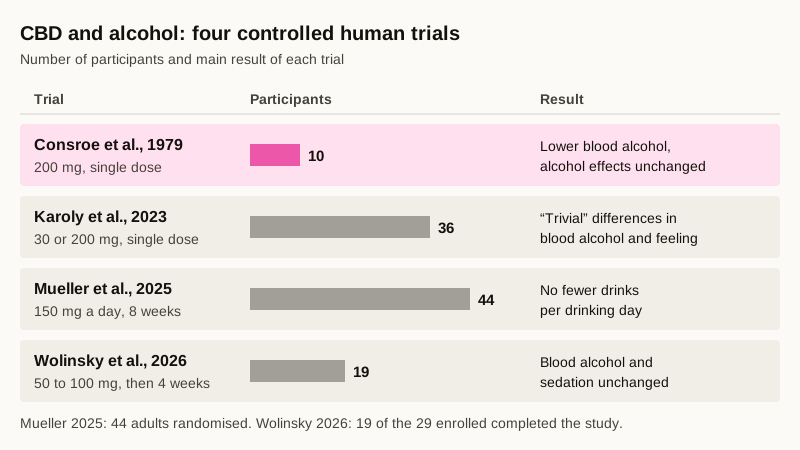
| Trial | Participants | CBD given | Main result |
|---|---|---|---|
| Consroe et al., 1979 | 10 healthy volunteers | 200 mg, single dose | Lower blood alcohol, impairment unchanged |
| Karoly et al., 2023 | 36 heavy drinkers | 30 or 200 mg, single dose | "Trivial" differences in blood alcohol and subjective effects |
| Mueller et al., 2025 | 44 adults with alcohol use disorder | 150 mg a day, 8 weeks | No fewer drinks per drinking day |
| Wolinsky et al., 2026 | 19 adults who completed the study | 50 or 100 mg, then 50 mg twice a day, 4 weeks | Blood alcohol and sedation the same across conditions |
Karoly's trial, published in 2023, is the closest to the 1979 question. Thirty-six people who reported heavy drinking took 30 mg of CBD, 200 mg or a placebo before a standardised dose of alcohol. The authors did record small gaps: blood alcohol fell slightly faster on placebo, and felt stimulation wore off more slowly on 200 mg. Their conclusion: CBD has minimal influence on breath alcohol and the subjective effects of alcohol, with differences of "trivial" size.
Mueller's trial, published in 2025 in Frontiers in Psychiatry, followed 44 adults with moderate to severe alcohol use disorder for eight weeks, on 150 mg a day of full-spectrum CBD, broad-spectrum CBD or a placebo. It found no effect of the treatment on drinks per drinking day. The full-spectrum group reported less craving at 8 and 16 weeks, a signal the authors treat as preliminary given group sizes of 13 to 16 people.
The most recent, published in June 2026 in the Journal of Cannabis Research, is a phase I trial focused on safety. Twenty-nine adults enrolled and nineteen completed it. The researchers found no difference in peak breath alcohol or in its time course between CBD doses, nor in sedation or craving.
Liver and brain: results in animals
The promises of "protection" come from somewhere else: rodents. A French review published in 2019 in Frontiers in Pharmacology gathers this work. In animals, CBD reduces alcohol intake and alcohol-related fatty liver and liver fibrosis, as well as some brain damage. The authors themselves write that any other application requires trials in humans.
Those human trials confirm nothing so far. An umbrella review of 22 systematic reviews, published in 2025 in Addiction by a team at Sorbonne University, concludes that CBD on its own does not appear effective for substance use disorders. For alcohol, the evidence is judged limited and inconclusive. What works in rats does not automatically carry over to humans, and checking that is exactly what clinical trials are for.
On the liver, the Epidyolex label even calls for caution. In the controlled trials of this medicine, given at 10 to 25 mg per kilo per day, 12% of patients on cannabidiol saw their liver enzymes (ALT) rise above three times the upper limit of normal, against less than 1% on placebo. Those doses have nothing in common with an everyday oil. Our article on CBD and liver enzymes details these figures.
The one solid signal: drowsiness that adds up
The summary of product characteristics for Epidyolex, published by the European Medicines Agency, is the most precise document on the question. It states that cannabidiol can cause somnolence and sedation, and that other central nervous system depressants, including alcohol, can increase this effect. It also rates cannabidiol as having a major influence on the ability to drive.
That text concerns a high-dose medicine prescribed for rare epilepsies; the details are in our file on Epidyolex. But the mechanism does not depend on the bottle: two substances that can make you drowsy do not cancel each other out. The 2023 and 2026 trials, with doses of 30 to 200 mg, did not measure extra sedation. That still does not rule out the effect in a given person.
CBD also acts on the liver enzymes that break down many medicines. If you take a treatment, the article on the grapefruit effect explains why to talk to your doctor or pharmacist.
Behind the wheel: two possible offences
In France, driving after drug use is punished whatever the amount detected, as the “Drogue au volant” page on service-public.fr points out. A CBD product may contain traces of THC, up to 0.30% in the finished product, and roadside saliva tests look for THC, not CBD. Our guide to saliva drug testing describes what the tests detect.
The penalties: 3 years in prison and a €9,000 fine for driving after drug use. If alcohol is involved as well, up to 5 years in prison and a €15,000 fine, with 9 licence points removed instead of 6. Between possible drowsiness and the legal risk, the practical rule is simple: do not drive after combining the two.
The alcohol guidelines do not change
Taking CBD changes nothing in the guidelines of Santé publique France, the French public health agency. It recommends no more than 10 standard drinks a week and no more than 2 a day, with alcohol-free days. A standard drink in France contains 10 g of pure alcohol, whether it is wine, beer or spirits. The agency also stresses that no level of drinking is risk-free.
We found no position from the ANSM, the HAS or Inserm specifically on combining CBD and alcohol. To compare the two substances more broadly, see our article alcohol and cannabis: which is more harmful.
Frequently asked questions
Does CBD lower blood alcohol levels?
Not in any useful way. The idea comes from a 1979 study of ten people, where blood alcohol was lower with CBD but the effects of alcohol were the same. In 2023, with 36 people, the measured gap was trivial, and in 2026, with 19 people, there was none.
Can CBD help you sober up?
No. No trial has shown that CBD reduces drunkenness, motor impairment or the time it takes to clear alcohol. Only time lowers blood alcohol.
Does CBD protect the liver from alcohol?
Nothing shows it does in humans. The liver effects were seen in animals. At high medicinal doses, cannabidiol can instead raise liver enzymes: 12% of patients on Epidyolex against less than 1% on placebo.
Does CBD help people drink less?
The data do not support it. In 2025, 150 mg of CBD a day for eight weeks did not reduce the number of drinks in 44 adults, and the 2025 review judges CBD alone ineffective in addiction. To cut down, the French helpline Alcool Info Service answers free of charge.
Can I drive after taking CBD and having a drink?
Better not. Cannabidiol can cause drowsiness and alcohol can make it worse. If traces of THC are detected on top of blood alcohol, penalties in France reach 5 years in prison and a €15,000 fine.
Written by the Phytogrammes team
Every article in this journal draws on primary sources (ANSM, EFSA, EUR-Lex, peer-reviewed publications) and on the lab's own practice: batch-by-batch HPLC analyses, measured cannabinoid profiles. Our approach.
Article published on . CBD is not a medicine.