Does CBD show up on a saliva drug test? What France checks
Yes, a saliva test can come back positive after a CBD product. The test does not look for CBD: it looks for THC, and a full-spectrum product may legally contain up to 0.30% of it. On French roads, the mere presence of THC is an offence, with no tolerance threshold, even if the product was sold legally.
Contents
> Key takeaways > > - No roadside or workplace test looks for CBD. They all target THC or its metabolite, THC-COOH. > - French saliva kits must detect THC from 15 ng per millilitre of saliva; the confirmation analysis goes down to 1 ng/ml. > - In a 2021 trial, 7 of 14 participants tested positive in urine after 4 weeks on an oil with 0.02% THC. > - Driving after drug use carries up to 3 years in prison and a €9,000 fine, whatever the amount. > - Only a product whose certificate shows Δ⁹-THC as not detected really lowers the risk.
What tests look for: THC, never CBD
French drug tests target Δ⁹-THC, the psychoactive molecule in cannabis, and THC-COOH, an inactive metabolite the liver produces when it breaks THC down. Cannabidiol is not a controlled drug: no approved kit screens for it, and the French Highway Code sets no CBD threshold.
The cut-offs are set by the decree (arrêté) of 13 December 2016 on drug testing of drivers. They are not tolerance limits but detection limits: the level at which the test must react.
| Step | Sample | Molecule tested | Detection cut-off set by the decree |
|---|---|---|---|
| Roadside screening | Saliva | THC | 15 ng/ml of saliva |
| Urine screening (cases provided for in the text) | Urine | THC-COOH | 50 ng/ml of urine |
| Confirmation analysis | Saliva | THC | 1 ng/ml of saliva |
| Confirmation analysis | Blood | THC | 0.5 ng/ml of blood |
Confirmation is done in a laboratory by chromatography coupled with mass spectrometry, on a second saliva sample or a blood sample. It is fifteen times more sensitive than the roadside kit.
Why a legal product can make you test positive
The 0.30% threshold governs the sale of hemp, not driving. A compliant full-spectrum product therefore contains THC, in small but real amounts: a flower at 0.25% THC carries 2.5 mg per gram. Used often, that THC ends up crossing the cut-offs above. The sales threshold is explained in our article on the legal THC level.
A team at McLean Hospital, affiliated with Harvard, measured it. Published in 2021 in JAMA Psychiatry, the study followed 14 adults taking a full-spectrum hemp oil every day: about 35 mg of CBD and 0.8 mg of THC per day, from an oil assayed at 0.02% THC. After four weeks, 7 of the 14 participants had a urine test positive for THC-COOH. The oil held fifteen times less THC than the French ceiling.
CBD does not mask THC either. An Australian team had 14 volunteers vaporise THC-rich cannabis, with or without an equal amount of CBD. According to the 2019 study in Drug Testing and Analysis, the THC curve in saliva was the same in both cases. Neither of the two roadside kits tested reached the recommended 80% sensitivity, specificity and accuracy: a kit can be wrong in both directions.
Drogues Info Service, the public drug information service run by Santé publique France, sums it up in a 2025 note on CBD and saliva tests: a driver who tests positive after CBD took a product that contained THC. CBD without THC cannot trigger the test.
How long THC stays detectable
The window depends on the sample and, above all, on how often you use. THC is stored in fat and released slowly, which lengthens the window for daily users.
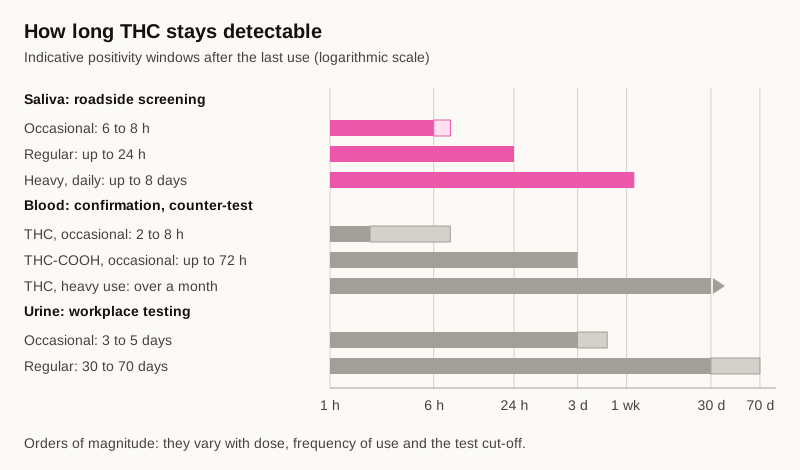
The table of positivity windows published by Drogues Info Service gives these orders of magnitude:
- Saliva: 6 to 8 hours after occasional use, up to 24 hours with regular use, up to 8 days with heavy daily use.
- Blood: THC detectable 2 to 8 hours after occasional use, THC-COOH up to 72 hours; over a month with heavy use.
- Urine: 3 to 5 days after occasional use, 30 to 70 days with regular use.
These figures apply to cannabis. A CBD product usually delivers less THC per use, but no official source gives a CBD-specific window. So will 0.3% THC show up in a urine test? With regular use it can, as the 2021 trial showed at a far lower level. CBD itself has a long half-life: a 2018 systematic review reports 2 to 5 days after repeated oral dosing and 31 hours when smoked. That changes nothing for the test, since CBD is not screened for. Sample-by-sample windows are detailed in our article on how long CBD stays in the body, and hair testing in the hair test.
Behind the wheel: no tolerance threshold
Article L235-1 of the French Highway Code punishes driving after drug use with 3 years in prison and a €9,000 fine, penalties raised by the law of 9 July 2025. With alcohol on top, it is 5 years and €15,000. The offence also costs 6 licence points and can lead to a licence suspension of up to 5 years, according to the « Drogue au volant » page on service-public.fr.
The law sets no minimum amount. The Court of Cassation confirmed this on 21 June 2023 (appeal no. 22-85.530): the authorisation to sell hemp derivatives below 0.30% THC "has no bearing on the offence of driving after drug use". Having bought a legal product is therefore not a defence.
In practice, a roadside check has three steps:
- A saliva kit at the roadside. If it is positive, the next step follows.
- A second saliva sample, sent to a laboratory for confirmation.
- At the driver's request, a blood sample for a counter-test, to be requested within 5 days.
Refusing the test carries the same 3 years and €9,000. The changes made by the 2025 law are covered in CBD and driving: what the law of 9 July 2025 tightens.
At work and in competition
An employer cannot test just anyone. Workplace saliva testing is limited to jobs where a mistake endangers the employee or others, and it must be provided for in the company's internal rules. The exact conditions and employee rights are in what an employer can legally test.
For athletes, the World Anti-Doping Agency removed CBD from its prohibited list in 2018. THC remains banned in competition above 150 ng/ml of urine. An athlete taking a full-spectrum oil faces the same risk as a driver; the full picture is in CBD and doping: the 2026 WADA list.
Lowering the risk: what actually matters
Three product families do not carry the same risk:
| Product type | THC present | Drug-test risk |
|---|---|---|
| Full spectrum (flower, resin, full-spectrum oil) | Yes, up to 0.30% | Highest, especially with daily use |
| Broad spectrum | THC removed, sometimes traces | Lower, not zero |
| CBD isolate | Not detected if the isolate is properly purified | Lowest |
What helps:
- Read the Δ⁹-THC line on the batch certificate of analysis. "ND" (not detected) or "< LOQ" (below the limit of quantification) is not the same as "0.2%". Our guide to reading a certificate of analysis goes through each line, and the laboratory page describes the measurement methods.
- Choose an isolate if you drive or are tested at work. What "99%" guarantees is explained in CBD isolate: what 99% means, and the formulation differences in full spectrum or isolate.
- Do not drive after using a product that contains THC. No waiting time guarantees a negative test.
What does not work: quick "detox" products, litres of water before a test, and a certificate kept in the glovebox. It shows good faith, but the court looks at the analysis. Common beliefs about clearing THC are reviewed in clearing THC: myths and facts.
Frequently asked questions
Do police drug tests detect CBD?
No. Roadside kits look for THC and other controlled drugs, never cannabidiol. A positive test after CBD means the product contained THC.
Can you fail a saliva test from CBD alone?
Yes, if the product is full spectrum. It contains up to 0.30% THC, and regular use can be enough to exceed the saliva kit's 15 ng/ml cut-off.
How long should you wait before driving after CBD?
There is no official waiting time. For cannabis, Drogues Info Service gives 6 to 8 hours of saliva positivity after occasional use and up to 8 days with heavy daily use. The safest option is not to drive after a product that contains THC.
Can a CBD isolate make you test positive?
A properly purified isolate contains no detectable THC, and Drogues Info Service confirms that CBD without THC does not trigger the test. Check that the batch certificate shows Δ⁹-THC as not detected.
Can you challenge a positive test if the product was legal?
The product's legality is not a defence: the Court of Cassation ruled so on 21 June 2023. A challenge can target the procedure or the analysis, and you can request a blood counter-test within 5 days.
Written by the Phytogrammes team
Every article in this journal draws on primary sources (ANSM, EFSA, EUR-Lex, peer-reviewed publications) and on the lab's own practice: batch-by-batch HPLC analyses, measured cannabinoid profiles. Our approach.
Article published on . CBD is not a medicine.