Organic CBD flowers: what the EU label covers and excludes
A CBD flower can carry an organic claim if the hemp was grown under the EU organic regulation: in the ground, without mineral nitrogen fertilisers or GMOs, and checked at least once a year. The same regulation bans hydroponic growing, so a "hydro" flower cannot be organic. The label says nothing, however, about THC or CBD levels: those are read on a laboratory analysis.
Contents
> Key takeaways > > - Regulation (EU) 2018/848 applies to unprocessed agricultural products, and raw hemp appears on the Treaty's list of agricultural products. > - An organic crop grows in living soil connected to the subsoil: hydroponics and growing in pots for harvest are excluded. > - Every operator that produces, packs or repacks the product must be certified. A retailer reselling bags that are already sealed is exempt. > - The label of an organic product carries the code of the control body, in the form FR-BIO-XX in France. > - Organic does not mean compliant: Δ⁹-THC must stay at 0.30% or below, whatever the growing method.
What the EU organic regulation covers
Organic farming is governed by Regulation (EU) 2018/848. Its article 2 covers "live or unprocessed" agricultural products, processed products intended for food, animal feed and a short list of other products. The agricultural products in question are those in Annex I of the Treaty on the Functioning of the EU, which includes raw hemp (Cannabis sativa). A dried flower, an unprocessed agricultural product, can therefore in principle be certified, like the crop it comes from.
The production rules deal with how the crop is grown:
- GMOs are banned, in seeds as in inputs (article 11);
- mineral nitrogen fertilisers are banned, and soil fertility relies on crop rotation, green manures and organic matter (Annex II);
- pest control starts with prevention, then relies on a short list of authorised products;
- every operator is checked at least once a year, normally through an on-site inspection (article 38).
An oil meant to be swallowed is a different case. Beyond organic rules, a CBD extract intended as food falls under the novel food regime, covered in our update on CBD regulation in 2026.
Living soil: why a hydro flower cannot be organic
Annex II of the regulation sets a requirement few buyers know about. Organic crops "shall be produced in living soil", in connection with the subsoil and bedrock. The next point explicitly bans hydroponic production, defined as growing roots in a nutrient solution or in an inert medium fed with that solution.
The exceptions are narrow. Growing in pots is allowed only for ornamental plants and herbs sold in their pot to the consumer, and for transplants. A hemp flower harvested from a plant grown in a pot or an above-ground container fits none of these exceptions.
In practice, a flower sold as "hydro", grown out of soil in a nutrient solution, cannot be certified organic, however good it may be otherwise. A greenhouse crop can be, if the plants grow in the ground. Our comparison of indoor, outdoor and greenhouse and our article on hydro CBD flowers describe these growing methods.
| Growing method | Can it be organic? | Reason |
|---|---|---|
| Open field, in the ground | Yes | Living soil connected to the subsoil |
| Greenhouse, plants in the ground | Yes | Same living-soil requirement |
| Indoors, in pots or containers | No | Pots are allowed only for other uses |
| Hydroponics | No | Banned by Annex II, point 1.2 |
The certification chain, from field to bag
Organic status does not stop at the farm. Article 34 of the regulation requires any operator that produces, prepares, stores, imports or places an organic product on the market to notify its activity and be inspected. A wholesaler that sorts, weighs and bags flowers bought in bulk must therefore be certified itself.
The main exemption concerns resale. A seller who passes prepacked products on to the final consumer, without preparing or repacking them, needs no certificate. A shop that opens a 1 kg bag to sell it by the gram under an organic claim falls, in principle, outside that exemption.
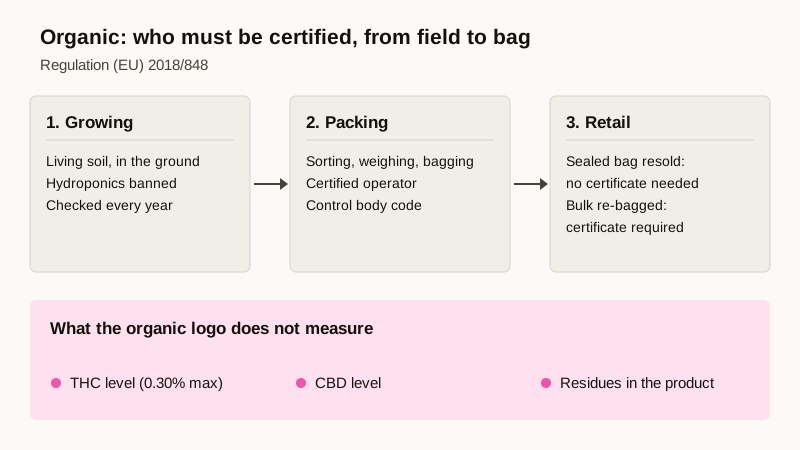
The label must carry the code number of the control body responsible for the operator that carried out the last production or preparation step (article 32). When the EU logo is used, the place where the raw materials were farmed appears next to it: "EU Agriculture", "non-EU Agriculture" or the name of a country.
What the label does not tell you
Organic certifies practices, not composition. Three pieces of information are missing from a logo, and they matter for a CBD flower.
THC level. The French ministerial order of 30 December 2021 caps Δ⁹-THC at 0.30% in cultivated varieties and in products made from them, and requires varieties listed in the official catalogue. Organic hemp is subject to the same limit as conventional hemp. Our article on the legal THC level explains how it is measured.
CBD level. No organic standard sets a cannabinoid content. It depends on the variety, the harvest and the drying.
Residues actually present. Organic rules govern the inputs used; they do not replace an analysis of the finished product. Spray drift from a neighbouring field, for example, only shows up on an analysis. Our article on pesticides and maximum residue levels describes what a laboratory measures.
The MILDECA-supported report of 2023 shows the gap between label and content: of 248 products bought in France, 30 exceeded the THC limit and 46% carried no composition labelling at all. A claim, organic or not, does not replace a measurement.
Checking an organic claim in four steps
- Read the control body code on the label or product page. A logo without a code, or a bare "100% organic", has no regulatory value.
- Look up the operator in the official Agence Bio directory, which lists certified operators in France, and check that its activity covers hemp.
- Ask for the certificate of the operator that packed the product, not just that of the farm of origin.
- Read the batch analysis for THC, CBD and, if available, residues. Our guide to reading a certificate of analysis goes through each line.
Claims such as "natural", "pesticide-free" or "sustainably grown" are not governed by the organic regulation. They may be true, but no body checks them.
Frequently asked questions
Can a CBD flower be certified organic in France?
Yes, in principle: the organic regulation applies to unprocessed agricultural products, and hemp is one of them. It takes a crop grown in living soil, a certified operator at every preparation step, and the control body code on the label.
What does "certified flower" mean?
The word alone says little. A flower can be certified organic by a control body. It can also come with a laboratory analysis, which is a measurement report, not a certification. Always ask who certifies, and what.
Does an organic CBD flower contain less THC?
No. Organic covers how the plant is grown, not its composition. The 0.30% Δ⁹-THC limit applies in the same way to an organic flower and a conventional one.
Why are hydro flowers never organic?
Because Regulation (EU) 2018/848 bans hydroponic production and requires living soil connected to the subsoil. A flower grown out of soil can be of good quality, but it cannot carry the organic logo.
Are Phytogrammes flowers organic?
Our product pages do not claim organic status. The flowers in our CBD flower catalogue are presented with their growing method and profile, and our laboratory page explains how cannabinoids are measured.
Written by the Phytogrammes team
Every article in this journal draws on primary sources (ANSM, EFSA, EUR-Lex, peer-reviewed publications) and on the lab's own practice: batch-by-batch HPLC analyses, measured cannabinoid profiles. Our approach.
Article published on . CBD is not a medicine.