CBD flower: indoor, outdoor or greenhouse, what changes
Indoor, outdoor and greenhouse describe three growing environments, not three quality levels. A 2023 study on cloned plants measured more terpenes outdoors and more oxidised cannabinoids indoors. For French law, the growing method changes nothing: only the variety and a Δ⁹-THC content of 0.30% or less count.
Contents
> Key takeaways > > - Indoor: artificial light and a fully controlled climate. Outdoor: open field and sunshine. Greenhouse: natural light under cover, with a partly controlled climate. > - In the 2023 study, limonene, myrcene, beta-caryophyllene and alpha-humulene were higher outdoors. > - The same study found more CBN and other oxidation products in indoor flowers. > - In the United States, indoor growing emits 2,283 to 5,184 kg of CO2 equivalent per kilo of dried flower. > - No published study compares all three methods at once: the greenhouse is still missing from the measurements.
Three environments, three levels of control
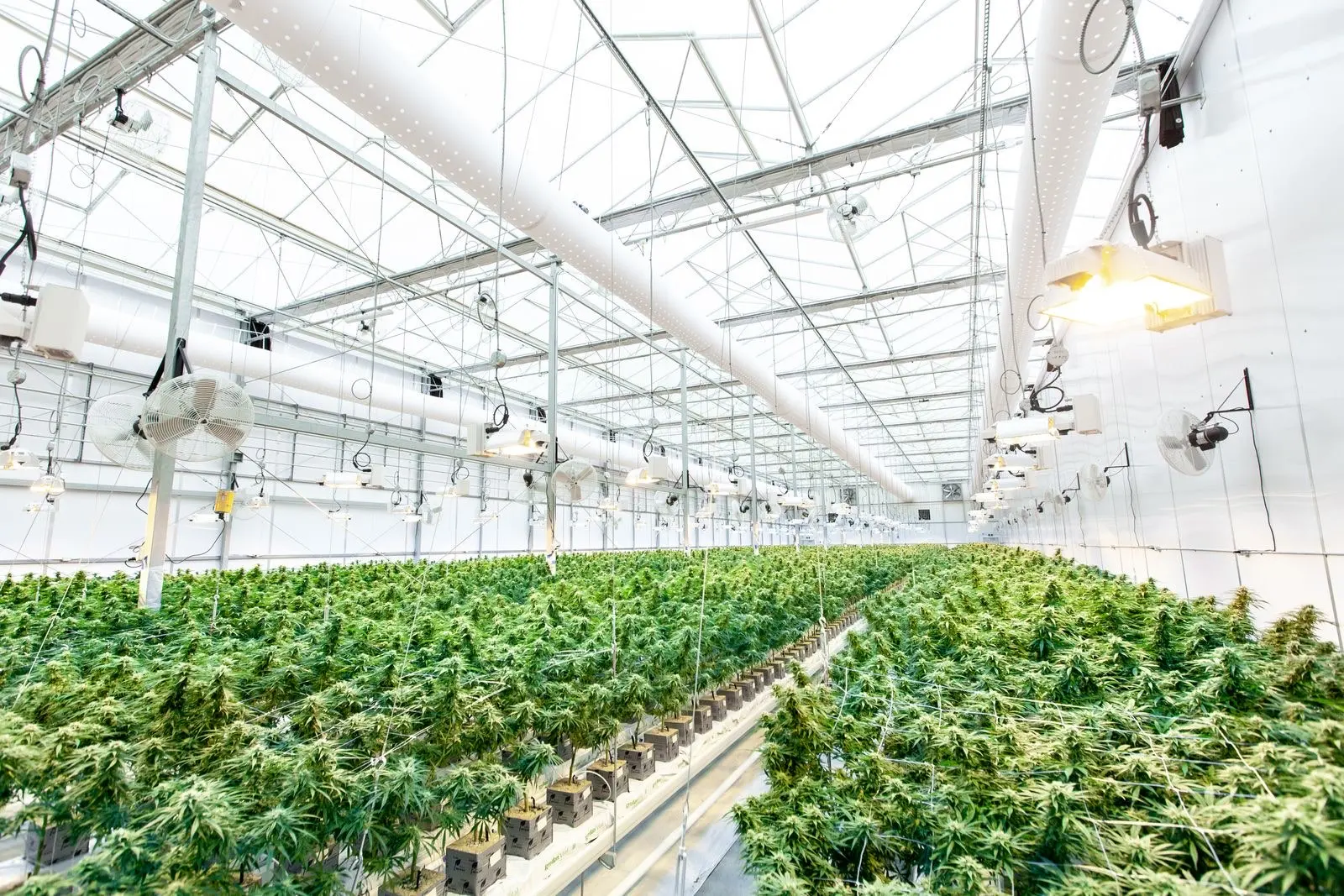
Indoor growing happens inside, under lamps, with temperature, humidity and day length set by the grower. It is often soil-free: that is what "hydro" means on a product page. Outdoor growing happens in the open field, in sunlight, in the ground and with the seasons. Greenhouse growing sits in between: light remains mostly natural, but the shelter allows partial control of temperature and humidity.
These labels often serve as a pricing argument, with indoor at the top and outdoor at the bottom. The available measurements tell a less simple story.
| Criterion | Indoor | Greenhouse | Outdoor |
|---|---|---|---|
| Light | Artificial | Mostly natural | Natural |
| Climate | Fully controlled | Partly controlled | Season and weather |
| Terpenes (2023 study) | Lower | Not measured | Higher |
| Oxidation products (2023 study) | Higher | Not measured | Lower |
| Carbon footprint | Best documented, high | Not quantified here | Not quantified here |
| Legal status in France | Same | Same | Same |
What the 2023 study measured
The most useful study appeared in 2023 in the journal Molecules. Its design isolates the effect of the environment: the researchers compared genetically identical clones grown indoors and outdoors, for two Californian cultivars. Outdoors, the plants grew in beds of soil and compost, in full sun. Indoors, they grew under artificial light, in the producer's own substrate.
On aroma, the outdoor samples contained significantly more limonene, beta-myrcene, beta-caryophyllene and alpha-humulene. The heavier terpenes, the sesquiterpenes, dominated more clearly. One of the indoor cultivars contained no detectable beta-myrcene at all. Our article on hemp terpenes introduces these molecules.
On cannabinoids, the main molecules (CBGA, CBDA, THCA, CBCA) varied little between environments. The clear difference lay in breakdown products: CBN, CBNA and other oxidised cannabinoids were far more present in the indoor flowers, for both cultivars. The authors put forward a hypothesis: with fewer terpenes, indoor flowers would be less protected against oxidation. Since CBN is a product of ageing THC, our comparison CBD vs CBN explains the mechanism.
Three limits frame these results. The sample is small: three samples per condition, two cultivars, a single season. Both cultivars are THC-rich commercial varieties, not CBD hemp. And the greenhouse was not part of the comparison: to our knowledge, no published study compares all three methods at the same time. The study documents a trend, not a ranking.
Energy footprint, the best-quantified gap
This is where the difference is clearest. A life cycle assessment published in 2021 in Nature Sustainability puts the emissions of indoor growing in the United States at 2,283 to 5,184 kg of CO2 equivalent per kilogram of dried flower, depending on the region. Most of it comes from the electricity and gas used for air conditioning, high-intensity lamps and the CO2 supplied to speed up growth.
These figures depend on the US power grid and do not carry over directly to France, whose electricity is less carbon-intensive. The order of magnitude still tells the story: recreating sun and climate indoors costs energy, which an open field does not require and a greenhouse requires far less of.
The legal framework does not depend on the growing method
The decree of 30 December 2021 allows the cultivation and trade only of Cannabis sativa L. varieties with no more than 0.30% Δ⁹-THC, listed in the EU common catalogue or the French official catalogue. It reserves the cultivation of flowers and leaves for active farmers, using certified seed. On 29 December 2022 the Conseil d'État struck down the ban on selling flowers to consumers, finding it disproportionate.
The European Commission states that 116 hemp varieties were listed in the common catalogue in 2024, and that France accounts for more than 60% of EU production. None of these texts mentions indoor, outdoor or greenhouse. The growing method is an agronomic choice with no legal category of its own. Our guide to the EU variety catalogue explains how to read it.
How to choose in practice
The growing method tells you how a flower grew. It says nothing precise about what it contains. Three simple rules follow.
- For a pronounced aroma profile, current data lean towards outdoor, which was richer in terpenes in the 2023 study. The greenhouse was not tested.
- For consistency from batch to batch, indoor remains the most reproducible environment, at the cost of a heavier energy footprint.
- In every case, read the analysis rather than the label. High CBN against low THC points to an oxidised flower, whatever its origin. Our guide to the certificate of analysis covers every line.
The growing method appears on our product pages. Full Gaz is grown in the open field in the Drôme, Durban Poison in a cold greenhouse, Skunk indoors. All our CBD flowers show their Δ⁹-THC ceiling. Drying matters as much as growing for aroma: our article on drying and curing shows why, and the one on hydro flowers compares three soil-free references.
Frequently asked questions
Is indoor better quality than outdoor?
No study supports that. The only work on identical clones, published in 2023, found the opposite: more terpenes outdoors and more oxidation products indoors. Indoor mainly offers better reproducibility, which is not the same as higher quality.
Does the growing method change the permitted THC level?
No. The decree of 30 December 2021 sets a ceiling of 0.30% Δ⁹-THC whatever the growing environment. The variety must also be listed in the EU common catalogue or the French official catalogue.
What is a greenhouse flower?
It is a flower grown under cover. Light remains mostly natural, but temperature and humidity are partly controlled. This method sits between the open field and indoor growing, with much lower energy use than indoor. No published study compares it directly with the other two.
What does "hydro" mean on a CBD flower?
It refers to hydroponic growing: the roots grow without soil, in an inert substrate or a nutrient solution, most often indoors. It is a growing technique, not a guarantee of CBD content.
Does an outdoor flower contain more CBD?
Not demonstrably. In the 2023 study, CBD was higher outdoors for only one of the two cultivars, and the study did not cover CBD hemp. The content depends first on the variety and the harvest: only the batch analysis gives it.
Written by the Phytogrammes team
Every article in this journal draws on primary sources (ANSM, EFSA, EUR-Lex, peer-reviewed publications) and on the lab's own practice: batch-by-batch HPLC analyses, measured cannabinoid profiles. Our approach.
Article published on . CBD is not a medicine.