CBD vs CBN: one comes from the plant, one from aged THC
CBD (cannabidiol) is made by the hemp plant itself. CBN (cannabinol) appears almost only when THC oxidises with time, heat and light. Neither is classified as a narcotic in France, but they differ in origin, in how they behave in storage and in how they act on the brain's receptors.
Contents
> Key takeaways > > - The plant makes CBDA, which heat turns into CBD. CBN comes mainly from the breakdown of THC. > - Stored at 20-22 °C in the dark, cannabis loses on average 16.6% of its THC in one year and 41.4% in four years. > - A CBD flower below 0.30% THC can therefore only form traces of CBN. > - The ANSM expressly excluded CBN from its 2024 classification. CBD is not a narcotic either. > - Since 20 May 2026, no food or supplement enriched with CBD or CBN may be sold in France.
CBD and CBN in one table
Both molecules are cannabinoids, the compounds specific to hemp. The resemblance nearly ends there.
| Criterion | CBD | CBN |
|---|---|---|
| Origin | Made by the plant (heated CBDA) | Oxidation of THC over time |
| Amount in a fresh flower | Major component of CBD varieties | Traces |
| Stability in storage | Stable at room temperature | Rises as THC breaks down |
| CB1 and CB2 receptors | Weak binding | Partial agonist, less potent than THC |
| Psychoactive effect | No | None demonstrated in clinical studies |
| Narcotic classification | No | No, expressly excluded by the ANSM in 2024 |
| Authorised medicine | Epidyolex | None |
| Food and supplements | Banned in France since May 2026 | Banned in France since May 2026 |
Two origins: synthesis versus ageing
Hemp first builds CBGA, the common molecule from which the other cannabinoids derive. An enzyme, CBDA synthase, converts it into CBDA, the acidic form of CBD. The heat of drying, burning or extraction then strips off a carboxyl group, and CBDA becomes CBD. Our article on CBG walks through this chain.
CBN takes a different path. A 2021 review in Frontiers in Pharmacology notes that it was isolated from Indian hemp as early as 1896, which makes it the first cannabinoid ever identified. The same review states that even under good storage conditions, ultraviolet light and heat gradually convert THC into CBN. In the plant, THCA follows the same slope and yields CBNA, its acidic form.
CBN is therefore a product of ageing. It needs THC to start with. A hemp variety that contains little THC cannot produce much of it.
What storage changes, in numbers
The reference measurement dates from 1997. Two researchers at the University of Mississippi followed cannabis stored in closed drums, in the dark, at 20 to 22 °C for four years and published their results in the United Nations Bulletin on Narcotics. THC lost on average 16.6% of its starting value after one year, 26.8% after two years, 34.5% after three years and 41.4% after four years. The CBN-to-THC ratio rose over time, to the point where it could be used to estimate a sample's age.
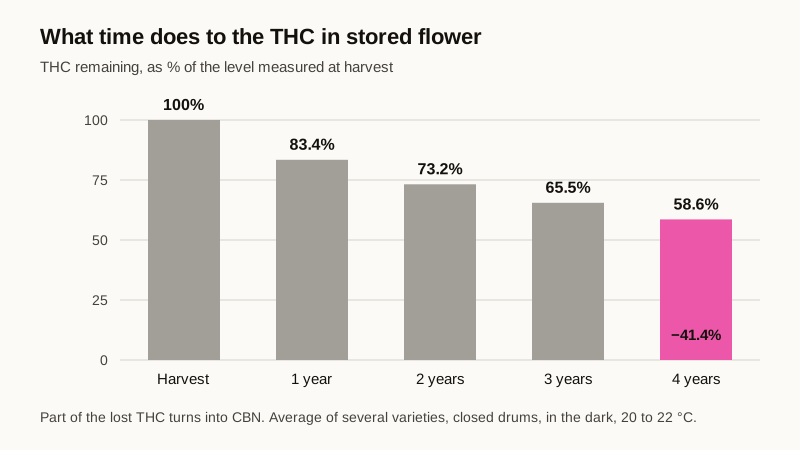
CBD behaves differently. A study from the same university, published in August 2026 in Cannabis and Cannabinoid Research, compared flowers, extracts, oils and isolates stored at room temperature, in a fridge and in a freezer. According to the study abstract, products containing only CBD stayed stable at room temperature, while the THC in THC-rich materials broke down into CBN under the same conditions.
Take a CBD flower at 0.2% THC, stored for four years under the 1997 conditions. It would lose about 41% of its THC, or 0.08 percentage points. Even if all of that THC became CBN, which is not the case, the flower would hold at most 0.08% CBN. Products sold as "CBN-rich" therefore cannot come from an aged CBD flower: they rely on another raw material or on a laboratory conversion. The 2021 review lists semi-synthesis among the production routes for minor cannabinoids.
Receptors: two pharmacological profiles
The body has two main cannabinoid receptors. CB1 sits mostly in the brain, and it carries the psychoactive effect of THC. CB2 sits mostly on immune cells.
CBD binds poorly to both. A 2008 review in the British Journal of Pharmacology reports that it only displaces a reference ligand from CB1 and CB2 receptors at micromolar concentrations, in other words with low affinity. Its studied effects go through other targets.
CBN binds better than CBD, but less well than THC. The 2021 review describes it as less potent than THC at CB1 and equally potent at CB2. It adds that no minor cannabinoid has been shown to be psychoactive in clinical studies. Our page on the endocannabinoid system presents these receptors.
In humans, the data on CBN remain thin. A randomised trial published in 2024, run on 293 adults, tested 20 mg of CBN alone or combined with 10, 20 or 100 mg of CBD for seven nights. The primary endpoint, sleep quality, was not met, and adding CBD brought nothing over CBN alone. Our article on CBN in France covers this trial and the next one. No CBN-based medicine is authorised. On the CBD side, the only authorised medicine is Epidyolex.
Legal status in France: same regime, one written exclusion
Neither molecule is a narcotic. When it classified H4CBD, THCP and other derivatives from 3 June 2024, the ANSM expressly excluded CBN and CBNA from its decision. THCA remains permitted in hemp whose THC content does not exceed 0.3%.
Products must stay within the hemp framework. The decree of 30 December 2021 limits cultivation and trade to varieties listed in the official catalogues with no more than 0.30% Δ⁹-THC, and caps extracts at the same level. On 29 December 2022 the Conseil d'État struck down the ban on selling raw flowers.
The real limit concerns ingestion. On 20 May 2026 the Ministry of Agriculture declared foods containing CBD or other extracted cannabinoids illegal, food supplements included, because none has been authorised under the EU novel food regulation. A CBD + CBN oil or gummy meant to be swallowed is therefore covered. Our overview of CBD regulation in 2026 describes the system, and our article on CBN + THC gummies explains why that mix also falls under narcotics law.
Reading CBD and CBN on a certificate of analysis
A certificate of analysis gives each cannabinoid as a percentage of mass for a flower or a resin, and in mg/ml for an oil. Four lines are enough to compare CBD and CBN.
- CBD and CBDA. Total CBD is calculated as CBD + 0.877 × CBDA, because CBDA loses about 12% of its mass when it becomes CBD.
- CBN. A CBD flower holds only traces, for the reason worked out above. A rising CBN/THC ratio points to an old or poorly stored flower.
- Δ⁹-THC and THCA. Δ⁹-THC must stay at 0.30% or below. THCA turns back into THC when heated.
- Batch number. It must match the product.
Our guide to reading a certificate of analysis covers every section, and the laboratory page describes the measurement methods. To limit CBN formation in your CBD flowers, our article on storage gives the light and temperature settings to aim for.
Frequently asked questions
Does CBD turn into CBN as it ages?
No. CBN comes from the oxidation of THC, not CBD. The study published in 2026 found that products containing only CBD stayed stable at room temperature.
Is CBN stronger than CBD?
It binds to the CB1 receptor better than CBD, but less well than THC. No trial compares their "strength" on a defined endpoint, and no psychoactive effect of CBN has been shown in clinical studies.
Is CBN legal in France?
Yes. It is not classified as a narcotic: the ANSM excluded it from its 2024 decision. Like CBD, it cannot be sold in a food or supplement since 20 May 2026.
Does a CBD flower contain CBN?
Yes, in traces. Starting below 0.30% THC, it cannot form much, even after years. An unusual CBN level on the analysis mainly tells you the age of the batch.
Can CBD or CBN make a saliva test positive?
Roadside tests look for THC, not CBD or CBN. A full-spectrum product does contain traces of THC, though, and the Cour de cassation ruled on 21 June 2023 that the offence exists whatever the dose. Our article on CBD and driving sets out the penalties.
Written by the Phytogrammes team
Every article in this journal draws on primary sources (ANSM, EFSA, EUR-Lex, peer-reviewed publications) and on the lab's own practice: batch-by-batch HPLC analyses, measured cannabinoid profiles. Our approach.
Article published on . CBD is not a medicine.