CBD and driving in France: 3 years and €9,000 since 2025
Driving after taking CBD is not an offence in itself: CBD is not a narcotic and roadside tests do not look for it. The risk comes from the THC in full-spectrum products. If THC is detected in saliva or blood, the offence under article L235-1 of the French Highway Code is made out, whatever the dose, and since 11 July 2025 it carries up to 3 years in prison and a €9,000 fine.
Contents
> Key takeaways > > - The law of 9 July 2025 raised the penalty from 2 years and €4,500 to 3 years and €9,000, and from 3 years and €9,000 to 5 years and €15,000 when alcohol is also involved. > - France's Court of Cassation ruled on 21 June 2023 that the product's legality has "no bearing", "whatever the dose absorbed". > - A meta-analysis of 28 publications concludes that THC levels in blood or saliva are a poor indicator of driving impairment. > - In saliva, THC stays detectable for 6 to 8 hours after occasional use, and up to 24 hours with regular use. > - Only a product whose analysis shows THC as not detected removes this risk.
What the law of 9 July 2025 changed
Law no. 2025-622 of 9 July 2025, published in the Official Journal the next day, created the offence of road homicide and toughened driving offences. It applies to acts committed from 11 July 2025. For drug driving, it raises the maximum penalties in article L235-1 of the Highway Code.
| Offence | Before 11 July 2025 | Since 11 July 2025 |
|---|---|---|
| Driving after using narcotics | 2 years, €4,500 | 3 years, €9,000 |
| Same offence, with an illegal alcohol level | 3 years, €9,000 | 5 years, €15,000 |
The law also created road homicide. The new article 221-18 of the Penal Code applies this term to a fatal crash caused by a driver whose test shows narcotic use, punishable by 7 years in prison and a €100,000 fine. The penalty rises to 10 years and €150,000 when several aggravating circumstances combine.
Refusing to take the test carries the same 3 years and €9,000. According to the official « Drogue au volant » page on service-public.fr, the loss of 6 licence points comes on top, along with a licence suspension of up to 5 years with no exemption for work, and an awareness course at your own expense.
A year later, the law of 18 August 2026 created a separate offence in article L237-1: driving after having "manifestly consumed" psychoactive substances on a list set by decree. It targets deliberate, diverted or excessive use, and changes nothing about the THC rule, which remains that of article L235-1.
Why legal CBD can be enough to break the law
A hemp product may contain up to 0.30% Δ⁹-THC. That limit governs sale, not driving: it is explained in our article on the legal THC level. A flower at 0.2% THC contains 2 mg of THC per gram. Smoked or vaped regularly, it can leave enough THC to trigger a test.
MILDECA, the body that coordinates French drug policy, says so on its page about CBD: traces of THC in CBD products "can pass into the blood or saliva of their consumers".
The courts make no distinction. In a ruling of 21 June 2023 (appeal no. 22-85.530), the Court of Cassation held that permission to sell hemp derivatives under 0.30% THC has "no bearing" on the offence. The offence is made out as soon as use is established, "whatever the dose absorbed". Having bought a legal product is therefore no defence.
THC levels do not measure impairment
French law punishes presence, not a state. It is a choice, because science offers no equivalent for THC of the 0.5 g of alcohol per litre of blood used for drink-driving.
An Australian team pooled 28 publications and 822 driving-related performance measures. According to this meta-analysis published in 2022 in Neuroscience & Biobehavioral Reviews, THC concentrations in blood and saliva are "relatively poor indicators" of impairment. In occasional users the link exists but is weak. In regular users no significant relationship appeared.
An on-road trial published in 2020 in JAMA shows the gap more precisely. In Maastricht, 26 occasional users vaporised cannabis rich in THC, rich in CBD, balanced, or a placebo, before 100 km of driving. THC-rich cannabis increased lane weaving 40 to 100 minutes after use, but no longer significantly 4 to 5 hours later. CBD-rich cannabis did not differ from placebo. The authors note that the dose tested, 13.75 mg, may not reflect typical use.
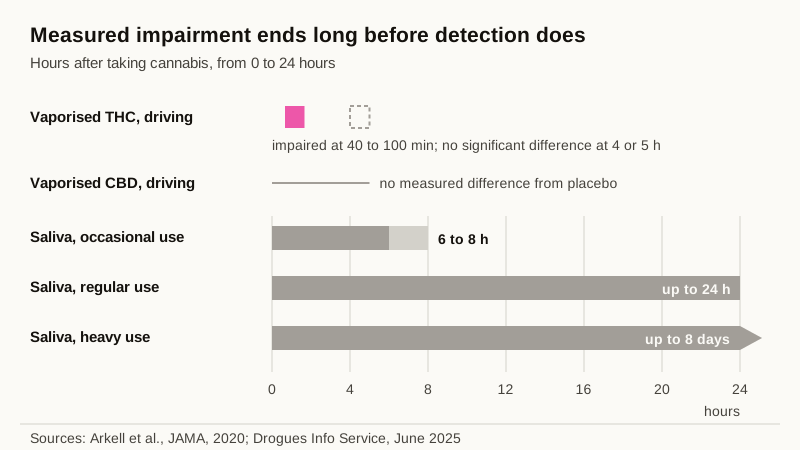
That is the mismatch: in saliva, THC stays detectable long after the measured effect has ended. The table of detection times from Drogues Info Service, France's public drug information service, gives 6 to 8 hours after occasional use, up to 24 hours with regular use and up to 8 days with heavy daily use. A driver who no longer feels anything can still test positive, and the offence is made out.
The roadside check, step by step
Testing follows three stages, as described by service-public.fr:
- Roadside saliva test. It looks for THC, never CBD.
- Confirmation sample. If the test is positive, a second saliva sample goes to a laboratory. That result is the one that counts.
- Blood sample, if you ask for one. It allows a counter-analysis, to be requested within 5 days of being notified of the result.
The kit thresholds, the molecules tested for and other types of test are covered in our guide CBD and drug testing. At work, different rules apply: see saliva testing by employers.
Reducing the risk if you use CBD
No official source gives a safe waiting time after a CBD product. The amount of THC varies from one product to another, and how fast it clears depends on how often you use it. Three practical rules follow.
- Do not drive after a full-spectrum product. Full-spectrum flowers, resins and oils contain THC, in small but real amounts.
- Choose a product with no detectable THC if you drive often. An isolate or a THC-free oil removes the risk, provided the batch analysis shows THC as "not detected", with its limit of detection.
- Read the analysis, not the label. Our guide to reading a certificate of analysis shows where to find the Δ⁹-THC line.
Clearance times, sample type by sample type, are covered in how long CBD stays in the body.
Frequently asked questions
Can you drive after taking CBD?
CBD alone poses no legal problem: it is not a narcotic and no test looks for it. The risk comes from traces of THC in full-spectrum products. If they are detected, the offence is made out, whether or not the product was legal.
What are the penalties since the law of 9 July 2025?
For acts committed from 11 July 2025, driving after using narcotics carries 3 years in prison and a €9,000 fine, and 5 years and €15,000 with alcohol. A fatal crash is now classed as road homicide, punishable by 7 years and €100,000.
Is there a tolerated THC level for driving?
No. The ban applies "whatever the quantity" consumed, according to service-public.fr. The kit thresholds are technical detection limits, not tolerance levels.
Does a higher THC level mean more impaired driving?
Not reliably. The 2022 meta-analysis finds a weak link in occasional users and no significant link in regular users. The law ignores this: only presence counts.
Can you contest a positive test?
Yes. During the check you can ask for a blood sample for a counter-analysis, to be requested within 5 days of the result. Proving the product was legal, however, has been useless since the ruling of 21 June 2023.
Written by the Phytogrammes team
Every article in this journal draws on primary sources (ANSM, EFSA, EUR-Lex, peer-reviewed publications) and on the lab's own practice: batch-by-batch HPLC analyses, measured cannabinoid profiles. Our approach.
Article published on . CBD is not a medicine.