How long does CBD stay in your blood and saliva?
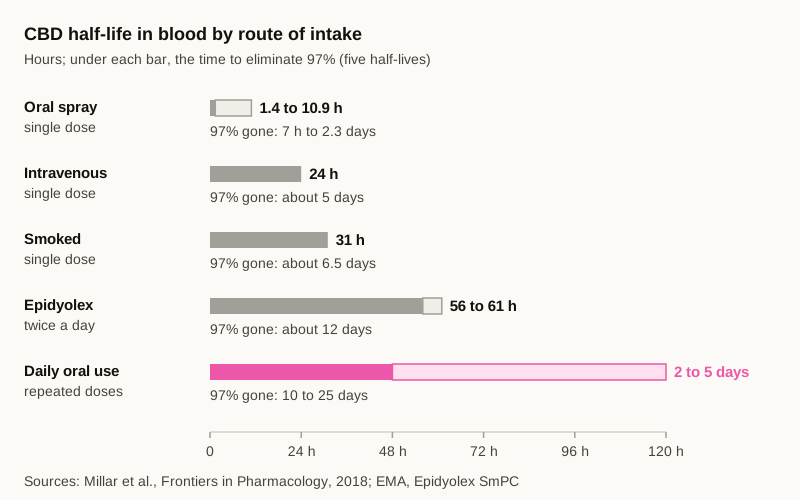
In blood, half of the CBD is gone within 1.4 to 10.9 hours after a single dose of mouth spray, but only after 2 to 5 days with repeated oral doses, because it is stored in fat. It takes about five half-lives to clear 97% of it. In saliva, it peaks half an hour after an oil, then drops quickly. No roadside test looks for it: it is the THC in a full-spectrum product that can make a test positive.
Contents
> Key takeaways > > - CBD half-life: 1.4 to 10.9 h for a single dose of spray, 31 h smoked, 2 to 5 days with repeated oral use. > - The medicine Epidyolex, taken twice a day, has a half-life of 56 to 61 hours. > - The French police saliva kit reacts to THC from 15 ng/ml; the confirmation analysis goes down to 1 ng/ml. > - In a 2026 trial, 8 participants out of 10 tested positive for THC in saliva after an oil that provided 2.8 or 3.7 mg of it. > - At the wheel, French law sets no THC threshold, and the legality of the product is no defence.
Half-life: what the studies measure
The half-life is the time it takes for the concentration of a substance in the blood to fall by half. For CBD, it varies a lot with the route of intake and how often it is used. A 2018 systematic review, which pooled 24 studies in humans, gives these values:
| Route and use | CBD half-life in blood | Source |
|---|---|---|
| Mouth spray, single dose | 1.4 to 10.9 h | Millar et al., 2018 |
| Intravenous | 24 h | Millar et al., 2018 |
| Smoked | 31 h | Millar et al., 2018 |
| Oral, repeated daily doses | 2 to 5 days | Millar et al., 2018 |
| Epidyolex, two doses a day for 7 days | 56 to 61 h | EMA, summary of product characteristics |
Peak concentration comes within 4 hours of an oral or mouth dose. The gap between a single dose and repeated use comes from the nature of CBD: it is lipophilic, meaning it dissolves in fat. It spreads into the tissues, then comes back out slowly. The more regular the use, the fuller this reservoir, and the longer elimination takes.
Meals matter too. According to the Epidyolex summary of product characteristics, a high-fat meal multiplies the peak blood level by 5 and total exposure by 4, compared with taking it on an empty stomach. The same dose therefore does not put the same amount of CBD into the blood depending on when it is taken.
How long it takes to clear
After one half-life, 50% remains; after two, 25%; after five, about 3%. Five half-lives are therefore taken as near-complete elimination. Applied to the published values:
- Single dose of mouth spray: from 7 hours to a little over 2 days.
- Smoked CBD: about six and a half days, based on the only published value.
- Daily oral use: 10 to 25 days after the last dose.
- Epidyolex at medical doses: about 12 days.
These durations are orders of magnitude drawn from small studies. Body fat, liver function, dose and product make them vary from one person to another. They say nothing about a drug test, since no roadside test looks for CBD.
In saliva: a quick peak, then a drop
Saliva has been studied recently. In a US trial published in 2026 in the Journal of Analytical Toxicology, 60 volunteers took an oil with 100 mg of CBD twice a day for 14 days. CBD measured in saliva peaked at a median of 2,198 ng/ml half an hour after the dose, then fell quickly. According to the authors, this peak mostly reflects oil left in the mouth rather than CBD that has passed into the blood.
The same trial answers the real question, the one about THC. Depending on the group, the oil also contained 0, 0.5, 1, 2, 2.8 or 3.7 mg of THC per dose. With 0.5 mg, 1 participant out of 10 tested positive for THC, between 1.5 and 6 hours after a single dose. With 2.8 or 3.7 mg, 8 out of 10 did. The cutoff used was 2 ng/ml, the one applied by workplace saliva tests in the United States.
Applied to France: an oil at the legal ceiling of 0.30% THC contains close to 3 mg per millilitre. One millilitre, about twenty drops, therefore provides roughly as much THC as the 2.8 mg group, where 8 participants out of 10 tested positive. French thresholds differ: 15 ng/ml for the roadside kit, 1 ng/ml for the confirmation analysis, under the order of 13 December 2016.
Blood and urine: what the analyses look for
Pure CBD does not appear to turn into THC in the body. A 2022 study followed the urine of 18 adults for 58 hours after 100 mg of CBD, swallowed or vaporised: no trace of Δ⁸- or Δ⁹-THC appeared after pure CBD. After a CBD-rich cannabis that provided 3.7 mg of THC, however, 3 participants out of 18 gave urine samples positive for the THC metabolite.
For THC itself, the detection-time table from Drogues Info Service, the French public drug information service, gives these orders of magnitude for cannabis:
| Sample | Occasional use | Regular or heavy use |
|---|---|---|
| Saliva | 6 to 8 h | up to 24 h, up to 8 days with heavy daily use |
| Blood | THC 2 to 8 h, metabolite up to 72 h | more than a month with heavy use |
| Urine | 3 to 5 days | 30 to 70 days |
A CBD product usually provides less THC per dose than a joint, but no official source gives a detection time specific to CBD products. How a roadside check works is covered in the CBD and saliva test guide, and the case of hair in the hair test.
At the wheel: the rule that applies
Article L235-1 of the French Highway Code punishes driving after drug use with 3 years in prison and a €9,000 fine, with no THC threshold. The Court of Cassation ruled on 21 June 2023 that permission to sell hemp products under 0.30% THC has no bearing on this offence. No waiting time guarantees a negative test.
If you drive, three steps reduce the risk:
- Choose an isolate rather than a full-spectrum product; what a "99%" guarantees is explained in CBD isolate: what 99% means.
- Read the Δ⁹-THC line on the certificate of analysis: "ND" (not detected) does not mean the same as "0.2%". Our guide to reading a certificate of analysis goes through each line, and the laboratory page describes the measurement methods.
- Do not drive after a product that contains THC, whether flower, resin or full-spectrum oil.
Frequently asked questions
How long does CBD stay in saliva?
In the 2026 trial, CBD peaked half an hour after an oil, then dropped quickly. This peak comes mostly from oil left in the mouth. In practice it matters little: the police saliva kit looks for THC, not CBD.
How long does CBD stay in the blood?
Its half-life ranges from 1.4 to 10.9 hours after a single dose of spray, and from 2 to 5 days with daily oral use. Count five half-lives for near-complete elimination: from a few hours to about two days after a one-off dose, up to 10 to 25 days after regular use.
Can a test detect CBD?
A laboratory can measure CBD, but no roadside test and no legal threshold targets it. Drug tests look for THC and its metabolite. A positive test after CBD means the product contained THC.
How long should you wait before driving after CBD?
There is no official waiting time. After an isolate with no THC detected, the test has nothing to find. After a full-spectrum product, THC can remain detectable in saliva for several hours, and longer with daily use: the safest choice is not to drive.
Written by the Phytogrammes team
Every article in this journal draws on primary sources (ANSM, EFSA, EUR-Lex, peer-reviewed publications) and on the lab's own practice: batch-by-batch HPLC analyses, measured cannabinoid profiles. Our approach.
Article published on . CBD is not a medicine.