Cannabis hair test: why THC in hair does not prove use
A hair test can find THC in hair from someone who has never used cannabis: smoke, hands or a cosmetic oil are enough to deposit it. What shows that THC went through the body is THC-COOH, a metabolite made by the liver, provided the laboratory looks for it. For a CBD user, the risk therefore depends on how the product is used.
Contents
> Key takeaways > > - The recommended positive cut-off is 50 pg of THC per mg of hair, on a segment no longer than 3 cm, about three months of growth. > - THC-COOH is sought at far lower levels: the laboratory must be able to quantify it from 0.2 pg/mg. > - In a lab, smoke from a flower at 0.4% THC deposited about 35,540 pg/mg of THC on clean hair locks, more than 700 times the cut-off. > - Regular users of CBD-rich extracts stayed negative for THC in hair. > - In France, roadside drug testing uses saliva, not hair.
How a hair analysis is read
Hair keeps a record of what circulated in the blood while it grew. The general recommendations of the Society of Hair Testing (SoHT), an international scientific society, use a growth rate of about 1.0 cm a month and stress that it varies from person to person. The lock is cut from the back of the crown, the area where growth is most regular.
The SoHT consensus on drugs of abuse, finalised in 2021, sets the rules of interpretation. The cut-off applies to head hair and to segments no longer than 3 cm: a longer segment dilutes the result. The text also sets three limits. The measured concentration cannot be used to work out the amount consumed. Dyeing, bleaching and UV exposure can change it. And analysing the wash water helps detect external contamination.
The French Society of Analytical Toxicology already summed up the logic of the different samples in its 1999 consensus: urine shows recent use, hair shows repeated or chronic use. The same text calls "unacceptable" a result obtained from an immunoassay screen alone, without confirmation by a reference method.
The cut-offs, and why the metabolite decides
The 2021 consensus sets 50 pg/mg for THC and 50 pg/mg for CBD. One picogram per milligram means one billionth of a gram of molecule per gram of hair. For THC-COOH, the text gives no decision cut-off but a sensitivity requirement: the laboratory must be able to quantify it from 0.2 pg/mg. It states that detecting it strongly supports THC use.
The argument goes back to work from the Institute of Forensic Medicine in Strasbourg, published in 1995 in the Journal of Forensic Sciences. The authors explained that THC-COOH documents use better than THC, which can come from a smoky atmosphere. Of 30 samples analysed, 17 contained the metabolite, at 0.02 to 0.39 ng/mg, or 20 to 390 pg/mg.
A study from the University of Freiburg, published in 2015 in Scientific Reports, has an explicit title: finding cannabinoids in hair does not prove cannabis consumption. Volunteers took THC by mouth: it did not appear in their hair in any relevant amount. THC-COOH, on the other hand, also showed up in segments that had grown before the dose, and in sweat and sebum. The authors conclude that all three molecules can pass from a user to someone close by through hands, sweat or smoke. They name child-protection cases among the situations concerned.
A Belgian study published in 2026 in Drug Testing and Analysis adds field data. It analysed 639 hair samples from drivers monitored to regain their licence. 76 were positive for THC-COOH alone, 52 for THC alone. Wash tests on the samples positive for the metabolite alone were negative, which points to an internal origin. The authors conclude that THC-COOH, even without THC, is valid evidence of use. Samples positive for THC without the metabolite fit the profile of contamination.
CBD users: three very different situations
The route of use changes everything, and the available studies put numbers on it.
Smoked or vaped flower deposits THC. A team in Bologna exposed clean hair locks to cannabis smoke and vapour in a small closed system. According to their study, published in 2024 in Drug Testing and Analysis, a product at 0.4% THC, slightly above the French limit of 0.30%, deposited an average of 35.54 ng/mg of THC, or 35,540 pg/mg. Cannabis at 9.7% deposited 169.30 ng/mg. Smoking or vaping made no significant difference. This was an in vitro experiment in a confined space, not a measurement on users.
A swallowed extract leaves little THC in hair. A Luxembourg study published in 2018 in Forensic Science International followed regular users of CBD-rich extracts. They reported taking 4 to 128 mg of CBD a day, or 0.1 to 4.3 mg of THC. CBD in hair ranged from 10 to 325 pg/mg, but THC was found in only one sample, below the laboratory's cut-off.
An oil applied to hair can deposit it. In a study published in 2019 in Scientific Reports, ten volunteers applied a commercial hemp oil to their hair every day for six weeks. Analysis of the oil had found no THC. Yet 89% of volunteers then had at least one cannabinoid in their hair, with THC up to 0.13 ng/mg, or 130 pg/mg. None had THC-COOH. Our article on CBD for hair and scalp covers these products.
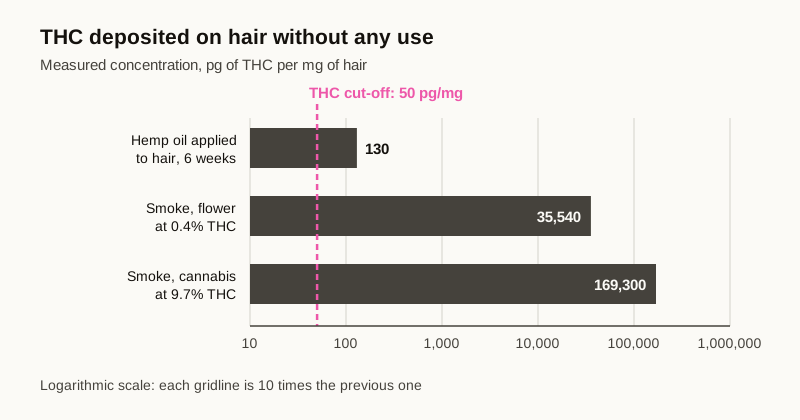
In two of these three cases, external exposure can push hair THC above the cut-off without producing any THC-COOH. The result then depends on what the laboratory looks for.
One last factor lies in the product itself. The MILDECA-supported report of December 2023 analysed 248 products bought in France. 30 exceeded the limit, with 0.4 to 1.2% THC. Once THCA, the acid form that heat turns into THC, was added, 21% of samples went above 0.3%. Using a product like that puts THC into the body, and therefore THC-COOH. Our guide to the legal THC level explains how that level is measured.
Where hair tests are used in France
Not at the roadside. Drug testing of drivers, governed by articles R235-1 onwards of the French Highway Code, relies on a saliva test. Confirmation uses a saliva sample analysed in a laboratory, or a blood sample if the driver asks for a second opinion. Hair appears nowhere in that chapter. Our article on CBD and driving covers the penalties, and our saliva test guide explains what that test measures.
Hair analysis appears in court-ordered expert reports, abstinence monitoring and child-protection cases. The Belgian study cited above concerned drivers regaining their licence in Belgium. Workplace testing is covered in our article on employers and saliva tests.
Faced with a hair result, three questions are worth putting to the laboratory. Was THC-COOH tested for, and at what limit of quantification? Was the wash water analysed? And was the segment tested 3 cm or shorter?
Frequently asked questions
Can a CBD user test positive on a hair test?
For THC, yes, especially if they smoke or vape flowers, or apply hemp oil to their hair. For THC-COOH, the metabolite that shows THC went through the body, the studies cited here find no positive result from external exposure alone. A product whose THC exceeds the legal limit changes the picture.
Why test for THC-COOH rather than THC?
Because THC can land on hair from outside, through smoke, hands or a cosmetic, whereas THC-COOH is made by the liver. In the 2026 Belgian study, wash tests of samples positive for the metabolite alone were negative. The Freiburg study notes, however, that a user's sweat can pass THC-COOH to someone close.
How far back does a hair test go?
The cut-off applies to a segment no longer than 3 cm. At about 1.0 cm of growth a month, that covers roughly three months. Growth varies between people, and the concentration cannot be used to work out the amount consumed.
Can shampoo or hair dye skew the result?
The SoHT consensus states that bleaching, dyeing, straightening or UV can change the measured concentration. These treatments should be recorded when the sample is taken. How long cannabinoids stay in the body is covered in our article on CBD in the body.
Written by the Phytogrammes team
Every article in this journal draws on primary sources (ANSM, EFSA, EUR-Lex, peer-reviewed publications) and on the lab's own practice: batch-by-batch HPLC analyses, measured cannabinoid profiles. Our approach.
Article published on . CBD is not a medicine.