CBD for hair: what 4 studies actually say
On the scalp, CBD has mostly been studied in the lab: it reduces sebum production in cultured cells and, at high concentration, slows the growth of isolated hair follicles. In humans, the only published data is a series of 35 cases with no control group. A CBD cosmetic therefore cannot claim to stop hair loss or regrow hair: the law requires evidence these studies do not provide.
Contents
> Key takeaways > > - The human hair follicle has its own endocannabinoid system, and activating the CB1 receptor there slows growth. > - In human sebaceous cells, CBD reduces lipid production: that is the basis of the interest for oily scalps. > - The only human regrowth study covers 35 people, with no placebo and no blinding. > - Hemp seed oil, common in these products, provides more than 70% polyunsaturated fatty acids and almost no CBD. > - A cosmetic claim must be substantiated; a product presented as curing a disease becomes a medicine.
Four studies, four levels of evidence
The endocannabinoid system is the set of receptors (CB1, CB2) and of molecules the body makes to activate them, such as anandamide. It is present in the skin and in the follicle, the small pocket that produces each hair. Four papers come up whenever CBD and hair are discussed, and they do not carry the same weight.
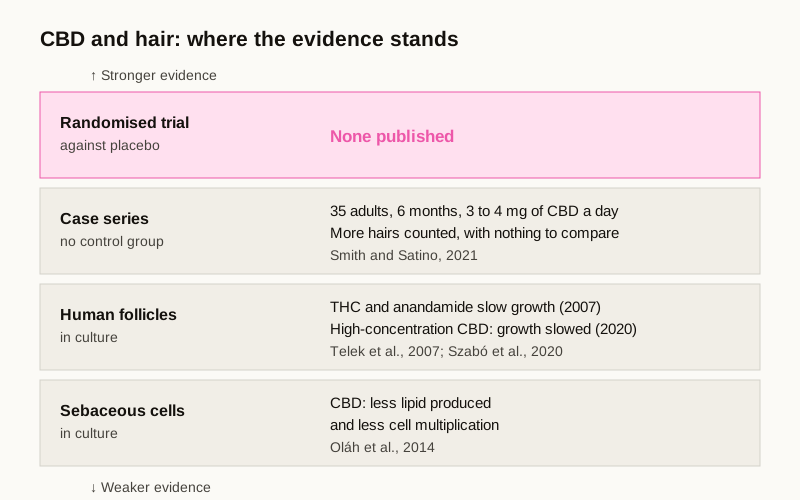
| Study | What was tested | Result |
|---|---|---|
| Telek et al., 2007 | Human follicles in culture, THC and anandamide | Growth slows, through the CB1 receptor |
| Oláh et al., 2014 | Human sebocytes in culture, CBD | Less lipid produced, less proliferation |
| Szabó et al., 2020 | Human follicles in culture, CBD at several concentrations | Anti-inflammatory at low dose, growth slowed at high dose |
| Smith and Satino, 2021 | 35 adults with androgenetic alopecia, no control group | More hairs counted after 6 months |
In the lab: sebum and follicles
Three of these four papers come from the University of Debrecen, in Hungary. In 2007, Telek and colleagues showed, on human follicles taken and kept alive in culture, that anandamide and THC slow the lengthening of the hair shaft and push the follicle early into its regression phase, called catagen. The effect disappears when the CB1 receptor is blocked. The follicle therefore produces its own signals that slow its growth.
In 2014, the same team published a study on sebocytes, the cells of the sebaceous glands, in the Journal of Clinical Investigation. CBD reduced lipid production and the multiplication of these cells, through the TRPV4 channel, and showed an anti-inflammatory action. The authors were looking at acne, not the scalp. Our article on CBD and sebum covers these results.
In 2020, Szabó and colleagues applied CBD to follicles in culture. At concentrations below one micromolar, it had an anti-inflammatory effect. At micromolar concentrations, it slowed growth. In other words, more CBD does not mean more hair, and none of these lab concentrations translates directly into a shampoo dose.
In humans: a series of 35 cases
The only clinical data is a case series published in 2021 in the journal Cannabis. Its two authors followed, in their own practice, 28 men and 7 women with androgenetic alopecia, the hormonal and genetic form of hair loss. For six months, each applied a hemp flower extract once a day, delivering about 3 to 4 mg of CBD. In the men, the average number of hairs counted in the monitored area went from 18.3 to 33.2.
Three limits prevent any conclusion. There was no placebo group and no blinding: every participant received the extract and knew it. The sample is small. And no other team has repeated the study. The authors also note that a third of the patients shed slightly more hair during the first month.
Hemp oil and CBD: two different ingredients
Many "hemp" hair products mainly contain hemp seed oil, listed as Cannabis Sativa Seed Oil in the INCI ingredient list. Pressed from the seeds, it contains almost no cannabinoids. Its cosmetic value lies in its lipids: a comparative analysis published in 2022 measured more than 70% polyunsaturated fatty acids, with a large share of omega-3. In cosmetics, these lipids are mainly used to nourish the hair fibre and limit dryness.
CBD, on the other hand, comes from the flowers and leaves and appears as Cannabidiol or under the name of a plant extract. If the INCI list only mentions seed oil, the product does not deliver a meaningful amount of CBD. Our article on CBD massage oil shows how to read these names.
What a CBD cosmetic can promise
Regulation (EC) No 1223/2009 defines a cosmetic by its functions: cleaning, perfuming, changing the appearance, protecting, keeping in good condition. Its Article 20 prohibits attributing to it characteristics or functions it does not have. Regulation (EU) No 655/2013 adds six common criteria, including evidential support: every claim must rest on adequate and verifiable evidence.
Two practical consequences follow:
- a promise of regrowth or of stopping hair loss based on CBD lacks evidence, since the only human study had no control group;
- a product presented as curing alopecia falls within the scope of medicines. Article L5111-1 of the French Public Health Code defines a medicine as any substance "presented as having curative or preventive properties with regard to human diseases".
A CBD product can, on the other hand, claim what its formula demonstrates: cleaning, nourishing the fibre, comfort. Our guide to authorised claims for CBD cosmetics goes through the six criteria, and the one on fragrance allergens helps you read the rest of the label.
Sudden hair loss, loss in patches or loss lasting several months calls for a dermatologist. Its causes, hormonal, nutritional or autoimmune, can be diagnosed. Finally, if you have to take a hair drug test, our article on what hair reveals in drug testing explains what these tests look for.
Frequently asked questions
Does CBD make hair grow back?
No controlled study has shown it. A series of 35 cases counted more hairs after six months of application, but without a placebo group. In the lab, high-concentration CBD even slows follicle growth.
Is CBD suitable for an oily scalp?
In sebaceous cells in culture, it reduces lipid production. No trial has measured this effect on a human scalp. A product may claim an effect on oiliness only if it has demonstrated it for its own formula.
Does hemp oil contain CBD?
Hardly any. Hemp seed oil is rich in fatty acids, not in cannabinoids. CBD comes from the flowers and leaves, and appears under its own name in the ingredient list.
Can a CBD shampoo prevent hair loss?
No data supports that. A cosmetic that promises to stop hair loss thanks to CBD makes a claim without sufficient evidence, and a product claiming to cure alopecia falls under medicines law.
Written by the Phytogrammes team
Every article in this journal draws on primary sources (ANSM, EFSA, EUR-Lex, peer-reviewed publications) and on the lab's own practice: batch-by-batch HPLC analyses, measured cannabinoid profiles. Our approach.
Article published on . CBD is not a medicine.