CBD and acne: from sebum in the lab to a 368-patient trial
In the laboratory, CBD curbs the excess lipid production of human sebocytes, the cells that make sebum. In humans, the largest registered controlled trial, 368 participants treated for 12 weeks with a 2.5% or 5% CBD solution, did no better than the same solution without CBD. A CBD cosmetic cannot promise anything against acne, and the law forbids it to.
Contents
> Key takeaways > > - In 2014, CBD brought the lipid production of stimulated sebocytes back to normal, in cell culture and in donated human skin. > - This effect runs through targets other than the CB1 and CB2 cannabinoid receptors. > - In the BTX 1503 phase 2 trial, inflammatory lesions fell by 8.5 to 12.0 with CBD, against 11.3 with the solution without CBD. > - The European Scientific Committee on Consumer Safety considers CBD safe up to 0.19% in a cosmetic: the trial used 13 to 26 times more. > - A product presented as treating acne becomes a medicine in the eyes of the law.
What the 2014 sebocyte study shows
The reference study was published in 2014 in the Journal of Clinical Investigation by Oláh and colleagues. The team worked on a human sebocyte line (SZ95) and on whole human skin kept in culture. They first stimulated lipid production with “pro-acne” agents, then added CBD. CBD brought this abnormally high lipogenesis back to normal, slowed cell multiplication without killing the cells and reduced the expression of several inflammatory mediators.
This remains a laboratory result. Cultured cells and donated skin reproduce neither the length of a treatment, nor the way a product crosses the skin barrier, nor the other factors in acne. The result justifies human trials. It says nothing about what a cream does.
The receptors involved: CB2 present, CB1 absent
You often read that sebocytes “carry CB1 and CB2 receptors”. That is inaccurate. A study published in 2008 in the FASEB Journal showed that SZ95 sebocytes express the CB2 receptor but not CB1. In these cells, the endocannabinoids made by the body increase lipid production through CB2.
CBD does not act through that route. In the 2014 study, blocking CB1 and CB2 did not prevent its effect. The authors attribute it to two other targets: the TRPV4 ion channel for the effect on lipids, and the adenosine A2a receptor for the anti-inflammatory effect they observed. These mechanisms were described in cells. They say nothing about what happens on a face.
The BTX 1503 trial: 368 participants, 12 weeks
The most direct test is a controlled trial. The BTX 1503 phase 2 trial, registered on ClinicalTrials.gov as NCT03573518, enrolled 368 people aged 12 to 40 with moderate to severe facial acne. They were split into four groups of 92: 5% CBD solution twice a day, 5% CBD once a day, 2.5% CBD once a day, and vehicle, meaning the same solution without CBD. The trial ended in September 2019; its results were posted on 18 April 2022.
| Group | Change in inflammatory lesions at day 84 |
|---|---|
| CBD 5%, twice a day | −8.5 |
| CBD 5%, once a day | −12.0 |
| CBD 2.5%, once a day | −11.7 |
| Vehicle without CBD | −11.3 |
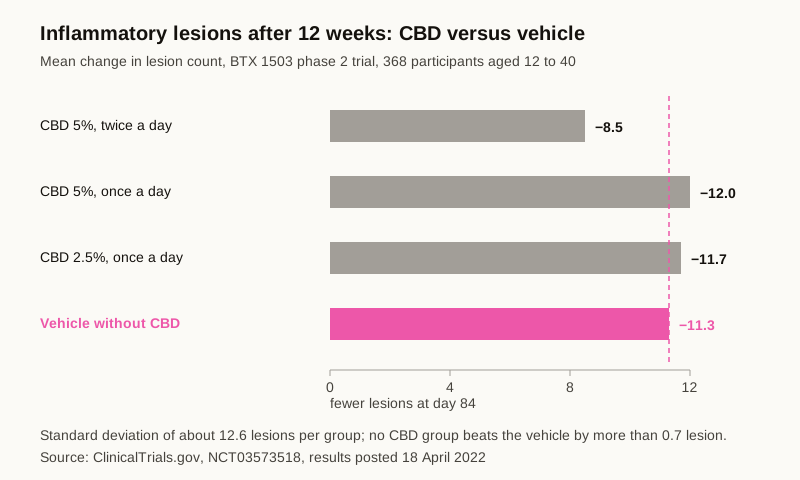
Every group improved, vehicle included. That is exactly why a trial has a vehicle group: what counts is the gap between the product and the same formula without CBD. That gap is at most 0.7 lesion in favour of CBD, with a standard deviation of about 12.6 lesions in each group. The highest-dose group even did slightly worse than the vehicle. On this measure, the trial shows no benefit from CBD.
0.19%: the safety ceiling for CBD cosmetics
A cosmetic is not a medicine, and its CBD content has a safety limit. The European Scientific Committee on Consumer Safety (SCCS) published its opinion SCCS/1685/25 on 24 April 2026. It considers CBD safe up to 0.19% in cosmetics applied to the skin or used in the mouth, and THC present as an impurity up to 0.00025%. The opinion excludes products that can be inhaled, such as sprays, and the committee notes that the data submitted were limited.
The comparison speaks for itself. The BTX 1503 trial used 2.5% and 5% CBD, 13 to 26 times that ceiling. A cosmetic cream sold in France contains, at most, a fraction of the dose that did no better than the vehicle. On the label, CBD appears in the INCI list as “cannabidiol”; its concentration does not have to be stated. Our guide to assessing a CBD cream, balm or gel shows how to read the rest of the label.
What a CBD cosmetic may say, and what it may not
Three texts set the line. Regulation (EC) No 1223/2009 forbids, in its Article 20, the use of text, names, trade marks or pictures to attribute to a cosmetic characteristics or functions it does not have. Regulation (EU) No 655/2013 sets six criteria for any claim: legal compliance, truthfulness, evidential support, honesty, fairness and informed decision-making.
The third text moves the boundary. Under Article L5111-1 of the French Public Health Code, any substance “presented as having curative or preventive properties with regard to human diseases” is a medicine. Acne vulgaris is a skin disease: a product presented as “anti-acne” or “clears spots” leaves the cosmetic field. On top of that comes a rule specific to CBD: the MILDECA points out that products containing CBD may not make any therapeutic claim, on pain of criminal penalties.
| Wording | Status |
|---|---|
| “Light texture, matte finish” | Cosmetic claim, to be backed by tests |
| “For oily-prone skin” | Cosmetic claim, to be backed by tests |
| “Regulates sebum” | Effect claim, which needs solid evidence |
| “Anti-acne”, “clears spots” | Forbidden: presentation of a medicine |
Our article on permitted claims for CBD cosmetics goes through the six criteria one by one.
When acne is a matter for a doctor
Acne that scars, spreads or lasts is a matter for a doctor or dermatologist. Topical and oral prescription treatments exist. No CBD medicine is authorised for acne: the only cannabidiol-based medicine authorised in France, Epidyolex, is reserved for certain rare forms of epilepsy.
A CBD cosmetic remains a care and comfort product. Choose it for its texture, how your skin tolerates it and its ingredient list, not for an effect on acne. The same caution applies to other reactive skin, as our article on CBD, eczema and psoriasis explains.
Frequently asked questions
Does CBD reduce sebum?
In cultured sebocytes and donated human skin, yes: CBD brings artificially stimulated lipid production back to normal. In people with acne, the largest phase 2 trial showed no difference on inflammatory lesions compared with the same solution without CBD.
Can a CBD cosmetic be sold as anti-acne?
No. Presenting a product as treating or preventing a disease makes it a medicine under Article L5111-1 of the French Public Health Code, and CBD products may not make any therapeutic claim.
How much CBD can a cosmetic contain?
The European scientific committee considers CBD safe up to 0.19% in cosmetics applied to the skin or used in the mouth. The concentration does not have to appear on the label: ask the seller if it is not stated.
Why does CBD act on sebocytes in the lab?
According to the 2014 study, through the TRPV4 channel for lipid production and the A2a receptor for inflammation, not through the CB1 and CB2 receptors. The sebocytes studied express CB2 but not CB1.
Is there a CBD medicine for acne?
No. The only authorised cannabidiol-based medicine, Epidyolex, is indicated for certain forms of epilepsy.
Written by the Phytogrammes team
Every article in this journal draws on primary sources (ANSM, EFSA, EUR-Lex, peer-reviewed publications) and on the lab's own practice: batch-by-batch HPLC analyses, measured cannabinoid profiles. Our approach.
Article published on . CBD is not a medicine.