CBD after-sun: no human trials, what we actually know
No published clinical trial has tested a CBD product on sunburnt skin: as of September 2026, the PubMed database returns no article for "cannabidiol" and "sunburn". The available data come from cells and mice, and they do not all agree. In France, a CBD cream remains a cosmetic: it can moisturise and care for the skin, not manage a sunburn, and it does not protect against UV.
Contents
> Key takeaways > > - No human study has looked at CBD and sunburn. > - In the lab, a 2022 study saw less UVB damage in cells and mice; another, in 2021, saw no effect of pure CBD on inflammation markers. > - A cosmetic may not claim functions it does not have (Regulation (EC) No 1223/2009, article 20). > - Without an authorised UV filter, a CBD product does not protect against the sun. > - French health insurance advises seeing a doctor once blisters exceed 3 × 3 cm or the burn covers more than 10% of the body.
What research has measured, and on what
Skin has its own endocannabinoid system. A 2019 review in Molecules describes CB1 and CB2 receptors and their related enzymes in the skin, where they help keep the skin barrier in balance. That finding drives brands' interest in CBD. On its own, it says nothing about what a cream does.
Two laboratory studies point in opposite directions. In 2022, a team at Sichuan University exposed cultured human keratinocytes, the cells of the epidermis, to UVB. With CBD at 8 µM, the cells suffered less DNA damage, and a 5% CBD cream reduced skin damage in mice. In 2021, another team tested CBD purified to more than 99% on irradiated keratinocytes: it changed none of the inflammation markers measured, neither caspase-1 nor IL-6, IL-8 or PGE2.
These results do not transfer to your skin. A cell culture does not reproduce the skin barrier, a mouse does not have human skin, and the concentration of a commercial cream is rarely stated. Our article on CBD, eczema and psoriasis shows the same gap between lab and clinic.
What a CBD cosmetic is allowed to say
Regulation (EC) No 1223/2009 defines a cosmetic by its function. It is meant to clean the skin, perfume it, change its appearance, protect it, keep it in good condition or correct body odours (article 2). Article 20 forbids using text, names or images "to imply that these products have characteristics or functions which they do not have".
In practice, a CBD product may claim to moisturise or soften the skin, provided it can prove it. It may not present itself as a treatment for sunburn. Beyond the cosmetics rule, a product presented as having curative properties is a medicine under the French Public Health Code, and cannot be sold without authorisation. Our article on the claims allowed for CBD cosmetics sets out the criteria.
A European file could change things. France's food and environment safety agency, Anses, proposed in March 2025 to classify CBD as presumed toxic to reproduction, category 1B. According to the Belgian Federal Public Service for Health, the European Chemicals Agency's risk assessment committee adopted an opinion along these lines in March 2026. The European Commission has yet to decide. If the classification is adopted, article 15 of the cosmetics regulation in principle bans substances in category 1A or 1B, unless an exemption is granted under strict conditions. Our article on the classification proposed by Anses follows the file.
A CBD after-sun does not protect against the sun
The cosmetics regulation calls UV filters the substances meant to protect the skin by absorbing, reflecting or scattering UV rays. Only those in its Annex VI may be used for that purpose, and cannabidiol is not on the list. A CBD product without a filter from that list therefore has no sun protection function.
Protection comes from shade, clothing and a sunscreen applied before exposure. Any after-sun, whatever it contains, comes afterwards.
Sunburn: when French health insurance advises seeing a doctor
The real question after a day in the sun is how bad the burn is. France's national health insurance distinguishes two cases in its sunburn guidance, updated in March 2026. Redness without blisters is a first-degree burn: cool the area with tap water, between 15 and 25 °C, for about 15 minutes, then apply a soothing ointment. Blisters signal a second-degree burn: do not burst them and do not pull off peeling skin.
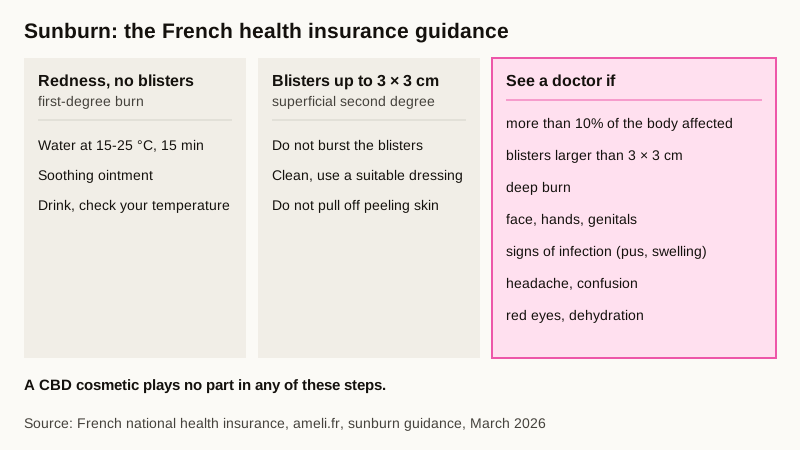
See a doctor if the burn covers more than 10% of the body, if blisters exceed 3 × 3 cm, if the burn is deep, or if it affects the face, hands or genitals. Signs of infection, headache, confusion, red eyes or signs of dehydration also call for medical advice. No cosmetic, with or without CBD, replaces these steps.
If you use a CBD product on warm skin
Keep a CBD product for skin that is simply warm and pink, with no blisters or wounds. A few pointers help avoid bad surprises:
- Read the INCI list: CBD appears as "cannabidiol". Its concentration does not have to be shown on the label.
- Be wary of fragrance on weakened skin: our article on fragrance allergens explains how to spot them.
- Test on a small area first, and stop if you feel stinging or the redness increases.
- Avoid any use during pregnancy and breastfeeding while the European classification is pending.
To judge the formula itself, texture, carrier oil, preservatives, our guide to assessing a CBD cream, balm or gel offers a reading grid.
Frequently asked questions
Can a CBD cream replace a regular after-sun?
It can play the same cosmetic role, moisturising the skin, if its formula allows. No study shows that it does better than an after-sun without CBD.
Does CBD act on sunburn?
Nobody has measured it in humans: a PubMed search for "cannabidiol" and "sunburn" returns no article as of September 2026. The data come from cells and mice, and they contradict each other. Sunburn with widespread blisters calls for medical advice.
Can a CBD product be applied to blisters?
No. French health insurance advises not bursting blisters, cleaning them and using a suitable dressing. A cosmetic is not applied to damaged skin.
Does a CBD product protect against the sun?
No. Cannabidiol is not among the UV filters authorised by the cosmetics regulation. Only a sunscreen containing those filters, applied before exposure, protects the skin.
Written by the Phytogrammes team
Every article in this journal draws on primary sources (ANSM, EFSA, EUR-Lex, peer-reviewed publications) and on the lab's own practice: batch-by-batch HPLC analyses, measured cannabinoid profiles. Our approach.
Article published on . CBD is not a medicine.