CBD and horses: banned at shows, 161-hour half-life
In international competition, the FEI lists CBD among its "controlled medication": a substance a vet may use in treatment, but which must no longer be in the horse's body on competition day. Yet in horses, its half-life after repeated doses has been measured at 161 hours, nearly 7 days. Elimination is therefore counted in weeks. In France, no CBD veterinary medicine is authorised.
Contents
> Key takeaways > > - FEI list 2026: CBD and CBDA are "controlled medication"; the other natural cannabinoids, including THC, are "banned". > - A full-spectrum product, with its traces of THC, therefore exposes the horse to a substance banned at all times. > - In national competition, the list is set by the decree of 2 May 2011, by category: a vet's opinion settles it. > - A 2023 study of 6 horses measured a half-life of 161 hours after 15 days of repeated doses. > - No CBD veterinary medicine is authorised in France; a product promising to cure breaks the law.
What the FEI says in 2026
The Fédération Équestre Internationale (FEI) publishes a list of prohibited substances for horses every year. It has two categories, which the French equestrian federation (FFE) sums up as follows: "banned substances", prohibited at all times, in competition and in the stable, and "controlled medication", allowed as part of veterinary treatment but prohibited in competition.
In the 2026 list, in force since 1 January 2026, cannabis is split between the two:
| Substance | FEI 2026 status | Consequence |
|---|---|---|
| Cannabidiol (CBD) and its acid form, CBDA | Controlled medication, specified substance | Treatment possible, absent on competition day |
| Natural cannabis cannabinoids except CBD (including THC) | Banned, specified substance | Prohibited at all times |
| Synthetic cannabinoids and cannabimimetics | Banned, specified substance | Prohibited at all times |
"Specified substance" does not mean less serious. The FEI states at the top of the list that these are substances more likely to have been ingested for a reason other than performance, for example through contaminated feed.
This classification has a practical consequence. A full-spectrum "CBD" oil or pellet also contains THC, up to 0.30% in a product that complies with French law. For the FEI, that THC is a substance banned at all times, treatment or not. A CBD isolate avoids the problem, provided the batch analysis shows it: our article on CBD isolate explains what a certificate guarantees.
Human athletes are treated differently. The World Anti-Doping Agency does not list CBD among prohibited substances, only THC and the other cannabinoids, as our article on the WADA 2026 list explains.
National competition: the 2011 decree and the AFLD
For shows held in France outside FEI rules, the list of prohibited substances for horses is set by the decree of 2 May 2011. It works by pharmacological class, such as substances acting on the nervous system, not by molecule name. CBD is not named in it. The FFE points out that interpreting it takes a vet's help.
Tests are carried out by vets approved by the French Anti-Doping Agency (AFLD). They can take place in competition, at any level, but also during training or where the horse is kept. After a positive result, the AFLD can bar the owner or trainer from entering the horse, and impose bans on taking part in FFE events.
The FFE adds a point that applies to all supplements: no regulation guarantees that a supplement contains no prohibited substance. A "natural" herbal product is no exception.
How long CBD stays in a horse's body
The most precise answer comes from a pharmacokinetic study of oral CBD in horses, published in 2023 in Frontiers in Veterinary Science to help anti-doping laboratories. Six horses received a CBD paste at 3 mg per kilo, twice a day for 15 days. After the last dose, the terminal half-life of CBD in the blood averaged 161 hours, with a standard deviation of 43 hours.
A 161-hour half-life means it takes nearly 7 days for the blood concentration to halve, then another 7 days to halve again. The authors link this slowness to the wide distribution of CBD into the horse's tissues.
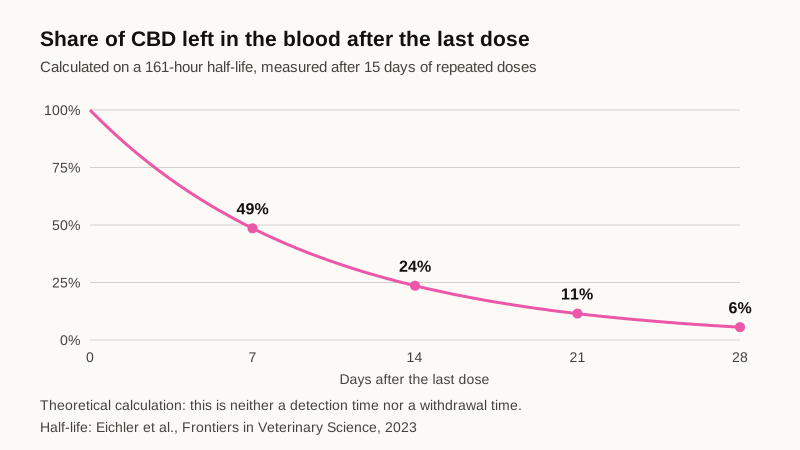
This calculation is theoretical. It does not say when a test would come back negative: that depends on the laboratory's detection limit, which the FEI does not publish for CBD. The list of detection times published by the FEI does not mention cannabidiol, and the FEI points out that a detection time is not a withdrawal time: the latter is set by the vet, with a safety margin. The authors themselves conclude that CBD should be given to sport horses with caution.
What research has measured in horses
Studies in horses focus mainly on how the body absorbs and eliminates CBD, and on how well it is tolerated. None was designed to measure an effect on a disease.
| Study | Horses | Protocol | What was measured |
|---|---|---|---|
| Eichler et al., 2023 | 6 | 3 mg/kg twice a day, 15 days | Well tolerated; half-life of 161 h after repeated doses |
| Wang et al., 2025 | 7 | 1 mg/kg of CBD or CBDA twice a day, 6 weeks each | No clinically relevant abnormality in blood work or liver biopsy |
In the 2025 trial, published in the American Journal of Veterinary Research, the two oils were given in turn to the same horses. CBDA reached the blood far better: a peak of 103 ng/ml, against 12 ng/ml for CBD. The authors conclude that CBDA deserves study, not that it benefits the horse. Our page on CBDA describes this acid form.
These studies cover a few horses over a few weeks. They establish neither a dose nor an indication. In dogs, trials are a little more numerous, with a rise in a liver enzyme in some animals: our article on CBD for dogs summarises them.
The status of CBD products for horses in France
European law classifies a product by what it promises. Presented as curing or preventing an animal disease, it becomes a veterinary medicine, and without a marketing authorisation it cannot be sold. To our knowledge, no CBD-based veterinary medicine is authorised in France. Sold as complementary feed, a product may not claim to prevent, treat or cure a disease. The article on CBD for dogs, cited above, gives the references of both regulations, and the one on CBD for cats applies the same framework.
The Ministry of Agriculture notice of 20 May 2026 on CBD foods covers human food and food supplements. It does not mention animal feed. Whatever the use, a hemp product must stay under the 0.30% Δ⁹-THC threshold, explained in our article on the legal THC level.
Before considering CBD for a horse
Talk to your equine vet first, especially if the horse is being followed for a health problem or entered in competition. Stiffness, new nervousness or a drop in form can have a medical cause that a product would mask. If a trial is considered, five points to check:
- The show calendar. With a half-life of nearly 7 days, stopping a few days before the event is not enough.
- An isolate rather than full spectrum, to avoid THC, banned at all times by the FEI.
- A certificate of analysis for the batch, with the CBD content and a Δ⁹-THC line reading "not detected"; our guide to reading a certificate covers each line, and the laboratory page describes the methods.
- A concentration in mg per ml or per gram, to calculate a dose in mg per kilo of body weight.
- No promise of care on the label: that is the mark of a product outside the law.
Frequently asked questions
Is CBD banned in equestrian competition?
Yes. In the FEI 2026 list, CBD is a "controlled medication": it can be used in veterinary treatment, but must not be present in the horse's body in competition. THC and the other natural cannabinoids are banned at all times.
How long before a show should CBD be stopped?
There is no official period. The FEI publishes no detection time for CBD, and the withdrawal time is up to the vet. A 2023 study measured a half-life of 161 hours after repeated doses: elimination takes several weeks.
Is CBD banned at FFE shows?
In national competition, the list is set by the decree of 2 May 2011, by class of substance and not by molecule. CBD is not named in it. Only a vet can say whether a given product falls into one of these classes.
Are there studies on CBD in horses?
Yes, mostly on its absorption, elimination and tolerance, in 6 to 7 horses per study. A 2025 trial found no blood or liver abnormality at 1 mg/kg twice a day for 6 weeks. None establishes an effect on a disease.
Is CBD for horses a veterinary medicine?
No. No CBD-based veterinary medicine is authorised in France. A product that claims to cure is a medicine sold without authorisation.
Written by the Phytogrammes team
Every article in this journal draws on primary sources (ANSM, EFSA, EUR-Lex, peer-reviewed publications) and on the lab's own practice: batch-by-batch HPLC analyses, measured cannabinoid profiles. Our approach.
Article published on . CBD is not a medicine.