CBD for dogs in France: legal, but not as a medicine
Yes, a CBD product for dogs can be sold in France, but only as complementary feed or a pet cosmetic, with no promise to treat anything. No CBD-based veterinary medicine is authorised, and an oil bought in a shop is not one of the options a vet can prescribe. The main risk for a dog is the THC found in full-spectrum products.

Contents
> Key takeaways > > - A product presented as curing an animal disease is a veterinary medicine under Regulation (EU) 2019/6: without authorisation, it is banned. > - Sold as complementary feed, a CBD product cannot claim prevention, treatment or cure of any disease. > - The veterinary cascade covers medicines; for CBD, the only authorised human medicine is Epidyolex. > - In the reference trial on canine osteoarthritis, 16 dogs received 2 mg/kg of CBD twice a day; 9 showed a rise in a liver enzyme. > - In healthy dogs, most moderate or severe side effects came from the oils containing THC.
Is CBD for pets legal in France?
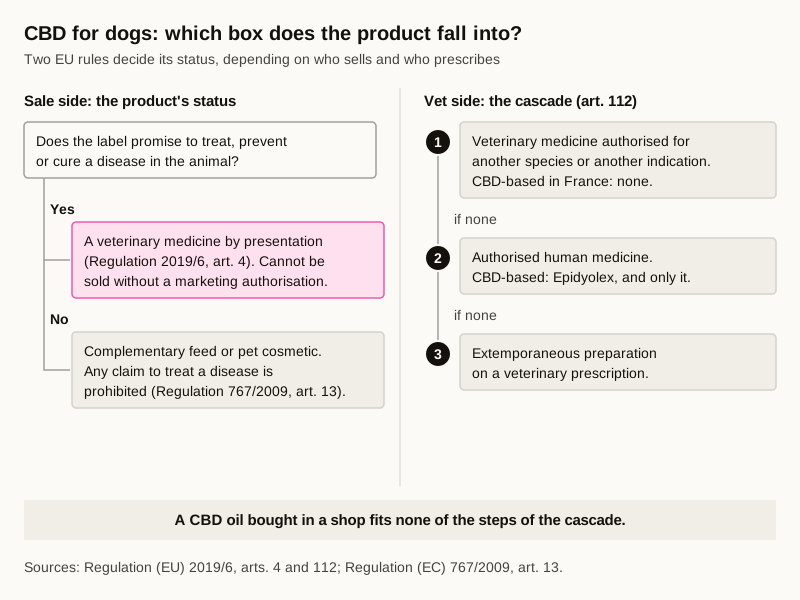
Yes, within narrow limits. Two EU texts decide a product's status, and what matters first is how it is presented.
Regulation (EU) 2019/6 on veterinary medicinal products defines, in its article 4, a veterinary medicine as any substance "presented as having properties for treating or preventing disease in animals". A CBD oil whose label or website mentions arthritis, epilepsy or anxiety therefore becomes a medicine by presentation. Without a marketing authorisation, it cannot be sold.
As far as we know, no cannabidiol-based veterinary medicine is authorised in France. The index of summaries of product characteristics kept by the French Agency for Veterinary Medicinal Products (ANMV, part of ANSES) is the reference for checking.
That leaves the other route: complementary feed, meaning a product added to the diet without replacing it. Regulation (EC) 767/2009 prohibits, in its article 13, stating that a feed "has the property of preventing, treating or curing a disease". Paw balms fall under pet cosmetics instead. In both cases, a hemp-derived product must also respect the 0.30% Δ⁹-THC threshold, explained in our article on the legal THC level.
What a vet can do: the cascade
You often read that a vet "can prescribe CBD off-label". The rule is more precise. Article 112 of Regulation 2019/6 allows a vet, when no veterinary medicine is authorised for an indication in an animal not kept for food, to treat the animal by way of exception, "under their direct personal responsibility", in this order:
- with a veterinary medicine authorised for another species or another indication;
- failing that, with an authorised human medicine;
- failing that, with an extemporaneous preparation made up on prescription.
All three options are medicines. A shop oil is not one. For CBD, the only authorised human medicine is Epidyolex, restricted in humans to rare epilepsies; our article on Epidyolex describes its trials. A vet may also decline to take responsibility for a product whose exact composition and strength they do not know.
Cats and horses fall under the same texts, with species-specific issues: see CBD for cats and CBD for horses.
What research has measured in dogs
Dogs, like humans, have an endocannabinoid system. A team at the University of Veterinary Medicine Hannover described in 2017 the distribution of CB1 receptors in the canine nervous system, from the cortex to the cerebellum and spinal cord. How the system works in general is explained in what is the endocannabinoid system. Its presence alone says nothing about what a product does.
Three controlled trials come up again and again:
| Study | Dogs | Protocol | What was measured |
|---|---|---|---|
| Gamble et al., 2018, Cornell University | 16 analysed out of 22 enrolled, osteoarthritis | 2 mg/kg of CBD every 12 h, 4 weeks, vs placebo | Better pain and activity scores on CBD; alkaline phosphatase up in 9 of 16 dogs |
| McGrath et al., 2019, Colorado State University | 26 enrolled, 16 analysed, drug-resistant epilepsy | 2.5 mg/kg twice a day, 12 weeks, on top of existing medication | Median seizure reduction of 33%, but no more "responder" dogs than on placebo; 2 dogs withdrawn for ataxia |
| Vaughn et al., 2020 | 20 healthy beagles | Rising doses of CBD, THC or mixed oils | CBD oil well tolerated up to about 62 mg/kg; moderate or severe effects mostly with THC |
Sources: Gamble et al., Frontiers in Veterinary Science, McGrath et al., JAVMA, Vaughn et al., Frontiers in Veterinary Science.
These studies cover a few dozen dogs over short periods. The Cornell trial was funded by the maker of the oil tested, and the authors of the 2020 trial worked for a cannabis company. These trials are not enough to set a dose, and no French or European authority has drawn any indication for dogs from them. The rise in alkaline phosphatase, a liver enzyme, shows up in two of the three trials: one more reason for veterinary follow-up. CBD also changes the activity of the enzymes that break down many medicines, as explained in the grapefruit effect.
THC, the real danger for dogs
In the Vaughn trial, moderate to severe effects (lethargy, hypothermia, ataxia, meaning poorly coordinated movement) mostly appeared in the two groups receiving THC. The mixed CBD/THC oil did not go beyond the fifth dose, while the CBD-only oil reached the tenth.
A compliant full-spectrum product contains up to 0.30% THC. For a human it is a trace; for a small dog given a concentrated oil, the amount of THC per kilo of body weight is no longer negligible. Three further risks add up:
- Mislabelled products. In June 2025, ANSES reported several hundred human poisonings linked to products sold as CBD that contained too much THC or synthetic cannabinoids. The agency cites analyses in which 8 products out of 10 did not show their actual CBD content.
- Banned cannabinoids. HHC has been a controlled drug since 13 June 2023, H4CBD and THCP since 3 June 2024, according to ANSM decisions. The risks of these molecules are covered in synthetic cannabinoids in CBD.
- Products made for humans. Some contain xylitol, a sweetener toxic to dogs, or essential oils. Their strength is designed for an adult, not for a dog weighing a few kilos.
Keep bottles out of reach. If your dog staggers, seems unusually flat or cold after swallowing a hemp product, call your vet or a veterinary poison centre straight away, with the packaging in hand.
Assessing a product if your vet considers it
If, after an examination, your vet thinks a trial makes sense, here is what to require from the product:
- A batch certificate of analysis from an independent laboratory, with the CBD content and a Δ⁹-THC line reading "not detected". Our guide to reading a certificate of analysis goes through each line, and the laboratory page describes the measurement methods.
- An isolate rather than full spectrum. What an isolate guarantees is explained in CBD isolate: what 99% means.
- No HHC, H4CBD or THCP where the laboratory tested for them.
- A concentration in mg per ml and a graduated dropper, to work out a dose in mg per kilo.
- An ingredient list with no xylitol and no essential oil.
- No promise of treatment. A product claiming to treat anxiety or arthritis breaks the law: a bad sign about how serious the seller is.
Restlessness, stiffness, separation: what comes before CBD
Most owners look for CBD for a dog restless at night, an older dog stiff when it gets up, or a dog that copes badly with being alone. In all three cases, the first step is a veterinary examination. Recent restlessness in a previously calm dog can signal pain; stiffness can come from something other than osteoarthritis.
The groundwork is well known to veterinary behaviourists: physical activity suited to breed and age, a stable routine, a bed away from busy areas and, for separation anxiety, gradual desensitisation to departures over several weeks. Authorised veterinary medicines exist for some anxiety disorders and for arthritic pain; they have been assessed in dogs, which a shop oil has not. CBD replaces neither these measures nor a prescribed treatment.
Frequently asked questions
Is CBD for pets legal in France?
Yes, as complementary feed or a pet cosmetic, provided it makes no claim about any disease and respects the 0.30% Δ⁹-THC threshold. No CBD-based veterinary medicine is authorised.
Can a vet prescribe CBD?
The cascade in Regulation 2019/6 allows a vet, by way of exception and under their responsibility, to use an authorised human medicine or a preparation made up on prescription. For CBD, the only authorised human medicine is Epidyolex. A shop oil is not a medicine.
Can I give my own CBD oil to my dog?
It is not advisable. It may contain THC, xylitol or flavourings toxic to dogs, and its strength is calculated for a human. Talk to your vet first.
What dose of CBD for a dog?
No dose has been validated by any authority. The trials used 2 to 2.5 mg/kg twice a day, over a few weeks and under veterinary supervision, with a rise in a liver enzyme in some dogs.
Can CBD make a dog high?
CBD alone has no psychoactive effect. Signs of intoxication, such as staggering or lethargy, come from THC or a synthetic cannabinoid in the product.
Written by the Phytogrammes team
Every article in this journal draws on primary sources (ANSM, EFSA, EUR-Lex, peer-reviewed publications) and on the lab's own practice: batch-by-batch HPLC analyses, measured cannabinoid profiles. Our approach.
Article published on . CBD is not a medicine.